
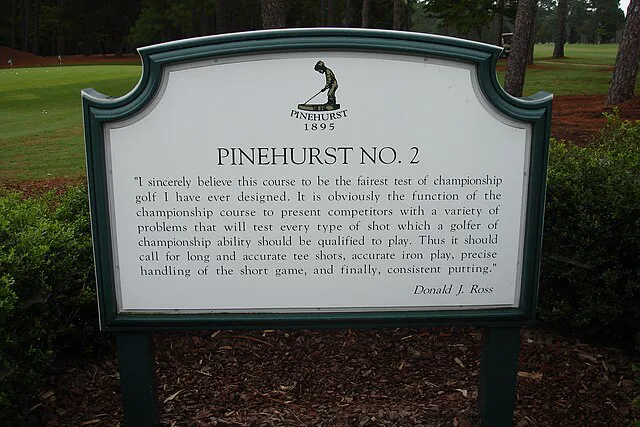
Pinehurst has nine golf courses. Most destination resorts would make that the headline—nine courses means nine chances to play different designs, nine rounds to fill a week-long trip, nine opportunities to post photos and check boxes.
Pinehurst makes it incidental. Because three courses matter more than quantity. No. 2—Donald Ross’s masterpiece and American golf’s most influential design. No. 4—Tom Fazio’s tribute to strategic golf on sandy terrain. No. 8—Tom Doak’s modern interpretation of Ross principles. These three courses represent different eras of American architecture while sharing the design philosophy that Ross established here 125 years ago.
The other six courses exist. They’re perfectly fine. Play them if you’re there for a week. But understanding Pinehurst means understanding No. 2 and what it taught American golf about strategy, subtlety, and designing courses that reward thinking as much as ball-striking. Everything else at Pinehurst—the resort, the other courses, the ambiance—exists in that shadow.
This is where American golf grew up. Not St Andrews or Royal County Down—those are golf’s birthplace and spiritual home. Pinehurst is where American golfers learned that great courses don’t need ocean views or mountain backdrops. That sandy soil and native wiregrass can create strategic complexity rivaling anything in Scotland. That golf architecture could be art practiced on American ground with American principles.
Donald Ross and the Course That Changed Everything
Donald Ross arrived in Pinehurst in 1900, hired to be the club professional and course designer. He spent the next forty-eight years refining Pinehurst No. 2, which opened in 1907 and was continuously modified until Ross’s death in 1948. The course he created became the template for American course design—hundreds of Ross courses exist across the country, most echoing principles he perfected here.
Those principles seem simple until you try to execute them:
Crowned greens that reject poor approaches. Ross greens sit like upside-down saucers, crowned in the center and falling away on all sides. Hit the green and the ball might stay. Miss and it runs off into collection areas where up-and-down becomes difficult. The design rewards precision without resorting to bunkers or water.
Strategic angles that matter. Fairways are generous—typically 40-50 yards wide. But approaching greens from the wrong angle makes two-putts difficult even when you hit the surface. Ross created angles that rewarded proper tee shots without punishing wayward drives excessively. This is strategic design: width from the tee, consequence on approach.
Natural terrain dictating routing. The sandhills property presented rolling terrain ideal for golf. Ross routed holes that followed natural contours rather than imposing geometric patterns. The result feels inevitable—like the course has always been there waiting to be discovered.
Subtlety over spectacle. No. 2 doesn’t try to impress visually. It’s native wiregrass, sand, and pine trees. The drama comes from playing it—from discovering that hitting greens is harder than it looks, that putts break in unexpected ways, that the course reveals complexity gradually rather than overwhelming immediately.
Ben Hogan called No. 2 the finest test of golf he’d played. Jack Nicklaus praised its strategic demands. Tom Watson cited the crowned greens as architecture he wished modern designers would study. The course has hosted four U.S. Opens (1999, 2005, 2014, 2024) and will host more. Every championship confirmed that Ross’s principles remain relevant 115 years later.
Then in 2010, Pinehurst hired Bill Coore and Ben Crenshaw to restore No. 2 to Ross’s original vision. They removed the rough, replaced Bermuda grass with native wiregrass, widened fairways, and created playing conditions that emphasized ground game strategy. The 2014 U.S. Open—won by Martin Kaymer—featured these restored conditions. Players and commentators praised it as the most interesting U.S. Open setup in decades.
The restored No. 2 plays firm and fast. Drives bounce and roll. Approach shots can be run onto greens or flown at specific landing areas. Missed greens require creativity and touch. The course rewards strategy, punishes carelessness, and makes golfers think on every shot. This is Ross’s vision fully realized—American golf at its most strategic and sophisticated.
The Three Courses That Matter
Pinehurst No. 2 (7,565 yards, Par 70)
This is why you’re here. The crowned greens. The strategic angles. The wiregrass. The firm conditions that turn a 390-yard par-4 into a puzzle requiring three shots to think about simultaneously. No. 2 doesn’t overwhelm—it reveals complexity gradually. First-time players often leave thinking it’s good but not great. Second time they understand what they missed. Third time they realize it’s brilliant.
Key holes: The 5th (482 yards, par-4 with severely crowned green), the 8th (485 yards, uphill par-4 where approach angle determines everything), the 15th (206 yards, par-3 to a green that rejects anything not perfectly struck).
Difficulty: Hard but fair. The course doesn’t beat you up—it exposes weaknesses through accumulated demands for precision around greens. Expect to hit lots of greens and still struggle with par.
Pinehurst No. 4 (7,178 yards, Par 72)
Tom Fazio designed No. 4 in 1999, creating a course that honors Ross principles while deploying modern design elements. The course features wider fairways than No. 2, more dramatic bunkering, and greens that reward proper angles without Ross’s severity.
No. 4 works as counterpoint to No. 2. It’s more visually dramatic, more immediately impressive, and slightly more forgiving around greens. Players who find No. 2 intimidating often prefer No. 4. Players who love strategic subtlety consider it Ross-lite—good but not transcendent.
Key holes: The 2nd (523 yards, par-5 where second shot placement determines whether you can attack the green), the 6th (212 yards, par-3 over wetland to an elevated green), the 17th (197 yards, all-or-nothing par-3 that creates tension late in rounds).
Difficulty: Manageable from forward tees, challenging from tips. Less severe than No. 2 around greens, but longer and requiring more forced carries.
Pinehurst No. 8 (7,192 yards, Par 72)
Tom Doak designed No. 8 in 1996, specifically asked to create a course honoring Ross’s principles while using modern understanding of design. The result is the closest thing to No. 2 that isn’t No. 2—crowned greens, strategic angles, native grasses, and firm conditions that reward ground game.
No. 8 gets overlooked because No. 2 dominates conversation. This is a mistake. No. 8 might be the second-best course in North Carolina and would be the headliner at any resort lacking No. 2. It’s longer than Ross’s course, features more dramatic terrain, and creates strategic interest through routing rather than individual hole heroics.
Key holes: The 2nd (439 yards, dogleg right where tee shot positioning determines approach angle), the 11th (535 yards, par-5 requiring three well-placed shots to attack the green), the 15th (161 yards, short par-3 where getting close requires understanding green contours).
Difficulty: Comparable to No. 2 but in different ways. Less emphasis on short game precision, more emphasis on tee-to-green strategy.
Planning Your Pinehurst Trip
Minimum Stay: Three Days
Day 1: Arrive, play No. 2 or No. 8 to adjust to firm conditions Day 2: Play whichever of No. 2/No. 8 you didn’t play yesterday Day 3: Play No. 4, replay No. 2 if time allows, or explore other courses
Three days gives you the essential Pinehurst experience without rushing. Five to seven days lets you play all nine courses, but diminishing returns kick in after the big three.
When To Visit
Spring (March-May) and Fall (September-November) offer ideal conditions. Courses are firm and fast. Weather is comfortable. Rates are highest but worth it for optimal playing conditions.
Summer (June-August) brings heat, humidity, and afternoon thunderstorms. Courses stay lush, which changes Ross’s strategic demands. Rates drop but so do conditions.
Winter (December-February) features inconsistent weather but lowest rates. The courses can play well on good weather days. Risk is temperatures and rain that make playing unpleasant.
Booking Strategy
Book directly through Pinehurst Resort for package deals combining lodging and golf. Rates vary dramatically by season—$500-800 per day including room and one round in peak season, $300-500 in shoulder season, $200-400 in winter.
No. 2 requires resort guests book at least a package including lodging. You can’t just pay for a round as outside visitor. This protects course conditions and pace of play. It also makes Pinehurst expensive compared to daily-fee courses.
Where To Stay
The Carolina Hotel sits at the resort’s heart—historic, comfortable, positioned walking distance from courses. Rates run $300-600 per night depending on season. The Manor Inn and Holly Inn offer smaller, more intimate alternatives at slightly lower rates.
Off-resort lodging exists in Pinehurst village and nearby Southern Pines. This saves money but adds logistics for getting to courses and managing tee times.
What Else To Do
The resort spa, restaurants, and village shops provide non-golf options. Southern Pines (5 minutes away) features restaurants, breweries, and shops. Realistically, you’re here for golf. The other activities exist to fill evenings and give non-golfers something to do.
Beyond The Courses
Pinehurst represents something beyond its individual holes or resort amenities. It’s where American golf developed its architectural identity separate from Scottish links traditions. Ross proved that strategic design could be built on parkland sites using American soil and vegetation. His principles—width from tees, strategic angles, crowned greens, subtlety over spectacle—influenced hundreds of architects and thousands of courses.
Walking Pinehurst No. 2, you’re seeing the template that shaped American golf. Every Ross course across the country echoes what he perfected here. Every strategic design philosophy that emphasizes angles and precision over length and forced carries traces back to these sandhills.
This makes Pinehurst pilgrimage rather than simple golf trip. St Andrews is golf’s birthplace. Pine Valley is its ultimate examination. Augusta National is its annual showcase. Pinehurst is where American golf learned what American golf could be—strategic, subtle, built from native ground rather than imported principles.
The resort could survive on No. 2’s reputation alone. The other eight courses exist because the land supports them and visitors want variety. But Pinehurst’s importance rests entirely on what Donald Ross built and what Coore/Crenshaw restored. Everything else is details.
The Practical Reality
You need to play three courses: No. 2, No. 8, No. 4 in that priority order. Budget three days minimum, five if you want the full experience. Expect to spend $1,500-3,000 total depending on season and accommodation choices. Book six to twelve months ahead for peak season, three months for shoulder season.
The courses will test your strategic thinking more than your swing speed. Crowned greens will humble your short game. Firm conditions will require ground game skills you might not use regularly. You’ll hit lots of greens and still struggle with par. This is normal. This is Ross testing you the way he tested Hogan, Nicklaus, and Watson.
Pinehurst isn’t cheap. It’s not quick to reach unless you’re driving from the Southeast. It’s not dramatically scenic in ways that make Instagram posts go viral. What it offers is American golf architecture at its most influential and sophisticated, played on courses that defined what American golf courses could be.
You can play golf anywhere. You can only play Donald Ross’s masterpiece at Pinehurst. That’s the trip. Everything else is details. The sandhills are waiting. The crowned greens are ready to reject your approaches. And American golf’s most important course is ready to teach you what Ross spent forty-eight years perfecting. Some lessons are only available in one place. This is one of them.