The Pebble Beach Company has accomplished something remarkable in the history of American golf: it has made $695 for a round of public golf feel not only reasonable but, for the golfer who has just played the approach over the chasm at the 8th hole, appropriate. That proposition is the organizing principle around which an entire golf destination has been built.
Pebble Beach is not just part of the Monterey Peninsula. It is the reason people come. But what makes the peninsula worth building a week around, rather than treating as a single-course pilgrimage, is everything beyond those famous resort gates. There is a second course of legendary difficulty carved through Monterey pines by Robert Trent Jones Sr. There is a renovated NCGA gem tucked inside the Del Monte Forest. There is a former military base with brutally penal bunkering. And there is a municipal course whose back nine runs along the Pacific Ocean, with a 170-year-old lighthouse watching from above.
What Samuel Morse began in 1919, when he chose to build a golf course on the coastal cliffs, has become a cohesive golf campus featuring architectural diversity across individually famous courses. The Monterey Peninsula has more usable, distinct golf per square mile than any other destination in the American West. Understanding how to navigate its booking windows, seasonal rhythms, and budget realities is the difference between the trip of a lifetime and one that simply documents how much things cost.
The Courses: What to Know Before Booking
| Course | Green Fee | Access | Booking Window | One-Line Take |
|---|---|---|---|---|
| Pebble Beach Golf Links | $695 | Resort (public 24-hr window) | 18 months (resort) / 24 hours (public) | The reason the trip exists: six coastal holes that justify every dollar |
| Spyglass Hill | $550 | Resort | 90 days (non-resort) | The peninsula’s hardest test; serious golfers sometimes call it the better round |
| The Links at Spanish Bay | Closed | Resort | Closed for Hanse/Wagner renovation through spring 2027 | Build 2026 itineraries without it |
| Poppy Hills | $350 | NCGA | 90 days (non-resort) | 2014 renovation turned a forgettable track into a clean, fast iron-play exam |
| Quail Lodge | $199 | Semi-private | 60 days | Fog-free Carmel Valley opener; flat, walkable, the yin-yang par 5s on 14–15 |
| Bayonet (Black Horse) | $79–$139 | Public | 120 days | Former military base; slope 148, penal bunkering, no-frills value |
| Pacific Grove Golf Links | $89 | Municipal | 60 days | $89 back nine along the lighthouse; best ROI coastal golf in the country |
| Pasatiempo Golf Club | $425 | Semi-private | 7 days (365 w/ priority fee) | MacKenzie’s personal masterpiece; the course that made Augusta National possible |
| CordeValle | $525 | Resort | Resort guests only | Championship RTJ Jr. layout behind a guarded gate; mandatory caddies, pristine conditioning |
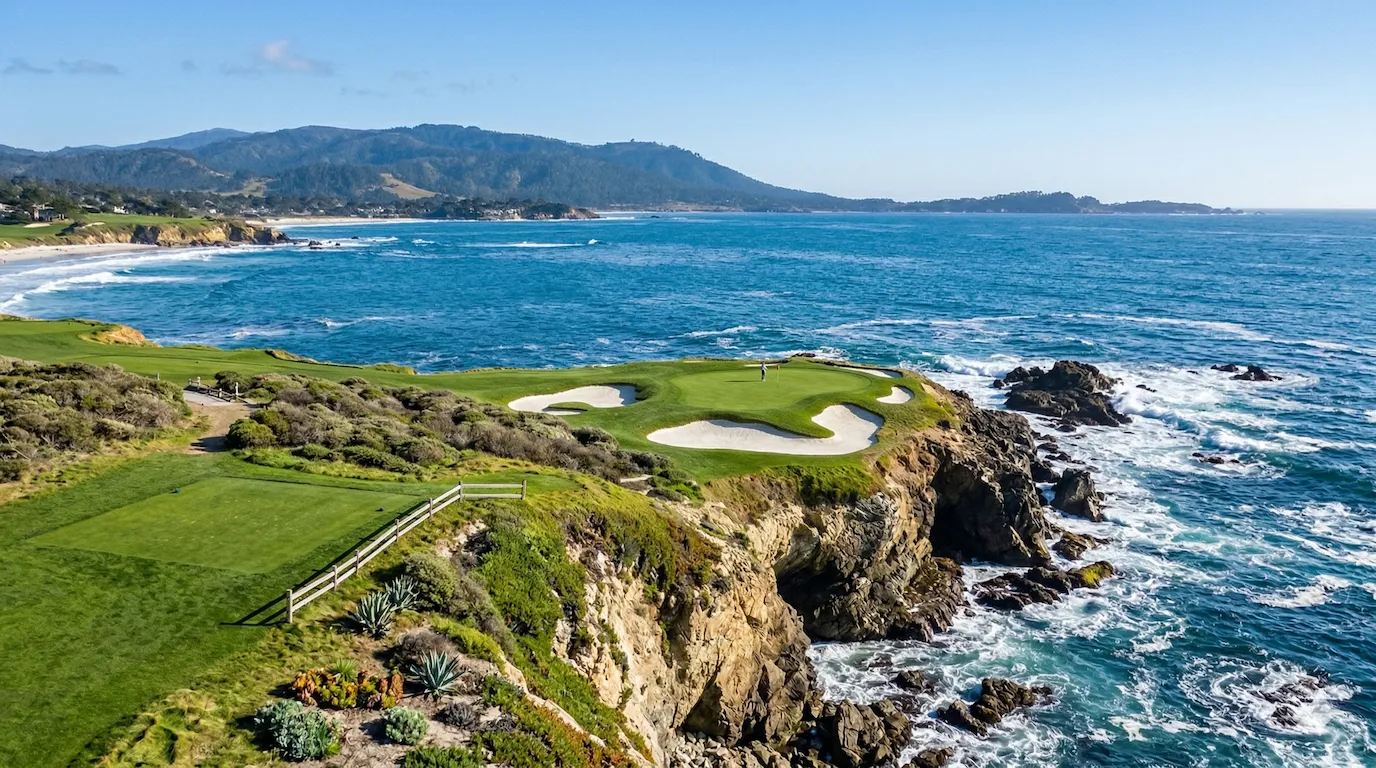
Pebble Beach Golf Links anchors the itinerary and warrants its own dedicated profile: the routing, the coastal holes, the strategic architecture of the 7th and 18th deserve more space than a destination guide can give them. The destination context matters here: the booking system requires either a two-night stay at a resort property (three nights for peak-season Thursday-Sunday tee times) or a phone call to the pro shop exactly 24 hours in advance to claim cancellation inventory. The $695 green fee is non-negotiable. Plan the entire budget around it from the start, not as an afterthought.
Spyglass Hill is the course serious golfers rank as the peninsula’s most demanding test (sometimes, on certain days, as the better round). Jones Sr. built a course that runs in two distinct acts: five holes through the coastal dunes, where the sandy waste areas and exposed positions evoke Pine Valley, then a hard pivot into the claustrophobic Monterey pine forest for the final thirteen, where the fairways tighten to 30 yards at their narrowest and the greens tip viciously in every direction. The first hole, “Treasure Island,” plunges from an elevated tee toward glimpses of Monterey Bay through the pines. The sixteenth, “Black Dog,” plays 469 yards and regularly ranks among the hardest holes on the PGA Tour rotation. Non-resort guests can book 90 days in advance; inventory depletes quickly after the window opens. At $550, it is the best value on the peninsula for what it delivers.
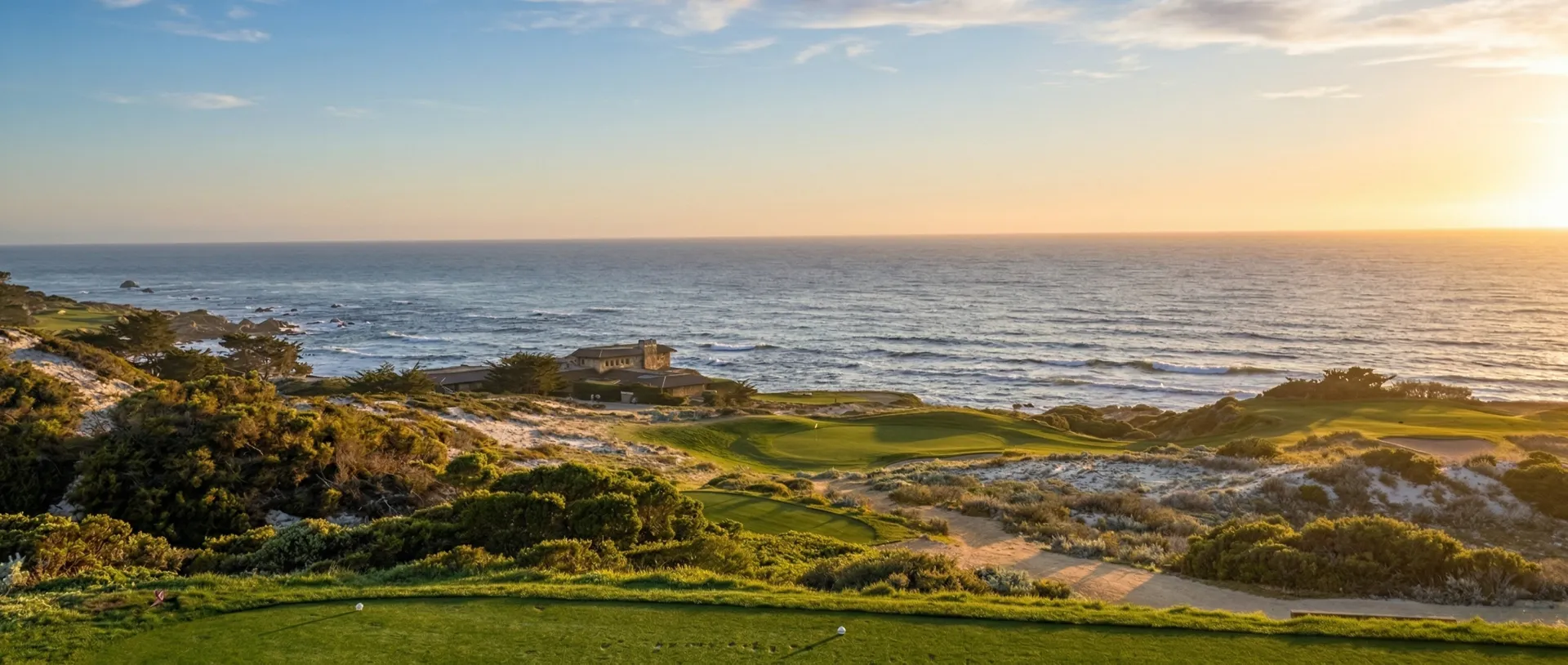
The Links at Spanish Bay is, as of March 2026, closed for renovation. The Pebble Beach Company has shuttered the course for a comprehensive redesign led by Gil Hanse and Jim Wagner, timed ahead of the 2027 U.S. Open at Pebble Beach. The reopening is projected for spring 2027. Travelers planning a 2026 trip should build their itinerary without it; Spyglass and Poppy Hills fill the schedule ably.
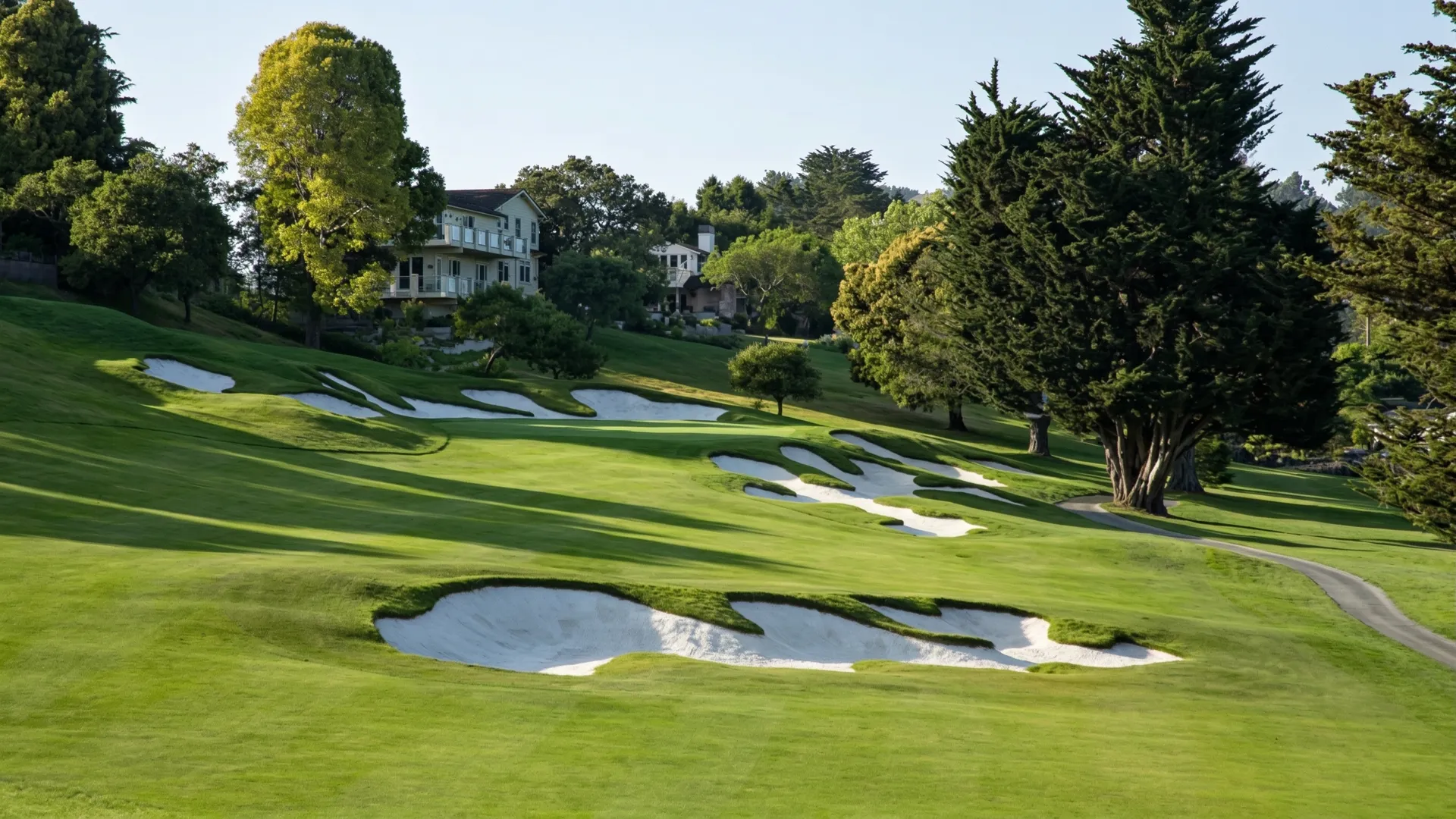
Poppy Hills Golf Course, NCGA-owned and tucked into the Del Monte Forest, deserves more attention than it gets. The 2014 renovation eliminated the rough entirely in favor of pine-straw and sandy waste areas, rebuilt the greens in fast bentgrass, and restored the holes to their natural contours along the forest floor. What remains is a clean, tree-framed test of iron play and putting precision that rewards the same skills Pebble Beach demands, at roughly half the cost. The 15th, a Redan-style par 3 sloping aggressively right-to-left, is the kind of hole that makes golfers take notes. At $350, it belongs in any itinerary where Spyglass is already booked. Non-resort guests book 90 days out.
Quail Lodge & Golf Club sits in Carmel Valley, ten miles from the coast, which produces two meaningful differences: no marine layer in the morning, and a fundamentally inland character. Robert Muir Graves designed the original layout in 1964 around ten lakes and the Carmel River; Todd Eckenrode’s 2015 refinements tightened the geometry without altering the mood. The architectural highlight is the 14th and 15th holes, back-to-back par-5 dogleg lefts that curve into each other in a continuous loop, both requiring aggressive carries over water to reach in two. The course rewards as an opening round: flat, walkable, strategically interesting without being punishing, priced at $199 and bookable 60 days out.
Bayonet and Black Horse occupy the grounds of the former Fort Ord military base in Seaside, twenty minutes north of the Pebble Beach gates. General Robert McClure built the Bayonet course in 1954 as a military test, and it has never shed that identity: narrow corridors through oak and cypress, penal bunkering that punishes anything offline, a slope rating of 148 that exceeds Pebble Beach. For golfers who want a hard technical examination before the premium rounds arrive, Bayonet delivers it without the premium price. Dynamic green fees run $79 to $139 depending on season and time.
Pacific Grove Golf Links makes the strongest argument for the peninsula’s breadth. The front nine moves through quiet residential neighborhoods: pleasant, pastoral, with the feel of a classic American municipal. Then the back nine turns toward the ocean and the Point Pinos Lighthouse, the oldest continuously operating lighthouse on the West Coast, and the holes run through exposed coastal dunes above the surf. The contrast between the two nines is jarring in the way only genuine geography can produce. Peak walking rates of $89 make this the highest return-on-investment coastal golf in the country. It earns a place in every itinerary, not as a consolation course but as a reminder of what golf looks like when cost is removed from the equation.
Pasatiempo Golf Club in Santa Cruz, fifty minutes north of Carmel, is the trip extension for golfers with an extra day and an appetite for architectural history. Alister MacKenzie designed the course in 1929 with Marion Hollins, then loved it enough to build his home along the sixth fairway and request his ashes be scattered on the 16th green. Bobby Jones played the opening-day exhibition and was so taken with MacKenzie’s strategic ingenuity that he hired him to co-design Augusta National. Pasatiempo is the architectural bridge that made the home of The Masters possible. A comprehensive 2023-2024 restoration by Jim Urbina rebuilt all 18 greens to their original 1929 dimensions and converted the putting surfaces from Poa annua to bentgrass, producing firmer, faster conditions than the course has seen in decades. It plays 6,495 yards from the championship tees (par 70, slope 141) through dramatic coastal barrancas and MacKenzie’s signature optical illusions: a cross-bunker on the 3rd sits 75 yards short of the green but looks greenside from the tee. At $425 walking, Pasatiempo is not cheap, but it is the most accessible world-class MacKenzie design in existence. Semi-private, with public tee times available up to 365 days in advance for a $35 priority booking fee.
CordeValle Golf Club sits forty-five minutes inland from the coast in San Martin, in the foothills of the Santa Cruz Mountains. Robert Trent Jones Jr. designed the course in 1999 across a 1,700-acre resort property owned by SAP co-founder Hasso Plattner, routing it through oak-studded valleys with 150 feet of elevation change and 68 Augusta-white bunkers. A comprehensive 2019-2022 renovation rebuilt every green with bentgrass, and the course has hosted the 2016 U.S. Women’s Open and four consecutive PGA Tour events. Access requires a resort stay at the Rosewood CordeValle ($600+ per night), and caddies are mandatory, which pushes a fully loaded round north of $750. The inland microclimate trades coastal fog for warm, clear days, and the Santa Clara Valley’s tasting rooms sit within a short drive. For a group adding a night before or after the Monterey itinerary, CordeValle functions as a bookend: serious championship golf without the coastal premium, in a setting that has nothing to do with the Pacific.
Planning the Trip
When to Go
| Window | Why |
|---|---|
| Dec–Feb 🌧️ Avoid | Pacific storms, 3+ inches of rain per month, soft turf; AT&T Pro-Am (February) locks down resort properties |
| Mar–May 🌤️ Good | Spring recovery, more availability, lower rates; “May Gray” marine layer possible on coastal holes |
| Jun–Aug ☁️ Good | Marine layer holds into afternoon; ocean views from 7th and 8th at Pebble Beach often behind fog. Monterey Car Week (August) floods hotels |
| Sep–Oct ☀️ Prime | The “Secret Season”: warm (71°F in September), clear, firm conditions, no marine layer; golden afternoon light across the Pacific |
| Nov 🌤️ Good | Shoulder rates, cooling temps, thinner crowds; occasional rain but playable |
Pebble Beach greens are typically aerated in late March and mid-August; Spyglass follows a similar schedule with a late-September cycle. Verify exact aeration dates with the resort before finalizing any booking.
Getting There and Getting Around
The closest airport is Monterey Regional (MRY), a genuine convenience but a small regional hub with limited connections. San Francisco International (SFO) and San Jose (SJC) offer significantly more flight options and usually lower fares at the cost of a two-hour drive south, a drive that, along the coastal stretch of Highway 1 through Santa Cruz, earns its place in the itinerary.
A rental car is non-negotiable. The peninsula courses are spread across several municipalities, Carmel Valley properties require a ten-mile drive inland, and Bayonet/Black Horse sits twenty minutes north of the Pebble Beach gates. No shuttle network connects the full itinerary.
Five Days on the Peninsula
| Day | Morning | Afternoon | Evening |
|---|---|---|---|
| 1 — Arrival | Fly into MRY or drive from SFO | Walk Ocean Ave in Carmel-by-the-Sea | Dinner at Casanova; make 24-hr Pebble Beach call-in if using non-resort strategy |
| 2 — The Valley | Quail Lodge (fog-free, flat, the yin-yang par 5s on 14–15) | Wine tasting: Bernardus or Folktale Winery in Carmel Valley Village | Dinner in Carmel |
| 3 — Spyglass | Spyglass Hill (book 90 days out; 4+ hours, slope 145) | Recovery: Bernardus spa, Point Lobos walk, or hotel bar | Dinner at The Bench overlooking the 18th at Pebble Beach |
| 4 — Lighthouse | Pacific Grove Golf Links (play 36 if legs allow) | 17-Mile Drive or e-bikes; alt: Hwy 1 south to Point Lobos Cypress Grove Trail | Links Club in Carmel Plaza: simulators, craft beer, bar food |
| 5 — Pebble | Pebble Beach Golf Links: the 7th, the 8th approach, the 18th along the cove | Post-round drinks at The Tap Room | Depart MRY or drive to SFO |
Budget Tiers
| Category | Smart Play ($1,500–$2,000) | Full Experience ($4,500–$5,500) |
|---|---|---|
| Lodging | Quail Lodge ($200–$300/night) or Carmel Airbnb | 2 nights Inn at Spanish Bay ($995/night) + 2–3 nights Bernardus or Quail Lodge |
| Golf | Pacific Grove ($89), Bayonet ($120), Quail Lodge ($199), Poppy Hills ($350), Spyglass ($550); attempt 24-hr call-in for Pebble Beach ($695) | Pebble Beach ($695 + caddie ~$200 all-in), Spyglass ($550), Poppy Hills ($350), Quail Lodge ($199), one additional round |
| Dining | 3 casual dinners in Carmel, 1 Carmel Valley wine afternoon, 1 dinner at The Bench | 1 dinner Aubergine ($200–$250/pp, reserve 2–3 months out), 2 mid-tier Carmel dinners, Carmel Valley wine afternoon |
| Transport | Rental car 5 days: $400–$500 | Rental car 5 days: $400–$500 |
| Booking key | 90-day window for Spyglass/Poppy Hills; 24-hr call-in for Pebble Beach (genuine inventory risk) | Resort stay unlocks 18-month advance Pebble Beach booking; the premium buys certainty |
The gap between these tiers is real, and the question worth asking before booking is whether the advance-booking guarantee for Pebble Beach justifies the lodging premium, or whether the 24-hour call-in strategy, with its genuine inventory risk, is the smarter bet for a flexible twosome.
Booking Timeline
| When | Action |
|---|---|
| 6–12 months out | Secure resort lodging at Spanish Bay or The Lodge if using advance-booking strategy; peak Sept–Oct dates fill early |
| 90 days out | Book Spyglass Hill and Poppy Hills the morning the window opens; prime morning inventory depletes within hours |
| 60 days out | Book Quail Lodge, Bayonet, Pacific Grove; reserve Aubergine (2–3 months for peak); confirm rental car |
| 2 weeks out | Check aeration schedules directly with courses; adjust packing for coastal cold and wind |
| 24 hours out | Non-resort Pebble Beach strategy: call pro shop at exactly the 24-hr mark; singles and twosomes have the best success rate |
For Non-Golfers
The Monterey Peninsula is one of the few American golf destinations that is genuinely worth visiting without touching a club. Carmel-by-the-Sea operates as a walkable village with more art galleries per block than anywhere in California, a wine bar culture that spans Carmel Valley AVA producers, and a farmers’ market on Tuesdays. The Monterey Bay Aquarium warrants a half-day: 35,000 animals, the kelp forest tank, the sea otter exhibit. Point Lobos State Natural Reserve, described without exaggeration as the crown jewel of the California State Park system, offers the Cypress Grove Trail and Bird Island Trail through hidden coves and dramatic sea cliffs in under two hours. Big Sur, forty minutes south on Highway 1 with Bixby Creek Bridge and McWay Falls as the anchors, justifies a full day. Lunch at Nepenthe above the Pacific, at a restaurant that has been there since 1949, is the right way to spend a non-golf afternoon.
Why the Peninsula Rewards the Planning
Every significant golf trip requires forward planning. Most require research. The Monterey Peninsula requires strategy — genuine thinking about booking windows, seasonal timing, budget allocation, and the honest question of whether the specific access method to Pebble Beach makes financial sense for this particular trip, this particular group. That strategic demand is, in a perverse way, part of the experience. The peninsula does not yield its best version easily.
A trip assembled without that thinking produces something smaller than what the peninsula actually is: an expensive single round at the famous course, surrounded by logistical friction, with the feeling that several more interesting things were available and missed. The version assembled with care delivers something entirely different — a week in which Pebble Beach is the culmination of a coherent progression through coastal dunes, pine forests, lighthouse headlands, and a sun-warmed valley with good Pinot Noir at the end of the afternoon. A trip that makes a complete argument.
The peninsula doesn’t reward proximity alone. It rewards attention. That’s exactly what makes it worth the planning.