
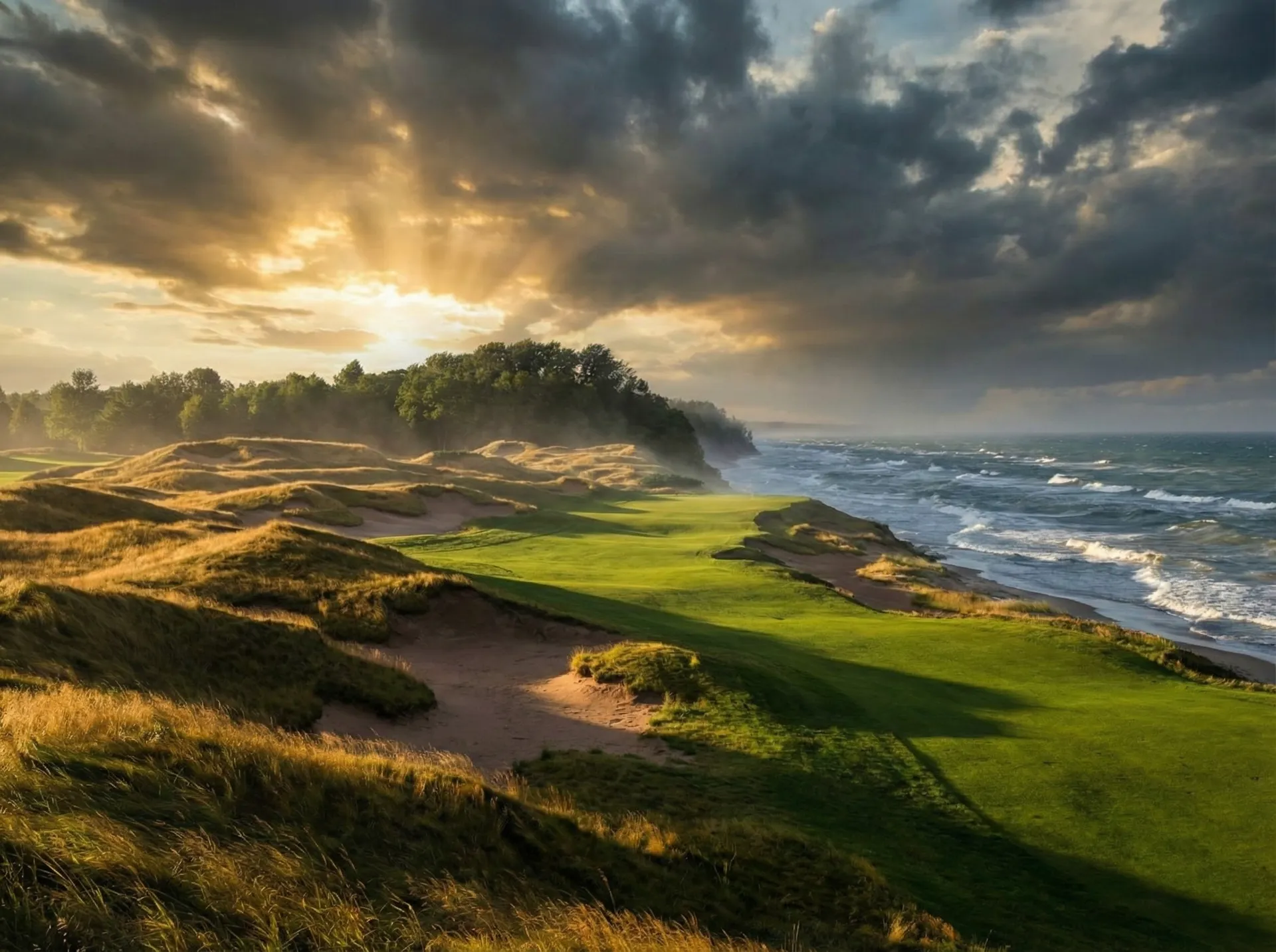
Pete Dye looked at a flat piece of Wisconsin farmland two miles from Lake Michigan and decided to build Ireland. Not simulate it. Not approximate it. Build it. He moved two million cubic yards of earth, planted fescue, carved 560 bunkers, and created something that shouldn’t exist: authentic links golf in the American Midwest.
The audacity worked.
Whistling Straits opened in 1998. Within a decade it hosted a PGA Championship. By 2021 it staged the Ryder Cup. Golf Digest ranks it 13th in America. World Golf Rankings place it in the top 50 globally. And unlike most courses in that conversation, you can actually play it. For a price. But you can play it.
That combination—world-class architecture, major championship pedigree, and public access—makes Whistling Straits golf’s most democratic masterpiece. It’s also one of its strangest.
The Vision Nobody Believed
Herb Kohler owned the land. Kohler, as in the plumbing fixtures company. He wanted a golf course. Pete Dye wanted to build links golf where links golf had no business existing.
The site had problems. It sat inland from Lake Michigan. It was flat. It had no natural dunes, no coastal winds, no centuries of sheep grazing to create the firm, fast conditions that define true links golf. What it had was Dye’s obsession and Kohler’s checkbook.
Dye brought in bulldozers. He created elevation where none existed. He shaped dunes by hand, walking the property with his construction crew, pointing at dirt piles and saying “higher” or “move it left.” He imported fescue from Scotland. He studied photographs of Royal County Down, Ballybunion, and Lahinch. He built what he saw.
The result looks nothing like Wisconsin and everything like the west coast of Ireland. Rolling fairways. Rumpled terrain. Bunkers that appear randomly, as if nature placed them during a particularly aggressive storm. And Lake Michigan, which from certain angles could pass for the Atlantic if you squint and ignore the lack of saltwater.
Critics called it artificial. Dye called it architecture. Both were right.
The Straits Course: 560 Bunkers and No Apologies
The Straits Course is Whistling Straits’ championship layout. It’s the one that hosted three PGA Championships (2004, 2010, 2015) and the 2021 Ryder Cup. It’s also the one that will break you.
Seven holes run along Lake Michigan. Not near it. Along it. The lake isn’t scenery—it’s strategy. Wind off the water changes direction mid-round. What played downwind at 9 a.m. plays into a gale by 2 p.m. Club selection becomes guesswork. Distance control becomes prayer.
The bunkers define the course. Dye carved 560 of them. Some are massive, swallowing entire fairways. Others hide in hollows, invisible until you’re standing in them. Many have steep faces requiring backwards exits. A few feature railroad ties, Dye’s signature sadism.
The 17th hole demonstrates Dye’s philosophy. It plays 223 yards from the tips, all carry over Lake Michigan to a green perched on a cliff. Miss right and you’re in the lake. Miss left and you’re in one of seven bunkers. Miss long and you’re off the property. The only safe play is perfect.
Dustin Johnson won the 2020 PGA Championship here with a score of 11-under. That was the lowest winning score in three championships. The course doesn’t give up birdies. It extracts mistakes.
What Links Golf Actually Means
Whistling Straits calls itself links golf. Purists argue. The debate misses the point.
True links golf exists on coastal land between ocean and arable soil—the “links” connecting sea to farmland. It features sandy soil, natural dunes shaped by wind, firm turf from sheep grazing, and weather that changes hourly. Scotland and Ireland have it. Wisconsin doesn’t.
But Whistling Straits captures links golf’s essence: strategic architecture over pure length, ground game options, firm and fast conditions, wind as the primary defense, and terrain that rewards creativity over power.
The fescue plays firm. Balls bounce and roll. The ground game works—running a 7-iron onto a green is often smarter than flying a wedge. Wind matters more than distance. A 150-yard shot into a 30-mph gust requires different thinking than a 150-yard shot in calm air.
Dye didn’t replicate links golf. He distilled it. He identified what makes links courses great and built those elements into Wisconsin farmland. The result isn’t authentic in origin. It’s authentic in experience.
The Irish Course: Whistling Straits’ Quieter Masterpiece
The Straits Course gets the attention. The Irish Course might be better golf.
Dye built the Irish Course in 2000, two years after the Straits. It sits inland, away from Lake Michigan, on more dramatic natural terrain. Where the Straits Course feels manufactured—because it is—the Irish Course feels discovered.
The routing follows the land’s natural contours. Holes tumble through valleys, climb ridges, and wrap around wetlands. The bunkering is more restrained—only 127 compared to the Straits’ 560. The design rewards strategy over survival.
The 5th hole plays 214 yards downhill to a green surrounded by bunkers and native grasses. The smart play is a long iron to the front, letting the ball release onto the putting surface. The aggressive play is a fairway wood at the flag. Both work. Both require thought.
The Irish Course doesn’t host major championships. It doesn’t appear in top 100 rankings. But golfers who play both courses often prefer it. Less theater. More golf.
The Public Access Reality
Whistling Straits is public. Technically. The reality is more complicated.
You can book a tee time. You don’t need membership. You don’t need connections. You need money and planning.
Peak season rates (May through October) run $450-$500 per round on the Straits Course. The Irish Course costs $300-$400. Those prices include caddie fees—caddies are mandatory on the Straits, recommended on the Irish. Add lodging at the American Club (Kohler’s five-star resort) and a weekend trip approaches $2,000 per person.
Booking opens 60 days in advance for resort guests, 30 days for the public. Prime tee times disappear within hours. Weekday mornings in shoulder season (April, early May, late October) offer the best availability and lower rates—sometimes as low as $300 on the Straits.
The caddie requirement isn’t negotiable. Dye designed the Straits Course with blind shots, hidden bunkers, and severe elevation changes. A yardage book helps. A caddie who’s walked the course 500 times helps more. They’ll tell you the 7th fairway slopes harder right than it appears. They’ll show you the safe miss on 17. They’ll explain why the wind on 11 always feels wrong.
Is it worth it? That depends on what you value. If you want to play a course that hosted the Ryder Cup, where Dustin Johnson won a major, where you can stand on the 17th tee and understand why professionals three-putt—yes. If you want accessible golf—no.
When to Play and What to Expect
Whistling Straits operates from April through October. The season is short. The weather is unpredictable. Plan accordingly.
Best times:
- Late May through June: Firm conditions, moderate crowds, reasonable rates
- September: Peak conditions, fall colors, fewer players
- Early October: Shoulder season pricing, crisp weather, risk of early cold
Avoid:
- July and August: Peak crowds, softest conditions, highest prices
- April: Unpredictable weather, course recovering from winter
Lake Michigan creates its own weather system. Mornings start calm. By afternoon, 20-mph winds are common. Temperature swings of 20 degrees during a round happen regularly. Bring layers. Bring rain gear. Bring patience.
The course plays firm and fast when conditions allow. Greens run 11-12 on the stimpmeter. Fairways provide generous landing areas but punish offline shots with deep rough or bunkers. The rough is fescue—thick, grabby, and unforgiving.
Expect a five-hour round. The course stretches over 7,790 yards from the tips, though most players should play the blue tees at 6,991 yards. Expect to lose balls. The fescue swallows everything. Expect to be humbled. The course doesn’t care about your handicap.
The Ryder Cup Legacy
The 2021 Ryder Cup put Whistling Straits in golf’s permanent record. Team USA dominated Team Europe 19-9, the largest margin of victory since 2004. The course played exactly as Dye intended—firm, fast, and unforgiving.
The 17th hole, playing 223 yards over Lake Michigan, became the tournament’s signature moment. Players hit everything from 3-iron to 5-wood depending on wind. Several balls found the lake. The hole yielded birdies and doubles in equal measure.
The Ryder Cup validated Dye’s vision. You can build world-class golf anywhere if you have the imagination, the resources, and the willingness to move mountains. Literally.
Comparing Whistling Straits to True Links
Whistling Straits invites comparison to Ireland and Scotland’s coastal masterpieces. The comparisons are inevitable. They’re also unfair.
Royal County Down has mountains, sea, and 120 years of history. Ballybunion has dunes shaped by millennia of wind and waves. Lahinch has the Atlantic Ocean and goats that predict weather. Whistling Straits has Lake Michigan and Pete Dye’s imagination.
What Whistling Straits offers is accessibility. You can’t play Royal County Down without connections or significant advance planning. You can’t play Ballybunion Old on a whim. You can book Whistling Straits 60 days out and show up with a credit card.
The experience differs. True links courses feel ancient, inevitable, as if nature designed them and humans merely discovered the routing. Whistling Straits feels intentional, constructed, a testament to human ambition. Both are valid. Both are memorable.
The Kohler Golf Empire
Whistling Straits is part of Kohler’s larger golf operation. The company owns four courses in Wisconsin:
Whistling Straits:
- Straits Course (championship layout)
- Irish Course (quieter, more strategic)
Blackwolf Run:
- River Course (parkland design along the Sheboygan River)
- Meadow Valleys Course (rolling terrain, dramatic elevation changes)
All four courses bear Dye’s fingerprints. All four offer public access at premium prices. Together they create a golf destination that rivals Bandon Dunes for American golf tourism.
The American Club anchors the resort—a five-star hotel with multiple restaurants, a spa, and enough Kohler plumbing fixtures to stock a showroom. Staying on property provides booking advantages and eliminates the 45-minute drive from Milwaukee.
What Whistling Straits Gets Right
Whistling Straits succeeds because it commits fully to its vision. Dye didn’t build a links-style course. He built a links course that happens to be in Wisconsin.
The details matter. The fescue isn’t decorative—it’s functional, creating the firm, fast conditions that define links golf. The bunkers aren’t random—they’re strategic, punishing poor angles and rewarding precise placement. The wind isn’t an inconvenience—it’s the course’s primary defense.
The maintenance standards match the ambition. Greens roll pure. Fairways provide consistent lies. The course presents itself in championship condition daily, not just for major tournaments.
The caddie program elevates the experience. Caddies know the course, read the wind, and provide the local knowledge that transforms a good round into a great one. They’re not optional extras—they’re essential guides.
The Criticism and the Counter
Critics argue Whistling Straits is artificial, a theme park version of links golf. They’re not wrong. The course is manufactured, from the shaped dunes to the imported fescue to the 560 bunkers carved by bulldozers.
But all golf courses are artificial. Augusta National didn’t exist before Alister MacKenzie and Bobby Jones built it. Pine Valley was New Jersey scrubland before George Crump moved sand. Cypress Point required dynamite and Alister MacKenzie’s vision.
The question isn’t whether Whistling Straits is artificial. The question is whether it’s good. And by any measure—championship pedigree, architectural merit, strategic interest, playing experience—it’s exceptional.
Dye built what he wanted to build. He didn’t apologize for the ambition. He didn’t hedge the vision. He moved two million cubic yards of earth and created something that didn’t exist before. That’s not simulation. That’s creation.
Planning Your Visit
Booking:
- Reserve 60 days in advance (resort guests) or 30 days (public)
- Book early morning tee times to avoid afternoon wind
- Consider playing both courses over two days
Costs:
- Straits Course: $450-$500 (peak season)
- Irish Course: $300-$400 (peak season)
- Shoulder season discounts available
- Caddie fees included in rates
Lodging:
- American Club (on property, five-star, booking advantages)
- Kohler hotels (nearby, more affordable)
- Milwaukee (45 minutes away, budget options)
What to Bring:
- Multiple layers (weather changes rapidly)
- Rain gear (Lake Michigan creates unpredictable conditions)
- Extra balls (fescue is unforgiving)
- Camera (the views are worth documenting)
What to Know:
- Caddies mandatory on Straits Course
- Walking only (no carts except for medical necessity)
- Firm, fast conditions require ground game strategy
- Wind is constant—club selection is guesswork
The Verdict
Whistling Straits is American golf’s most successful impersonation. It’s links golf built where links golf shouldn’t exist. It’s public access at private club prices. It’s Pete Dye’s ego and Herb Kohler’s checkbook creating something that has no business working but does.
The course challenges every part of your game. The wind tests your patience. The bunkers test your short game. The greens test your putting. The fescue tests your ability to find your ball. It’s exhausting, expensive, and occasionally infuriating.
It’s also unforgettable.
Most great courses are accidents of geography—land so perfect for golf that routing becomes obvious. Whistling Straits is the opposite. It’s golf through sheer force of will, imagination imposed on unwilling terrain. Dye looked at Wisconsin farmland and saw Ireland. Then he built it.
That’s not simulation. That’s vision. And vision, it turns out, is enough.
Whistling Straits proves you don’t need centuries of history or coastal dunes or Scottish weather to build great golf. You need a designer who refuses to compromise, an owner who refuses to question the budget, and the audacity to believe that moving mountains can create something worth remembering.
The course delivers. Not because it’s authentic. Because it’s excellent.
And in golf, excellence doesn’t require permission. It just requires commitment.