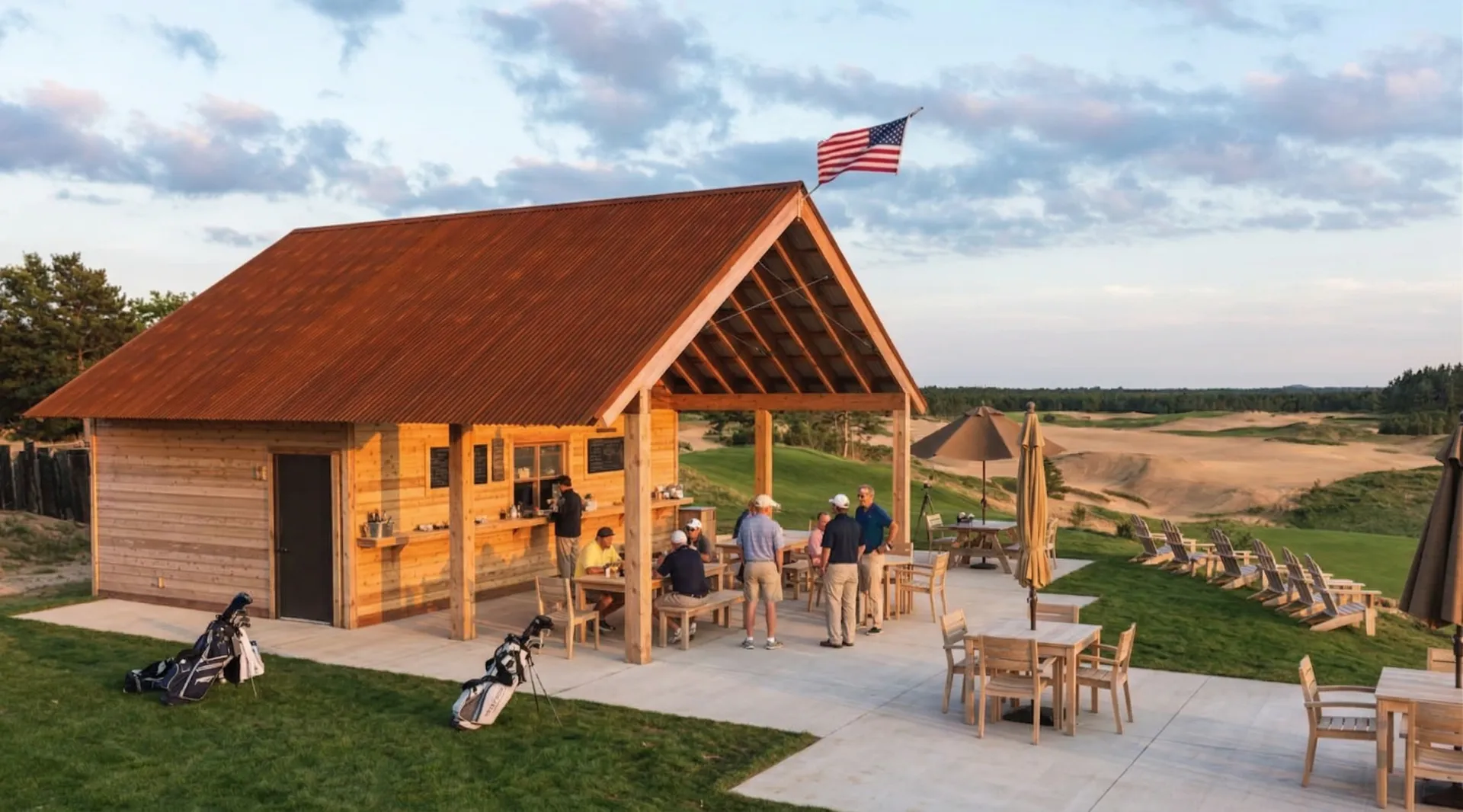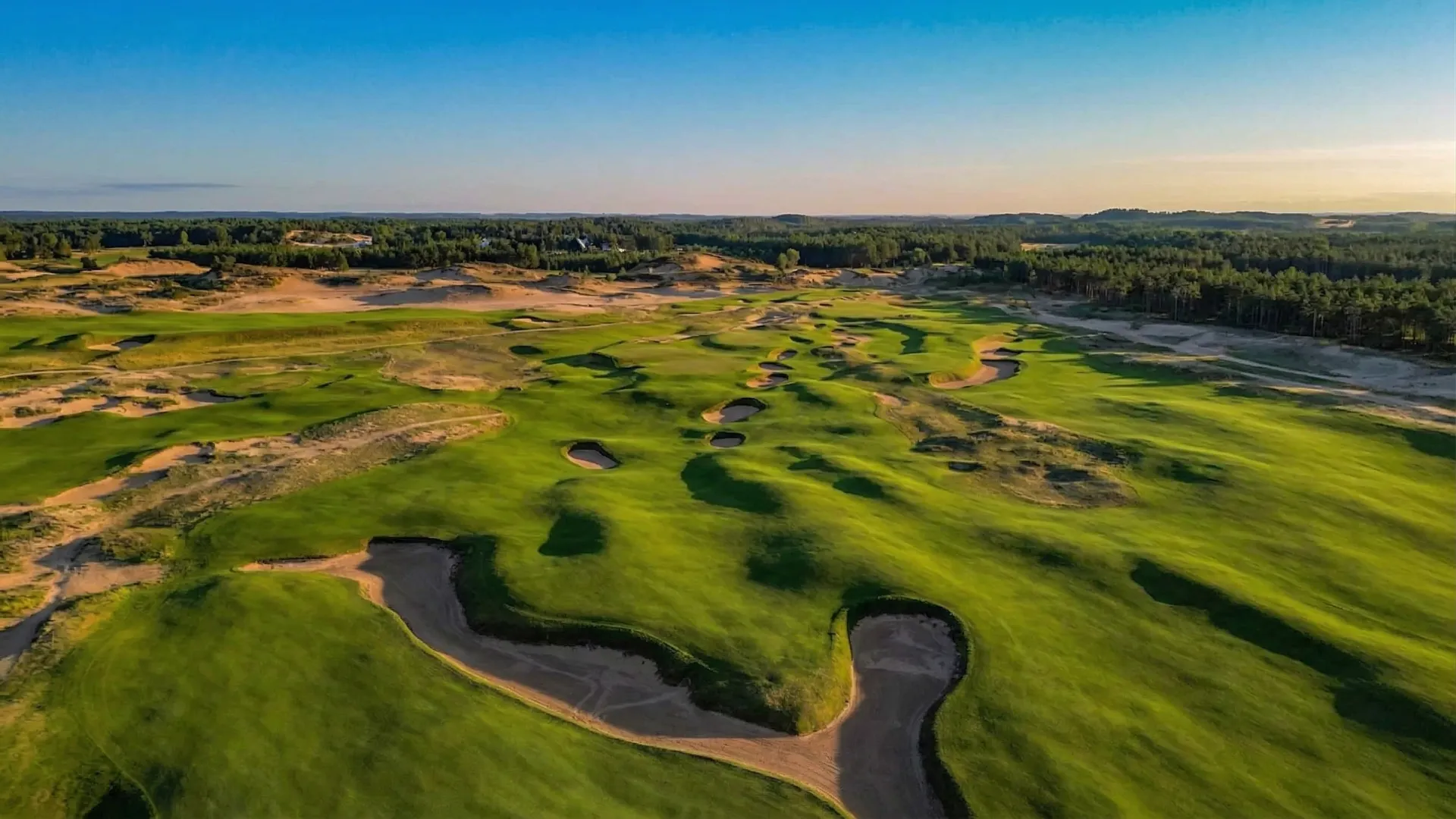
The original Lido Golf Club lasted twenty-five years. C.B. Macdonald and Seth Raynor built it in 1917 on Long Island’s south shore, dredging two million cubic tons of sand from the ocean floor to transform marshland into what Bernard Darwin called “a wonder of which will never fade.” The U.S. Navy seized the land in 1942. Schools and parking lots replaced the holes.
For eighty years, The Lido existed only as a myth. Then a golf historian named Peter Flory, with free time and a magnificent obsession, rebuilt it inside a video game. Pixel by pixel, using vintage photographs, historical surveys, and engineering records, he rendered Macdonald’s lost masterpiece in a golf simulator with enough topographic fidelity to make architects weep.
Michael and Chris Keiser saw the digital model and bought 850 acres of sandy terrain in central Wisconsin. They hired Tom Doak. Using Flory’s blueprint and GPS-guided bulldozers, Doak and Renaissance Golf associate Brian Schneider spent over 230 days on-site, grading the physical terrain to the millimeter. The Lido opened at Sand Valley Resort in 2023, and the USGA immediately contracted it to host four national championships, beginning with the 2026 U.S. Mid-Amateur.
This is not a tribute course. It is an academic resurrection: every green contour, every cross-bunker, every forced carry replicated from a 1917 original that ranked alongside Pine Valley and National Golf Links of America. Two of the holes were designed by architects who entered a magazine contest before they were famous. Alister MacKenzie won first place with the 18th. Tom Simpson’s entry became the 15th. The course that time buried is walking again in Wisconsin, and it plays exactly as hard as it did when its creators called it their finest collaboration.
Every Template Macdonald Ever Loved
Macdonald built The Lido as a catalog of his favorite strategic templates, and the recreation preserves every one. Players encounter textbook versions of the Alps, Redan, Eden, Biarritz, Cape, Punchbowl, Channel, and Short across eighteen holes that play to a 37-35 split between front and back nines. The front nine traces a massive counterclockwise loop around the 850-acre property. The back nine creates a tighter inner loop, with the 14th through 17th playing back-and-forth through the center of the course in a claustrophobic, high-tension finish.
The 4th, “Channel” (par 5, 550 yards from the Navy tees), presents the most dramatic risk-reward decision on the course. A kidney-shaped island fairway sits in a lagoon down the right side. Driving onto it requires a 250-yard carry over water but shortens the hole dramatically and opens an eagle look. The safe play to the wide left fairway turns it into a grinding three-shot affair ending with a forced carry over a cross-bunker with a ten-foot face, fifty yards short of an elevated green. The Channel separates players who carry the nerve gene from those who do not.
The 10th, “Alps” (par 4, 401 yards from the Navy tees), borrows directly from the 17th at Prestwick. A drive down the right side of the fairway optimizes the angle, but the second shot is entirely blind, played over a massive man-made sand dune to a green hidden in a bowl on the other side. The player stares at a wall of sand, picks a yardage, and trusts. Gathering slopes behind the dune funnel well-struck shots onto the putting surface. Short approaches plug into the dune’s face. The hole rewards preparation and imagination in equal measure, and punishes the aerial target-golf mentality that most American courses encourage.
The 18th, “Home” (par 4, 449 yards from the Navy tees), is MacKenzie’s contest-winning design from 1914, built faithfully by Macdonald as the original Lido’s closer and recreated just as faithfully by Doak. A nearly 100-yard-wide fairway splits into multiple routes. A central bunker branches off the tee, and carrying it provides the best approach angle but introduces a line of fairway bunkers. The safe play left removes hazards but leaves a very long approach into a well-guarded green. Good players work backward from the pin position, choosing the exact sliver of fairway that opens the green. Everyone else hits into the massive width and spends the walk to the ball wishing they had.
The remaining templates sustain the strategic intensity. The 3rd (“Eden”) recreates St. Andrews’ famous 11th, with a deep Hill Bunker guarding the left and Strath bunkers eating short-right approaches. The 8th (“Biarritz”) stretches 236 yards and demands a driving iron to carry a deep swale that bisects the green. The 16th (“Redan”) slopes severely from front-right to back-left; players who aim right of the pin and trust the contour are rewarded, while everyone aiming at the flag finds the bunker and carries that memory for years.
The greens average over 12,000 square feet, roughly three times a typical modern putting surface. Their size is not generous; it is punitive. Heavy contours, deep swales, and tiered surfaces mean that being on the wrong tier guarantees a three-putt. The turf is fast, firm fescue carved from prehistoric sand dunes, encouraging the ground game while launching errant shots into deep hazards. Wind blows consistently across the flat terrain (the Keisers selected the site partly because its wind profile matches the original Long Island location), and it transforms manageable par-4s into tests of nerve. Players who control trajectory and use the ground game score. Players who rely on high-spin target golf get educated quickly.
The difficulty is genuine and uncompromising. One Golf Magazine panelist called it “the ultimate IQ test for golf-course architecture.” Forced carries, blind approaches, and the massive green complexes combine to produce a strategic grind that separates thinkers from ball-strikers. Middle-to-high handicappers will be tested severely. That is not a drawback. That is the point.
Planning the Trip
Green fees are structured around season and accommodation status.
| Item | Cost |
|---|---|
| Green fee, peak season (May–Oct) | $325 |
| Green fee, shoulder season | $235 |
| Replay / 9-hole rate, peak | $165 |
| Caddie per bag (before tip) | $100 |
| Forecaddie per person (4-player group) | $40 |
| Club rental (per day) | $60 |
Caddies are mandatory on The Lido. No exceptions, no carts, no negotiations. The base caddie fee is $100 per bag, paid directly in cash. Standard gratuity adds $50–$80, bringing the realistic per-round cost to $150–$180 per bag above the green fee. Request caddies in advance through the resort’s caddie services department. On a course this strategically complex, a good caddie earns the tip before the front nine is over.
Booking requires planning and patience. Access is restricted to Sand Valley resort guests, Sunday through Thursday only. Demand far exceeds supply, and 2026 tee times are subject to waitlists. Securing on-property lodging is essential. The Lodge at Sand Valley ($350+ per night) offers walkable convenience to the clubhouse and Aldo’s Farm & Table. Lakes Inn ($140+ per night) provides a more budget-friendly option that still qualifies for resort-guest access. Cancellations require 45 days’ notice between May and October to avoid forfeiting the deposit.
When to Go
| Window | Why |
|---|---|
| Nov–Mar ❄️ Avoid | Course closed; heavy snow and sub-freezing temperatures |
| Apr 🌤️ Good | Shoulder season opens late April; brisk winds, cool turf, lower rates |
| May ☀️ Prime | Excellent spring conditions; moderate humidity, firm turf |
| Jun 🌧️ Good | Warmest temps begin, but historically the wettest month in Nekoosa |
| Jul–Sep ☀️ Prime | Peak summer and early autumn; firm, fast links conditions |
| Oct 🌤️ Good | Shoulder rates return mid-month; crisp autumn golf before closure |
The 2026 U.S. Mid-Amateur (September 26 through October 1) will close The Lido to resort guests during that window.
Central Wisconsin Airport (CWA) sits 45 minutes from the resort, served by American, Delta, and United. Madison (MSN) is 1 hour 45 minutes away. Milwaukee (MKE), 2 hours 40 minutes. Chicago O’Hare (ORD), 3.5 hours. Sand Valley partners with Go Riteway for direct airport transfers from ORD, MKE, and MSN. Once on property, a complimentary 24-hour shuttle moves guests between courses, lodging, and dining.
Three other championship courses share the resort: Sand Valley (Coore & Crenshaw, $325), Mammoth Dunes (David McLay Kidd, $295), and Sedge Valley (Doak, a par-68 heathland gem at 5,829 yards, $325). The Sandbox, a 17-hole par-3 course by Coore and Crenshaw, runs $65 and makes an ideal afternoon round. Aldo’s Farm & Table at the main clubhouse serves elevated Wisconsin comfort food and is the destination for the night before the round. Craig’s Porch near the Sand Valley first tee handles excellent grab-and-go pulled pork sandwiches and tacos between loops.
Why the Resurrection Matters
The Lido is not nostalgia. Nostalgia would be a plaque on a wall describing what Macdonald built and what the Navy destroyed. This is a functional, USGA-sanctioned championship venue where golfers play holes designed by MacKenzie and Simpson before either man was famous, on contours mapped from a golf video game, graded by GPS-guided tractors to replicate terrain that was paved over eighty years ago.
The technology is modern. The architecture is not. Every template on the course predates 1920. Every strategic decision the player faces (carry the channel or bail left, trust the blind approach or lay up, choose which third of a 100-yard-wide fairway to target) was conceived when Woodrow Wilson was president. The Lido proves that Golden Age design principles do not merely survive contact with the modern game. They thrive. The USGA’s decision to bring four national championships to Nekoosa is not sentiment. It is confirmation.
Book early. Access is limited, and the ghost of Long Island has no interest in waiting another eighty years.