The logo tells the story. A fox, paw raised, ears alert, watching. Not a bear. Not an eagle. A fox. At Sand Valley Resort, where Mammoth Dunes sprawls across enormous fairways and The Lido recreates a legendary par-72 at full scale, Tom Doak built a course whose mascot is the cleverest predator in the Wisconsin woods.
Sedge Valley opened in July 2024 at 5,829 yards and par 68. On the day the tee sheet went live, the resort’s reservation lines fielded 8,000 phone calls. Not for a 7,200-yard championship test. For a course with five par 3s, one par 5, and greens so small that the largest at Sedge Valley is roughly the size of the smallest at Mammoth Dunes. Doak walked the terrain (the very first parcel cleared when the Keiser family began building the resort), found the 18 best natural green sites, and connected them without any obligation to stretch past 6,000 yards. GOLF Magazine ranked it No. 22 on its Top 100 Courses You Can Play list in 2025, less than twelve months after opening day. The fox knew what it was doing.
Where the Fox Shows Its Teeth
Standard routing conventions do not survive this property. The par distribution reads 33-35, with a 3-4-3-3 sequence from holes 5 through 8 that breaks every pacing rule in the book. Doak placed back-to-back par 3s, then a drivable par 4, then another par 3. No two consecutive holes ask the same type of question.
The course draws its character from English heathland golf rather than the open dunescape that defines its neighbors. Where Mammoth Dunes offers sand blowouts visible from the parking lot, Sedge Valley’s corridors are framed by native grasses, sedge, and rock outcroppings. Fine fescue turf runs firm and fast, rejecting high-spinning approaches with quiet indifference. Players who embrace the ground game find creative angles the architect practically sketched in dotted lines. Players who insist on launching towering wedge shots spend the afternoon searching for balls in waist-high fescue.
The 6th (par 4, 294 yards from the back tees) crystallizes the philosophy. A tantalizingly short par 4 that begs for the driver. The green sits on a narrow shelf, skinny enough to make a thinking player reach for an iron instead. A pot bunker guards the optimal driving line. Miss the green by five yards in any direction and the ball disappears into native grass, converting a potential eagle into a scrambling bogey. The smart play is a layup, a precise wedge, and a quiet par. The fun play is the driver. Sedge Valley does not care which club the golfer pulls. It cares about what happens after.
The 10th (par 4, 356 yards from the back tees) introduces something unusual at a Keiser property: water. A hook-shaped dogleg wraps around an expansive lake, offering three distinct lines off the tee. The heroic play requires a 280-yard carry over the hazard to a green that pitches sharply away, making it nearly impossible to hold with a driver. Layered bunkering frames the water against the fescue like a warning label nobody reads. The conservative line left leaves a fuller wedge with enough angle to hold the firm, sloping surface. Most players who choose aggression here end up wet or through the fairway. Most players who choose caution walk away with par and a story about the one they almost tried.
The 18th (par 4, 318 yards from the back tees) closes with a hole that plays bigger than its yardage by a factor of about three. A massive diagonal ridgeline bisects the fairway, anchored by a towering bunker reminiscent of the Himalaya at Royal St. George’s. Carry it to reach the upper fairway and a straightforward pitch into an L-shaped punchbowl green. Bail right and face a completely blind wedge from below the ridge to a target the golfer cannot see. The amphitheater setting is theatrical, the stakes are binary, and the gap between the two possible outcomes makes this tee shot feel more consequential than most finishing holes twice its length.
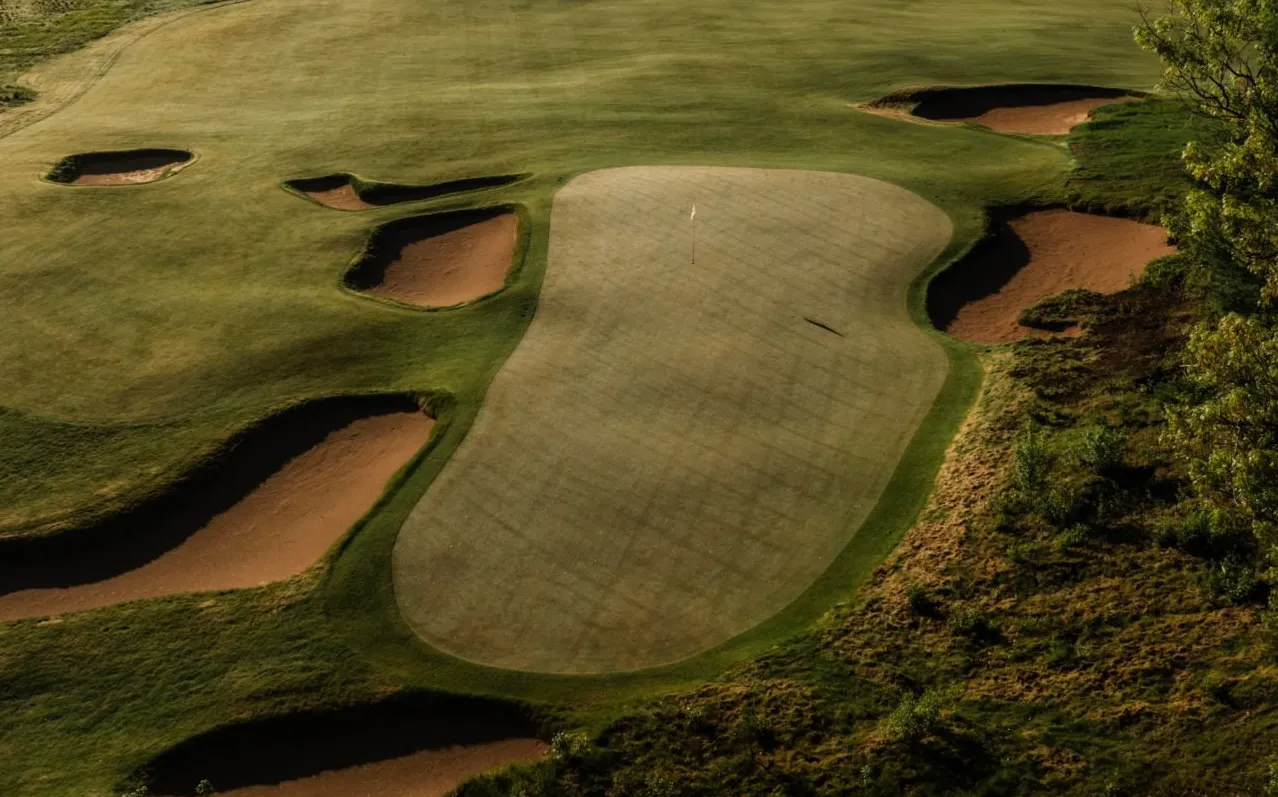
The greens throughout are small, violently contoured, and merciless to aerial attacks. V-shapes, punchbowls, steep false fronts. A caddie is not required (unlike The Lido), but first-time visitors without one will encounter blind tee shots on holes 2, 3, 12, and 18 that turn a pleasant walk into a ball-recovery expedition. Central Wisconsin’s wind swirls unpredictably through the heathland corridors, shifting intensity by the hour. Bring an extra sleeve of balls and the humility to play the shot the terrain suggests rather than the one the ego demands.
Planning the Trip
Green fees run $325 during peak season (late May through early October) for both resort and day guests, dropping to $235 in shoulder months.
| Item | Cost |
|---|---|
| Green fee, peak season | $325 |
| Green fee, shoulder season | $235 |
| Replay round (same day) | $165 |
| Caddie per bag (before tip) | $100 |
| Forecaddie per person (before tip) | $40–$60 |
| Pull cart rental | $10 |
| Club rental (includes 2 sleeves of balls) | $60 |
| Junior green fee (16 and under, after 2 PM) | Free |
Caddies are available and highly recommended. Standard gratuity runs $50 or more per bag on top of the base fee, bringing the total per-bag cost to roughly $150. The resort’s caddie program is first-rate; caddies typically stay with a group across a multi-day trip, and their knowledge of blind shots and green contours at Sedge Valley is worth every dollar. Request through Caddie Services well in advance. Players must use lightweight carry bags not exceeding 25 pounds; heavy cart bags are not permitted.
Booking at Sand Valley requires planning and flexibility. Tee sheets for the following year open in late winter or early spring, and peak dates sell out almost instantly. Staying on property guarantees advance access to the full portfolio, including The Lido, which is restricted to resort guests Sunday through Thursday. Day guests can book Sedge Valley through the resort’s online portal or Noteefy waitlist system, but date flexibility is essential. The best strategy: secure lodging 12 to 18 months ahead.
When to Go
| Window | Why |
|---|---|
| Nov–Mar ❄️ Avoid | Course closed; snow and freezing temperatures |
| Apr 🌤️ Good | Course opens late month; soft turf, brisk winds, dress in layers |
| May–Jun ☀️ Prime | Comfortable walking weather, long daylight, easy 36-hole days |
| Jul ☀️ Good | Peak heat and humidity; mosquitoes thick in the fescue |
| Aug–Sep ☀️ Prime | Humidity fades, turf firms up, statistically the best weather window |
| Oct 🌤️ Good | Fall foliage, cooler mornings, frost delays likely; course closes late month |
Central Wisconsin Airport (CWA) sits about 65 minutes north, served by American, Delta, and United. Madison (MSN) adds another 40 minutes but offers more flight options. Chicago O’Hare (ORD), roughly 3.5 hours south, is the best gateway for travelers connecting from across the country. A rental car is necessary unless the trip stays entirely on property, where a complimentary shuttle runs 24 hours between courses, lodging, and dining.
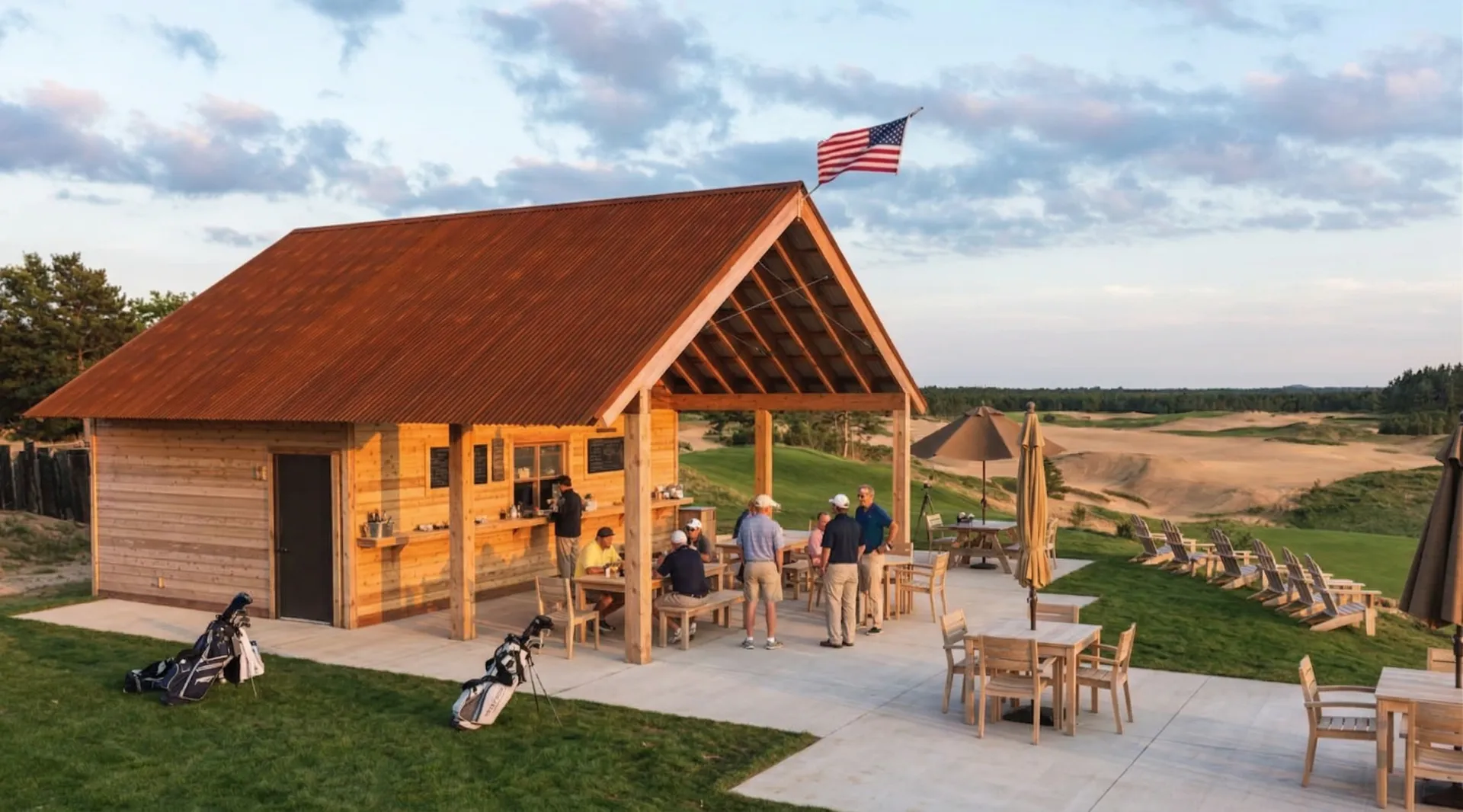
The rest of the Sand Valley portfolio makes a multi-day trip essential. Sand Valley (Coore & Crenshaw) is the strategic heathland foundation. Mammoth Dunes (David McLay Kidd) is the massive, forgiving playground. The Lido (Doak) is the meticulous recreation of C.B. Macdonald’s lost masterpiece. The Sandbox (Coore & Crenshaw) is the 17-hole par-3 loop built for afternoon wind-downs. Craig’s Porch, the iconic halfway house near the Sand Valley 1st and 10th tees, serves $1 tacos and $3 beers, a value proposition that may be the best deal in American golf not involving an actual golf ball. The Gallery, near the Sedge Valley clubhouse, offers excellent pizza and an Italian-influenced menu ideal for a relaxed dinner the night before taking on the fox.
Why 5,829 Yards Is Enough
Most modern resort courses prove their worth by stretching past 7,200 yards and manufacturing spectacle. Sedge Valley proves its worth by asking whether any of that was ever necessary. Doak looked backward to the Golden Age heathlands outside London, courses like Swinley Forest and The Addington, and built a routing where every question is answered with imagination rather than horsepower. The result is the most cerebrally demanding course in the Sand Valley collection, and the one most likely to send a golfer back to the first tee muttering about the shot they should have played.
The fox on the logo has its paw raised for a reason. It is not pouncing. It is waiting to see what the golfer does next. At Sedge Valley, the interesting answer is almost never the obvious one.