Josh Lesnik’s apology changed the trajectory of American golf. “I’m very sorry to tell you this,” the KemperSports president reported to Mike Keiser after scouting 1,700 acres of central Wisconsin sand barrens in 2012, “but you are going to love it.”
Keiser had built his empire on ocean-front property at Bandon Dunes. The notion that a landlocked site in Nekoosa, Wisconsin, could produce destination-caliber golf struck him as implausible at best. He sent Lesnik as a courtesy to a persistent advocate named Craig Haltom, fully expecting the report to kill the idea. Instead, Lesnik found dunes soaring sixty to eighty feet high and a pure sand base running a hundred feet deep, left behind 18,000 years ago by a prehistoric glacial lake. The skepticism died on the spot.
Bill Coore and Ben Crenshaw cleared the planted timber, exposed the dramatic heathland beneath, and shaped as little as possible. Sand Valley opened in 2017 and proved something the golf industry had long doubted: the prerequisite for world-class destination golf is not an ocean view. It is substrate. Ranked among the top 25 public courses in America by Golf Digest, Golfweek, and GOLF Magazine, the course earned the USGA’s ultimate endorsement in 2023 when the association selected Sand Valley to co-host four upcoming amateur championships, starting with the 2026 U.S. Mid-Amateur. The original course remains what it was from the first tee shot: proof that the greatest golf land in America was hiding under a pine plantation in central Wisconsin.
Where the Glaciers Left the Holes
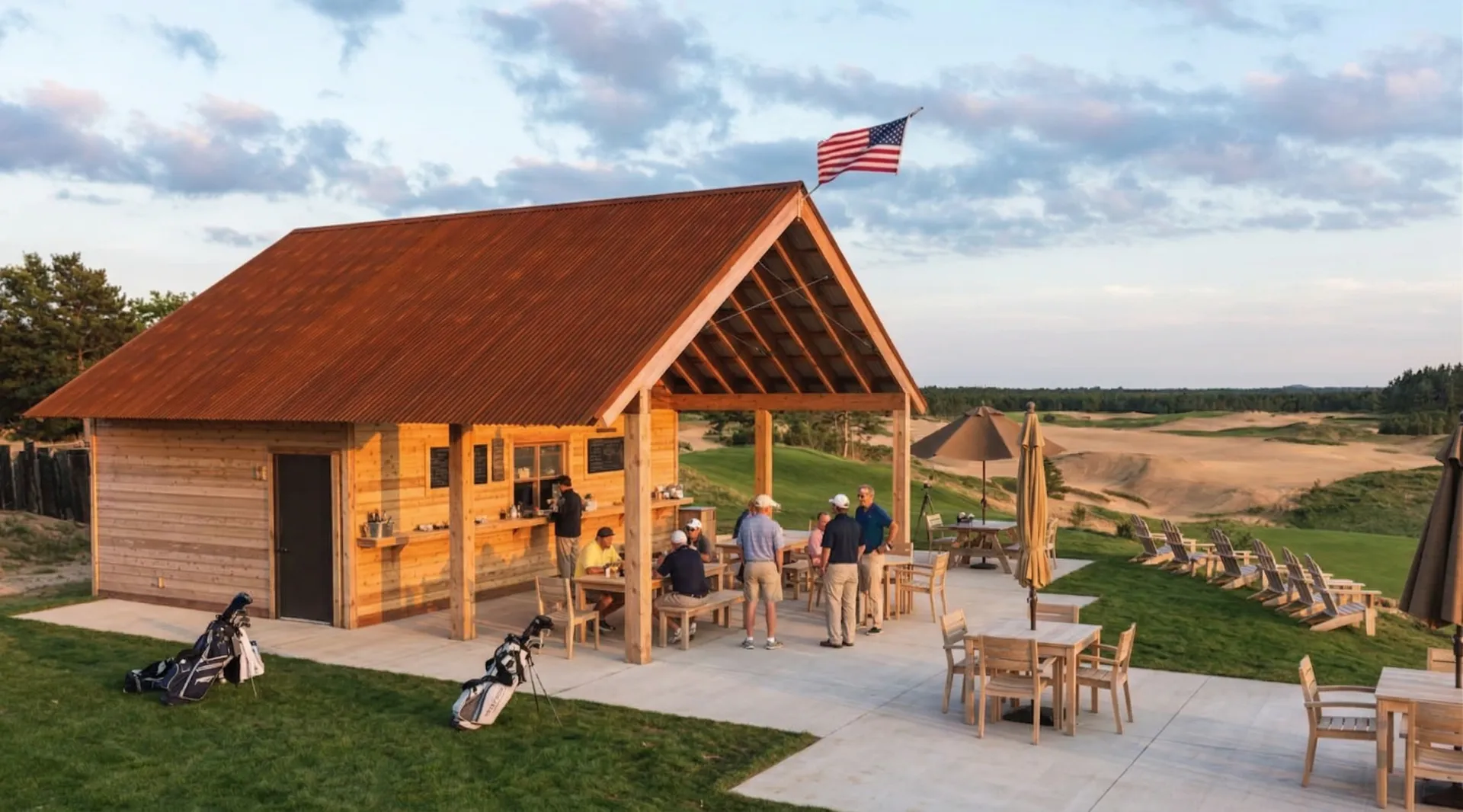
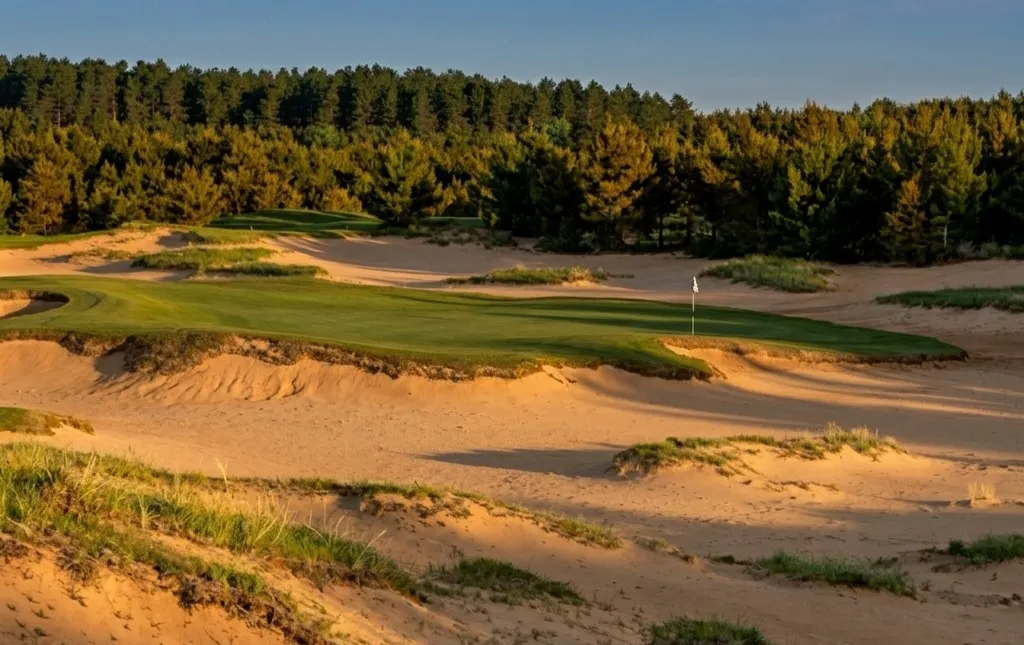
The routing follows a returning-nines design, beginning and ending at the high point of Craig’s Porch, the resort’s food hub named for the man who discovered the property. From that vantage, the course fans out through a landscape of exposed sand dunes, native black oaks, and scrub-lined waste areas that feel entirely unmanufactured. The scale is enormous. Waste bunkers stretch for hundreds of yards. Fairways roll across terrain that has been sculpting itself since the Pleistocene.
Coore and Crenshaw seeded the course with a fescue mix that delivers firm, fast, links-style conditions despite being three hundred miles from the nearest coastline. The tight lies demand crisp contact. High-trajectory approaches that work at most American courses bounce through these greens and into sandy collection areas. The ground game is the native language here: bump-and-runs, low runners, the occasional Texas wedge from the fringe. Players who adapt to the surface score. Players who insist on aerial target golf spend the afternoon watching approaches roll thirty yards past the green.
The greens themselves are massive and severely contoured, averaging well over 8,000 square feet. Coore and Crenshaw designed them with bold false fronts, dramatic internal waves, and steep runoff areas that punish anything less than precise distance control. The firmness makes them highly rejective. An approach that lands three yards short of a front pin can roll back down the fairway and leave a fifty-yard pitch. The comparison to Pinehurst No. 2’s crowned surfaces is not accidental; it is structural.
The 4th (par 5, 557 yards from the Orange tees) is the longest hole on the course and plays entirely uphill, a fact the yardage barely communicates. The fairway tightens dramatically around 215 yards from the green, forcing a critical decision on the second shot: lay up into the tight neck for a better angle, or challenge the scrub for position to reach in two. The green has sharp, repelling edges that shed anything arriving without sufficient commitment. Reaching this green in regulation from anywhere feels like a minor triumph.
The 8th (par 3, 115 yards from the Orange tees) is 115 yards of pure misdirection. Heavily inspired by the 11th at Shinnecock Hills, it demands precision over power with nothing more than a wedge. The green is forty-two yards long but roughly half as wide, and back hole locations are entirely blind from the tee because of the dramatic uphill pitch. Miss slightly left and deep bunkers intervene. Miss slightly right and the ball tumbles down a steep drop-off into sand. Bill Coore explained the philosophy at the resort’s media day: “On a short par three, everyone has the opportunity to beat even the best player in the world.” That sounds generous until the wind shifts and the pin tucks behind the ridge.
The 17th (par 3, 215 yards from the Orange tees) deploys a classic punchbowl green at the worst possible moment. The hole plays long enough to require a fairway wood or long iron, and the massive gathering contours act as both defense and assistance. Players who find the bowl watch the slopes feed their ball toward the hole. Players who miss it entirely face a blind pitch back into a green they cannot see. The smart play is to aim away from the flag and let the contours do the work, a strategy that requires the specific discipline of ignoring the pin with a long iron in hand on the 17th hole of the round. Most golfers cannot manage it.
The course is walking only. Carts are prohibited; the sole exception requires a doctor’s note, and even then the caddie drives. Traversing six miles of soft sand, steep dune climbs, and the relentless uphill march to the 18th green is genuinely exhausting. Hiring a caddie is optional but strongly recommended. The resort maintains a program of over 250 caddies whose knowledge of blind shots, green contours, and club selection adjustments is worth considerably more than the $100 bag fee.
Planning the Trip
| Item | Cost |
|---|---|
| Peak green fee (late May–early Oct) | $325 |
| Shoulder green fee (late Apr–mid May, mid-Oct) | $235 |
| Replay round, peak | $165 |
| Replay round, shoulder | $115 |
| Bag caddie (per bag; cash to caddie) | $100 |
| Forecaddie (per person, foursome) | $40 |
| Club rental (per day) | $60 |
Standard caddie gratuity runs $50 or more, bringing the fully loaded caddie cost to $150 in cash per round. Request caddies before arrival; your assigned caddie typically stays with your group for the entire trip across all courses, building the kind of rapport that turns local knowledge into saved strokes. Carry bags under 25 pounds are required.
Sand Valley operates on a stay-and-play model. Overnight guests have distinct booking priority, and prime summer tee times sell out 12 to 18 months in advance. Securing a trip requires immediate action and calendar flexibility. Morning tee times before 8 a.m. are designated speed slots requiring rounds under four hours. Cancellations during peak season require 45 days’ notice or the full deposit is forfeited.
When to Go
| Window | Why |
|---|---|
| Nov–Mar ❄️ Avoid | Course closed; Wisconsin winter in full effect |
| Apr 🌤️ Good | Late-month opening, shoulder rates, high frost risk; bring layers |
| May 🌤️ Good | Spring rates through mid-month; weather can swing from 40s to 70s |
| Jun–Aug ☀️ Prime | Warmest months, longest days, peak conditions; afternoon storms possible |
| Sep ☀️ Prime | Crisp mornings, warm afternoons, ideal heathland weather |
| Oct 🌤️ Good | Spectacular fall color, but frost delays are common; season closes mid-month |
The 2026 U.S. Mid-Amateur (September 26–October 1) will affect availability during that window.
Central Wisconsin Airport (CWA) is a 45-minute drive and the closest commercial option, served by American and Delta, with United resuming service in May 2026. Dane County Regional in Madison (MSN) sits 90 minutes away with broader connections. Milwaukee Mitchell International (MKE) offers the widest flight selection at 2.5 hours. A rental car is essential from any airport.
The three sibling championship courses at the resort turn a round into a pilgrimage. Mammoth Dunes (David McLay Kidd) plays wider and more forgiving, built for pure fun and playability. Sedge Valley (Tom Doak) is an intimate, sub-6,000-yard par-68 inspired by English heathland courses. The Lido (Tom Doak, recreating C.B. Macdonald’s lost masterpiece) is the most talked-about course in American golf. The Sandbox, Coore and Crenshaw’s 17-hole par-3 course, is the perfect way to settle a bet before dinner at Craig’s Porch, where the $1 tacos remain the best value in destination golf.
Why the Pines Had to Come Down
Keiser assembled the most significant collection of inland destination courses in the world. Sand Valley is the one that started it, the course that validated the gamble and proved that remote, landlocked sand could compete with anything on the coast.
The pines were never supposed to be there. They were a commercial crop planted decades ago on land that nature had spent millennia sculpting into something far more interesting. Coore and Crenshaw finished what the glaciers started. The result is a course that feels as if it has existed for centuries, plays differently every time the wind shifts, and asks a question the rest of the resort has spent a decade answering: what else is hiding under these trees?