Most golf architects defend par. David McLay Kidd decided that was the wrong fight.
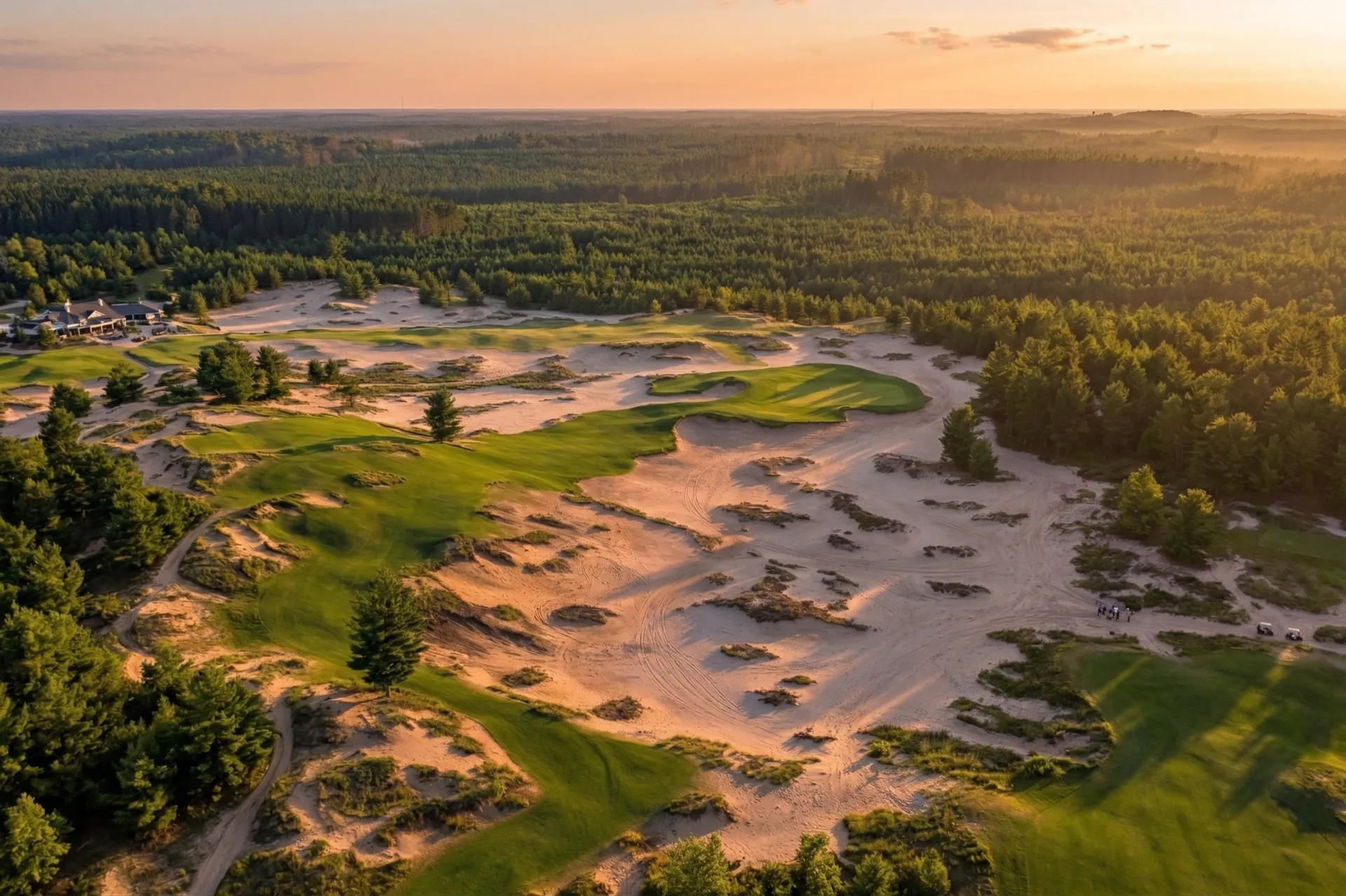
His mandate at Sand Valley Resort was to defend birdie instead, and the weapon he chose was scale. Mammoth Dunes opened in 2018 with fairways stretching up to 120 yards wide across 108 acres of maintained turf in the sandy barrens of central Wisconsin. That is roughly three times the acreage of a standard American course. Twelve of eighteen greens funnel approach shots toward the hole like bowling gutters running in reverse. Golfers routinely post career-low scores here. The course does not care about the tee shot until the ball reaches the putting surface, at which point 10,000 square feet of undulating bentgrass asks what, exactly, the golfer plans to do about it.
The project was also a redemption story. Two decades earlier, Kidd had launched the destination-golf revolution with Bandon Dunes (1999), Mike Keiser’s first resort course on the Oregon coast. He then spent fifteen years designing layouts so punishing that Keiser stopped commissioning him. A philosophical reset at Gamble Sands in Washington earned Kidd a second chance: he beat Tom Doak, Rod Whitman, and Dave Axland in a formal “Bake-Off” to design Sand Valley’s second championship course, routing eighteen holes around a V-shaped sand ridge that rises eighty feet above the surrounding terrain. Golfweek has ranked Mammoth Dunes as high as No. 17 among public courses you can play. It is the only top-100 course in the country where losing a golf ball is essentially impossible.
Where Width Becomes the Argument
The opening hole at Mammoth Dunes provides a fairway roughly 100 yards wide. The temptation is to relax. The correct response is to recognize that Kidd’s width does not remove strategy; it relocates it. The right side of that massive landing zone leaves a cleaner angle to an elevated green. The left side adds length and obstruction. Mammoth Dunes introduces its bargain on the first swing: take whatever line off the tee, but understand that angles still matter on arrival.
The 14th (par 4, 297 yards from the Orange tees, 325 from the Black) exists because a graphic designer named Brian Silvernail won a Golf Digest “Armchair Architect” contest in 2016 by sketching a drivable par-4 onto a topographic map of the Sand Valley property. Kidd’s team built it nearly as drawn. From an elevated tee, the hole tumbles downhill and left through a corridor of sand and fescue. A speed slot on the right side feeds aggressive drives onto a Redan-style green. Laying up to the left plateau leaves a simple pitch. Going for the green leaves an eagle putt or a sandy lie beside a bunker that probably deserved more respect. Either outcome is entertaining.
The 8th (par 3, 175 yards from the Orange tees, 198 from the Black) puts a 6,000-square-foot green on an island of turf surrounded entirely by sand. From the back tees, the carry is genuine and the depth perception intentionally deceptive. From the forward tees, the angle shifts dramatically left, opening a kicker slope that accepts a low runner and feeds it onto the putting surface. The visual is arresting: a green hovering in a sea of exposed sand against a backdrop of towering dunes and Central Wisconsin sky.
The 13th (par 3, 126 yards from the Orange tees, 130 from the Black) is the shortest and strangest hole on the course. A narrow green perches above a sandy chasm, and club selection can vary by four clubs depending on pin position. The routing crosses the spine of the property’s massive sand ridge here, offering a panoramic view of the terrain that contextualizes everything played and everything remaining. It is a moment of geographic orientation disguised as a golf hole.
The routing navigates the V-shaped ridge with a logic that feels inevitable rather than designed. The front nine works inside the dune line, climbing to the par-3 4th with its severe right falloff. The middle holes swing across the exterior. The 13th crosses back through the chasm. The result is constant elevation change without forced transitions, a seven-mile walk through terrain that reveals something new on nearly every tee box.
Fescue fairways play firm and fast, rewarding a ground game that many visiting golfers forgot they had. Wind across the exposed sand barrens is constant and formidable, demanding low, piercing trajectories. The massive bentgrass greens are smooth and receptive, but their sheer acreage creates a paradox: hitting the green in regulation is easy, two-putting from seventy feet across severe undulation is not. Mammoth Dunes finds its difficulty on the putting surface, and players who lag putt well post numbers that players with better swings cannot match.
The honest drawback for purists: the extreme width off the tee removes driving accuracy as a meaningful variable. A scratch player and a 20-handicapper land side by side in the same fairway. The separation comes on approaches and, most of all, on the greens, where the 18th’s half-acre putting surface puts an exclamation point on the course’s thesis. But the width serves another purpose the critics miss. It produces psychological liberation. Kidd described the effect himself: players hit better than usual because wide fairways build confidence, and confidence produces better swings. It is the rare course where the 15-handicapper and the single-digit player both walk off convinced they just played the round of their lives.
Planning the Trip
Green fees scale with the season.
| Item | Cost |
|---|---|
| Green fee, peak (late May–early Oct) | $295 |
| Green fee, shoulder (late Apr–late May / mid-Oct) | $220 |
| Club rental (per day) | $60 |
| Caddie per bag (base fee, cash) | $100 |
| Standard caddie gratuity | $40–$60+ |
Walking only. No carts, no exceptions. Caddies are recommended but not required (unlike The Lido, where they are mandatory). Request caddies at least a week in advance through [email protected]. “Caddie Cash” can be withdrawn at the golf shop and charged to a guest room for players who arrive without physical cash.
When to Go
| Window | Why |
|---|---|
| Nov–Mar ❄️ Avoid | Course closed; snow cover and freezing temperatures |
| Apr 🌤️ Good | Shoulder rates, dormant turf waking up, cool and breezy |
| May ☀️ Prime | Spring conditions, fair weather; rates shift to peak late in the month |
| Jun–Aug ☀️ Prime | Peak season; firm fairways, long daylight, best turf conditions |
| Sep ☀️ Prime | Ideal walking temperatures, clear skies, less humidity |
| Oct 🌤️ Good | Shoulder rates return mid-month, fall color, cooling temps |
Bug spray is essential in June and July. The native Wisconsin sand barrens produce gnats and mosquitoes with genuine enthusiasm.
Resort guests who book on-property lodging gain early access to tee sheets, and peak-season rooms sell out a year or more in advance. Day guests can book remaining tee times, but inventory is limited and generally appears only a few weeks before play. If the resort is full, off-property lodging at The Lodges of the Lakes (10 minutes) provides a base; monitor the Sand Valley online portal for day-guest releases.
Four other courses share the property: Sand Valley (Coore & Crenshaw), The Lido (Doak, a recreation of C.B. Macdonald’s lost 1917 masterpiece), Sedge Valley (Doak, compact par-68), and The Sandbox (Coore & Crenshaw, 17-hole par-3 at $65). Most visitors recommend budgeting at least three full days of golf to experience the property properly.
Central Wisconsin Airport (CWA) in Mosinee is the closest hub at roughly 50 minutes. Dane County Regional (MSN) in Madison is 1 hour 45 minutes south. Milwaukee (MKE) is 2.5 hours; Chicago O’Hare (ORD) is nearly 4. A rental car is essential. The resort sits at the end of rural highways through the pine-and-sand terrain of Adams and Wood counties, as remote as American destination golf gets outside of Bandon.
The walk itself is worth acknowledging. Seven miles over undulating sand dunes in an exposed landscape with no tree cover is physically demanding, particularly in July heat. Proper hydration, sunscreen, and walking-ready footwear are not optional.
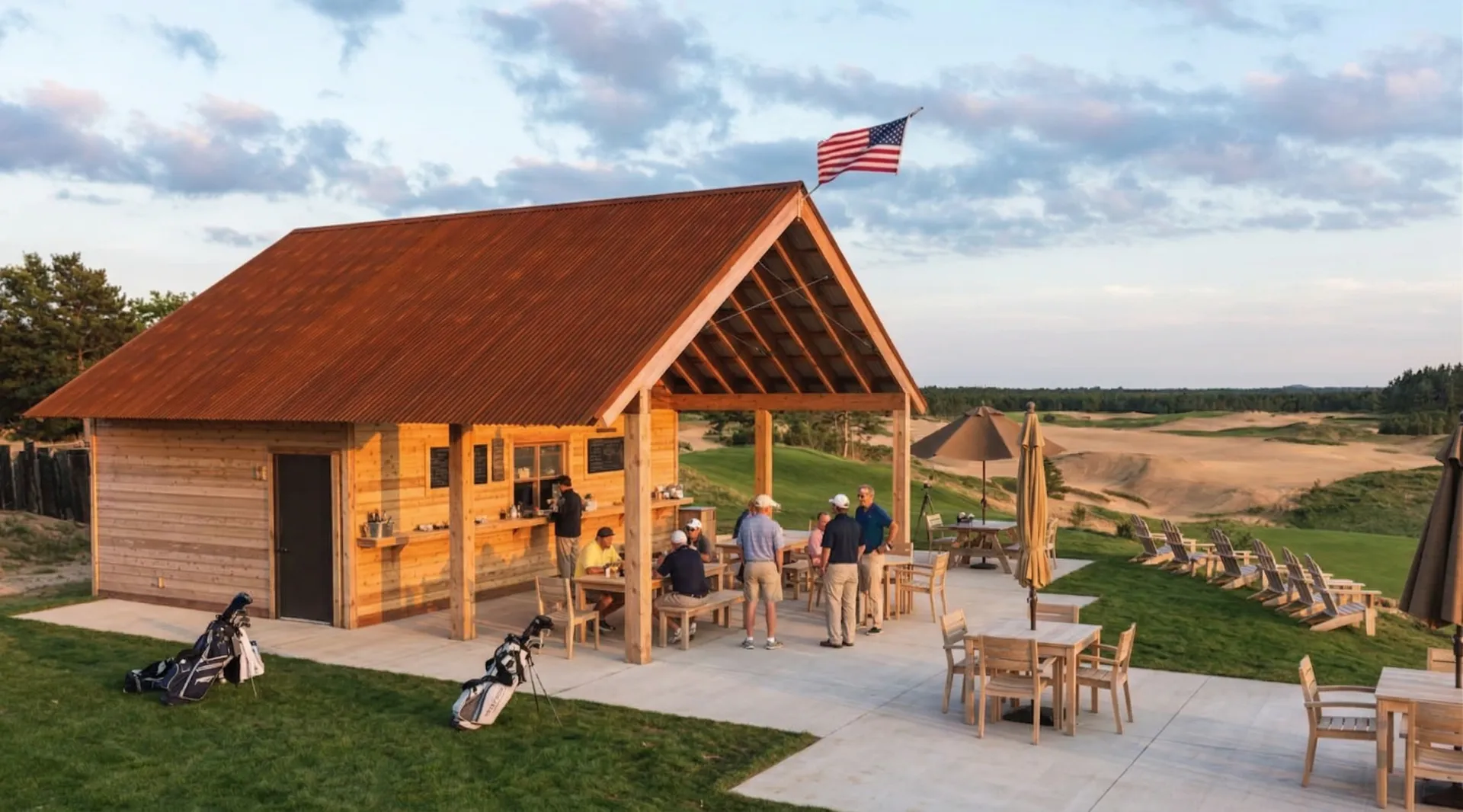
Post-round options run from Craig’s Porch ($1 tacos and sunset views from Adirondack chairs) to the Mammoth Bar (Wisconsin Old Fashioneds, cheese curds, the mandatory Spotted Cow) to Aldo’s Farm & Table for elevated Midwestern dining overlooking the 1st and 18th fairways.
Why the Width Was Always the Point
The architectural establishment spent decades designing courses that punished the average golfer off the tee. Kidd’s insight was that the punishment was the problem, not the solution. Width does not remove difficulty. It moves difficulty from the tee to the green, from the driver to the putter, from the shot that starts the hole to the shot that finishes it. That relocation makes golf more fun for the player who shoots 95 and more interesting for the player who shoots 72.
In the sandy barrens of central Wisconsin, a course with 120-yard fairways and half-acre greens is quietly proving that the profession’s foundational assumption was wrong. The fairways invite the swing. The greens deliver the verdict. Book the lodging first; everything else follows.