
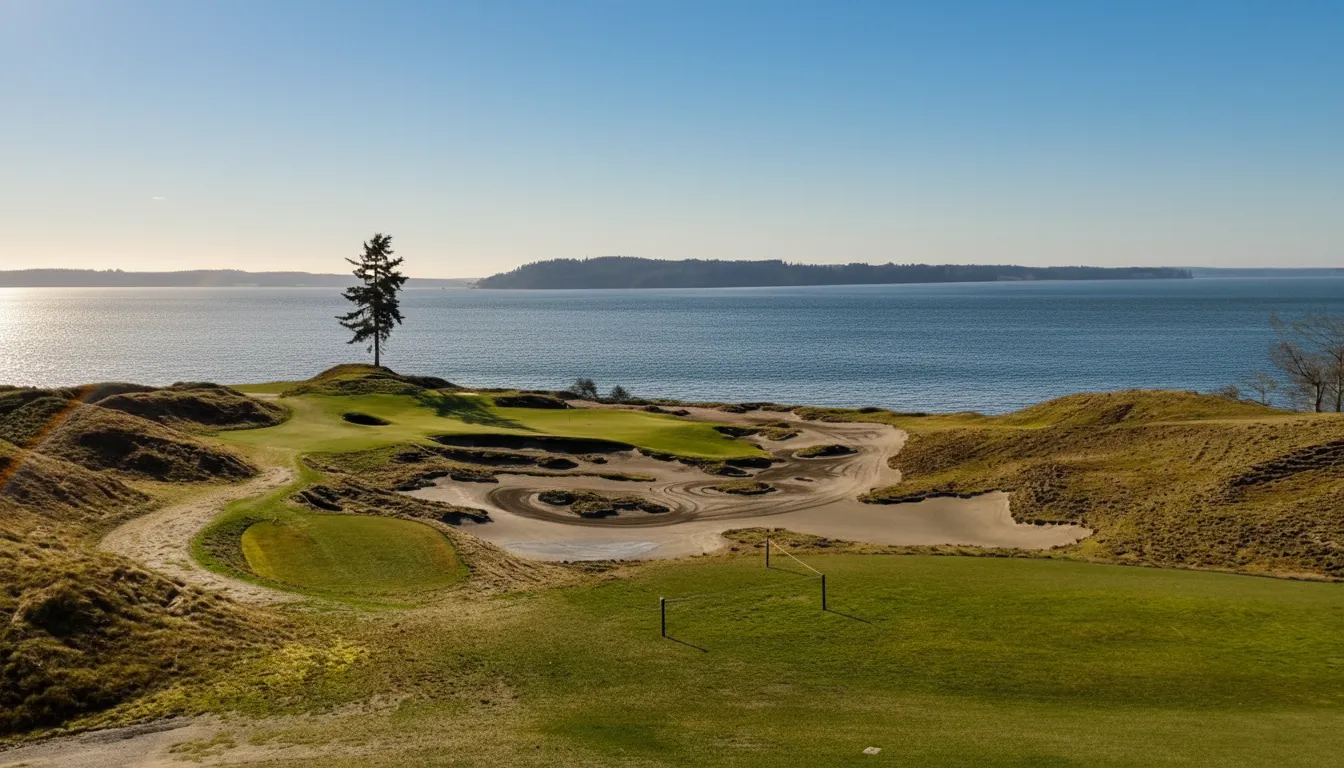
Chambers Bay hosted the 2015 U.S. Open. Jordan Spieth won. Dustin Johnson three-putted from twelve feet on the 72nd hole to hand him the championship. The greens were criticized as bumpy, inconsistent, and borderline unfair. Television ratings were excellent. The reviews were mixed. The course became famous for reasons both right and wrong.
None of that controversy changes what Chambers Bay actually is: the most ambitious attempt at links golf ever built on American public land.
The course sits on a former sand and gravel mine along Puget Sound, thirty miles south of Seattle. The terrain—massive dunes, dramatic elevation changes, views across the water toward the Olympic Mountains—resembles British links more closely than almost anywhere in America. Robert Trent Jones Jr. designed a course that embraces this character fully: wide fairways, firm conditions, minimal rough, strategic bunkering, and greens that run fast and punish poor approach angles.
The result is a municipal golf course that plays like Scotland. It’s also a course that exposes golfers accustomed to American target golf. Chambers Bay doesn’t care how far you hit it. It cares whether you can think, adapt, and execute shots that stay low when wind demands and run out when firmness allows. For golfers willing to learn what it teaches, Chambers Bay offers experiences unavailable almost anywhere else at public rates.
From Gravel Pit to Golf Course
Pierce County owned the land. A gravel mining operation had excavated millions of cubic yards of material over decades, leaving behind a moonscape of ridges, valleys, and exposed sand. The mining closed in the 1990s. The county faced choices about reclamation—what to do with a massive hole in the ground that overlooked some of Washington’s finest waterfront.
Someone suggested golf. The terrain, once examined properly, looked like Scottish linksland. The sandy substrate would drain perfectly. The Puget Sound proximity created wind patterns similar to coastal British Isles courses. The elevation changes—created by mining rather than geology—offered dramatic vistas and strategic possibilities.
Robert Trent Jones Jr. took the commission and designed a course that honored the land’s character rather than fighting it. The routing follows natural contours of the mining-altered terrain. The greens sit on platforms and in bowls that excavation created. The fescue grasses—unusual for American courses—thrive in the Pacific Northwest climate and create the firm, fast conditions that links golf requires.
The course opened in 2007. Within two years, it had been selected to host the 2015 U.S. Open—an unprecedented honor for a municipal facility less than a decade old. The decision reflected confidence in what Chambers Bay represented: proof that world-class links golf could exist on public American land.
The path from gravel pit to U.S. Open venue took less than twenty years. That transformation speaks to vision that recognized potential where others saw industrial waste.
What Links Golf Actually Means
Chambers Bay plays like links golf. That sentence requires explanation for golfers who’ve never experienced the real thing.
Links golf originated on the sandy, wind-swept terrain along British coastlines. The ground drains instantly, stays firm year-round, and produces unpredictable bounces that reward creativity over power. The wind changes constantly, affecting club selection and shot shape on every hole. The lack of trees means exposure to elements that inland courses avoid.
American golf developed differently. Irrigation created soft, receptive conditions. Trees lined fairways, protecting players from wind while demanding target-golf accuracy. Courses rewarded aerial attack—high, spinning shots that land and stop. The ground game that defines links golf became unnecessary.
Chambers Bay rejects all of that. The fescue fairways stay firm. Shots bounce and roll unpredictably unless played low. Wind off Puget Sound requires constant adjustment. The wide fairways that seem forgiving from the tee reveal their challenge on approach—proper angles matter more than brute accuracy.
The course measures 7,585 yards from the back tees but plays differently depending on conditions. Calm summer mornings allow aggressive play. Afternoon wind can add ten strokes to scores. The same hole that yielded birdie in morning can become survival test by sunset. This variability frustrates golfers expecting consistency and rewards those who embrace adaptation.
Chambers Bay teaches shots that most American courses don’t require. The bump-and-run approach. The low punch into wind. The running draw that uses fairway contour to reach tucked pins. Golfers who arrive with only high-trajectory options struggle. Golfers who expand their repertoire find rewards unavailable elsewhere.
The Holes That Define It
Chambers Bay’s routing spirals through the property, descending toward Puget Sound before climbing back to the clubhouse. Every hole offers views across the water toward the Olympic Mountains. The visual drama is constant and unrelenting.
The 1st hole plays 595 yards, downhill, toward the Sound. It’s a par-5 that reachable in two for longer hitters but demands precision on both shots. The green sits in a natural bowl, visible from the tee, beckoning aggressive play while punishing slight miscalculation.
The 8th hole—a 518-yard par-4 that played as par-5 during the U.S. Open—runs along the water’s edge with bunkers guarding the entire right side. The approach must carry proper distance while accounting for wind and firmness. It’s the kind of hole that reveals Chambers Bay’s true character: visually stunning and strategically demanding.
The 9th presents a 229-yard par-3 that drops to a green surrounded by massive bunkers. The shot plays directly toward Puget Sound, with the Olympic Mountains framing the backdrop. During calm conditions, it’s a mid-iron to a generous green. During wind, it becomes survival test.
The 15th and 16th—par-3s playing in opposite directions—create a stretch where wind calculations change completely between consecutive holes. What works on 15 fails on 16. The variety demands mental adjustment that adds strokes to scores of golfers who can’t adapt.
The 18th climbs 562 yards back toward the clubhouse, with the lone tree on the course—a massive fir that somehow survived mining operations—standing sentinel near the green. It’s a finishing hole that demands two quality shots followed by a putt on greens that run faster than most Americans experience.
The 2015 U.S. Open: What It Proved and What It Didn’t
The championship produced drama. Spieth completed the first two legs of a potential Grand Slam. Johnson’s three-putt collapse became instantly iconic. The course challenged the world’s best players in ways few venues manage.
The championship also produced controversy. The poa annua greens—which develop bumpy surfaces as the day warms—drew criticism from players and viewers. Some putts bounced offline despite good strokes. The course’s maintenance practices became subjects of debate. Television cameras captured frustration that reinforced perceptions of unfairness.
What the controversy obscured was what the championship actually demonstrated: that a municipal course could host major championship golf. That links conditions could be created outside the British Isles. That public golfers could experience terrain and challenge previously reserved for private club members or overseas travelers.
The U.S. Open hasn’t returned to Chambers Bay. The controversy lingers. But the course itself continues operating, offering the same terrain and challenge to anyone who pays the modest green fee. The experience that caused professional complaints remains available to amateur golfers willing to embrace rather than fight what Chambers Bay offers.
The greens have improved since 2015. Ongoing investment in maintenance has addressed some of the issues that plagued the championship. The course plays better now than it did during the U.S. Open—a statement that sounds like criticism but actually reflects continuous improvement.
What Public Golfers Can Access
Chambers Bay operates as a municipal golf course. Pierce County owns the property. Green fees—while not cheap—remain accessible compared to resort alternatives. Tee times can be booked online. Walking is encouraged and caddies are available. The experience that seemed impossible on public land is available to anyone who can reach University Place, Washington.
This accessibility matters. Most top-ranked courses in America are intensely private. Playing Augusta National, Pine Valley, or Cypress Point requires connections that most golfers will never develop. Playing Chambers Bay requires a credit card and a plane ticket.
The course rewards preparation. Understanding how links golf differs from American target golf helps tremendously. Practicing low-trajectory shots, bump-and-run approaches, and wind-management strategies prevents frustration. Arriving with only high-ball-flight techniques leads to scores that don’t reflect actual ability.
Walking is the proper way to experience Chambers Bay. The elevation changes create cardio demand, but the terrain rewards on-foot exploration that carts eliminate. Caddies add local knowledge that transforms first visits into something approaching familiarity. The investment in walking enhances rather than complicates the experience.
The lodge overlooking the 18th green provides dining and event facilities without pretending to resort luxury. The focus remains golf—specifically, links golf of a quality rarely available to public players anywhere in America.
The Experiment That Continues
Chambers Bay represents an experiment in what American public golf can become. The experiment produced controversy during the U.S. Open and continues producing debate about whether links conditions belong on American soil.
The answer, increasingly, seems affirmative. Bandon Dunes proved that links golf could succeed commercially in America. Sand Hills proved it could achieve critical acclaim. Streamsong proved it could work in unexpected locations. Chambers Bay proved it could exist on public land at accessible prices.
Each course expanded understanding of what’s possible. Each faced skepticism and criticism. Each ultimately demonstrated that golfers hungry for authentic experience would travel and pay for quality regardless of convention.
Chambers Bay’s contribution to this evolution matters specifically because of its accessibility. Private clubs can maintain whatever conditions their members prefer. Resort courses can charge whatever the market bears. Municipal courses face different constraints—tighter budgets, broader constituencies, less tolerance for exclusivity.
That a municipal course could achieve world-class links conditions, host a U.S. Open, and continue operating for public play demonstrates something significant about American golf’s potential. The experiment isn’t complete. Chambers Bay continues evolving, improving, and offering experiences that serious golfers travel specifically to access.
What Chambers Bay Teaches
Playing Chambers Bay for the first time humbles golfers who’ve mastered American target golf. The shots that work everywhere else—high, spinning approaches that land and stop—fail here. The course demands different skills, different thinking, different relationship between ball and ground.
This humbling has value. It reveals how limited most American golf experience actually is. It demonstrates that the game has dimensions that typical courses don’t explore. It creates appetite for links golf that can be satisfied at Bandon, at British Open venues, at courses worldwide that reward ground-game creativity.
Chambers Bay also teaches that controversy doesn’t define reality. The U.S. Open criticism focused on greens and preparation. The course itself—the terrain, the routing, the strategic demands—remains remarkable regardless of what happened in 2015. Golfers who dismiss Chambers Bay based on televised complaints miss something worth experiencing.
The course teaches that mining scars can become golf land. That municipal courses can achieve quality. That links conditions can exist in the Pacific Northwest. That American golf can embrace rather than resist the ground game that defines the sport’s origins.
These lessons matter beyond any single round or any single championship. They matter because they expand understanding of what golf can be—and where. Chambers Bay exists on a former gravel pit overlooking Puget Sound, offering links golf to anyone who books a tee time. That sentence still sounds impossible. The course proves it isn’t.