
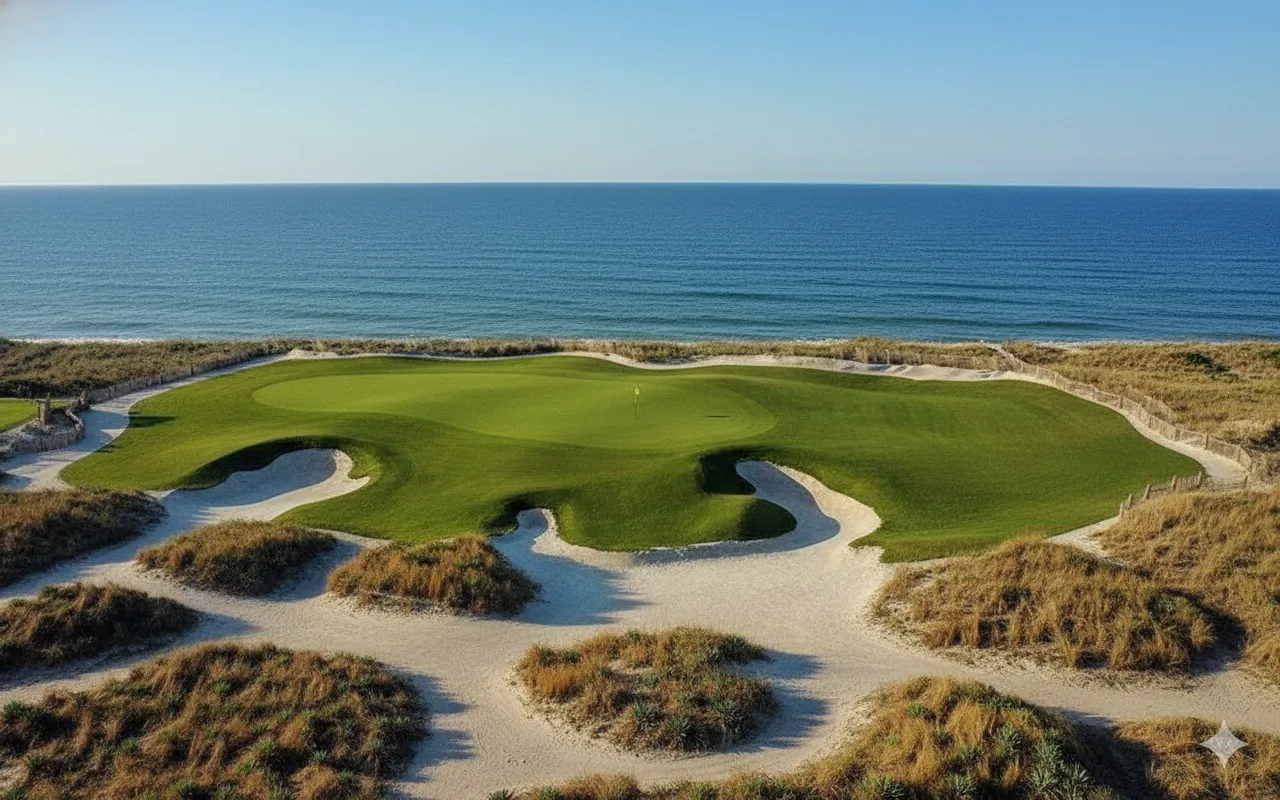
Pete Dye walked two miles of South Carolina coastline in 1989 with instructions to build something extraordinary in eighteen months. Kiawah Development wanted a Ryder Cup venue. The PGA of America needed a course ready by September 1991. Dye had sand dunes, ocean views, and impossible timeline.
He built the Ocean Course—seven holes directly along the Atlantic, ten others within sight of water, and strategic brutality that’s defined championship golf for thirty-four years. When the 1991 Ryder Cup arrived, the course produced the most dramatic finish in competition history: America defeating Europe 14½-13½ on Bernhard Langer’s missed six-foot putt on the 72nd hole.
They called it the “War by the Shore.” The name stuck because the golf was genuinely combative—grinding, physical, mentally exhausting competition on a course designed to test every skill and punish every mistake. Kiawah became permanently associated with that September weekend when golf felt like actual warfare played with wedges instead of weapons.
The course remains brutal. It’s the hardest course on the PGA Tour by stroke average—pros average over 75 from tournament tees. From the back tees it plays 7,876 yards, all of it exposed to wind that blows constantly off the Atlantic. There are easier courses on bucket lists. There are prettier courses in South Carolina. But there’s no course that tests championship golf more thoroughly than Kiawah’s Ocean Course.
What Dye Built
Pete Dye specialized in controversy. His courses were intentionally difficult, visually intimidating, and strategically unforgiving. TPC Sawgrass introduced the island green. Harbour Town demonstrated that short, tight courses could challenge professionals. The Golf Club pioneered minimalist architecture emphasizing natural contours.
Kiawah represented different challenge: building tournament-caliber course on raw coastal land in eighteen months. The timeline was insane—most quality courses require 2-3 years minimum. Dye had to route holes, construct greens, establish turf, and create something worthy of hosting Ryder Cup—golf’s highest-pressure team competition—before grass fully matured.
He succeeded by maximizing natural assets while creating manufactured difficulty where terrain was too benign. The oceanfront holes needed minimal intervention—wind, sand, water, and dunes provided challenge naturally. Inland holes required Dye’s signature features: deep pot bunkers, railroad ties, severe green contours, and visual intimidation that made shots look harder than they were.
The routing runs parallel to ocean for most of the front nine before turning inland briefly and then returning oceanside for a dramatic closing stretch. Holes 14-18 play directly into or along the Atlantic, creating theater that’s visually spectacular and strategically unforgiving.
Hole 2 (543 yards, par 5): The first hole directly along ocean, tempting long hitters to go for green in two despite bunkers, dunes, and wind. The lay-up requires precision—too far left finds bunkers, too far right finds dunes. This establishes pattern: Kiawah rewards calculated aggression and punishes careless play.
Hole 7 (206 yards, par 3): Long par-3 playing directly along ocean with water right and bunkers left. Wind determines everything—downwind it’s 6-iron, into wind it’s hybrid or 4-iron. The green is narrow and firm. There’s no safe bailout. This is golf’s version of threading a needle while wind gusts unpredictably.
Hole 13 (404 yards, par 4): The hardest hole on the course. Drives must find narrow fairway between bunkers. Approaches play to elevated green protected by deep bunkers and false fronts. Into the wind, this plays like 450-yard par-4. Tour players average over 4.5 strokes here. It’s not pretty or theatrical—just brutally difficult golf.
Hole 17 (197 yards, par 3): The signature hole and most recognizable image of Kiawah. Long par-3 playing directly along ocean with green surrounded by bunkers and water immediately right. Distance control is critical—long finds trouble, short finds bunkers, right finds Atlantic. When wind howls, this hole becomes survival exercise rather than scoring opportunity.
Hole 18 (439 yards, par 4): The hole where Langer missed his putt, where the 1991 Ryder Cup ended, where the War by the Shore reached conclusion. Long par-4 hugging ocean right, demanding drive that avoids both ocean and fairway bunkers left. Approach plays to green with water right and bunkers everywhere else. This is closing hole designed for drama—difficult enough to produce decisive results, scenic enough to provide memorable theater.
What Dye created isn’t subtle. The Ocean Course announces its difficulty immediately and never apologizes. Bunkers are deep and penal. Greens are firm and contoured. Wind affects every shot. Water threatens constantly. This isn’t strategic golf requiring nuanced decision-making—it’s attritional golf requiring sustained excellence across 72 holes.
The War by the Shore
The 1991 Ryder Cup remains golf’s most intense competition. America hadn’t won since 1983. Europe had dominated through the 1980s. The Americans were desperate. The Europeans were confident. Both teams arrived at Kiawah knowing the matches would be brutal.
The course magnified pressure. Wind gusted to 30 mph. Scoring was difficult for best players in the world. Physical and mental exhaustion accumulated over three days of grinding golf in harsh conditions. By Sunday singles, both teams were spent.
The drama peaked with final match: Bernhard Langer versus Hale Irwin. Europe needed Langer to win or halve his match to retain the Cup. Langer reached the 18th green needing to make six-foot putt for par to halve the match and give Europe a 14-14 tie.
He missed left. America won 14½-13½—the closest Ryder Cup result ever recorded at that time.
The television images are iconic: Langer crouched behind the ball, examining the line for what felt like minutes. The stroke that slid past the hole. Americans erupting in celebration while Langer stood motionless. That putt, that hole, that course became permanently linked in golf history.
The 1991 matches earned the “War by the Shore” nickname because competition was genuinely hostile. Players argued over conceded putts. Gallery behavior was aggressive. European players complained about American crowd partisanship. Seve Ballesteros and Paul Azinger nearly fought on multiple occasions. Tensions that normally stay submerged surfaced publicly.
Kiawah amplified everything. The course was so difficult that players were exhausted physically and mentally. Wind made golf feel like survival rather than sport. The matches were so close that every shot, every putt, every decision mattered absolutely. This created pressure-cooker environment where normal competitive tension became something more intense.
The course proved it could produce championship drama. Since 1991, Kiawah has hosted the 2012 PGA Championship (won by Rory McIlroy) and the 2021 PGA Championship (won by Phil Mickelson). Both championships featured difficult scoring, ocean-wind drama, and finishes determined by who handled conditions best rather than who played most brilliantly.
Playing the Ocean Course
Kiawah Ocean Course is resort course, meaning you can play it if you’re willing to pay premium green fees and travel to South Carolina’s barrier islands. Access is easier than Pine Valley or Augusta National. Cost is higher than your local muni.
Difficulty reality: From resort tees (6,500-6,800 yards), the course is difficult but playable for good golfers. The wind matters more than length. On calm days, the Ocean Course is challenging. When wind blows—which is most days—it’s brutal. Three-club wind swings are normal. Four-club winds happen. Plan for grinding rather than scoring.
Caddie recommendation: Take a caddie. The course is walkable—relatively flat despite dunes—but having someone who knows wind effects, proper angles, and which trouble is real versus visual intimidation saves strokes. Caddies at Kiawah know the Ocean Course intimately and provide value proportional to their fee.
Tee selection: Play from tees matching your driving distance and ball-striking ability. The Ocean Course from 7,300+ yards is masochistic unless you’re scratch or better. From 6,500-6,800 yards it’s tough but fair. From 6,000 yards it’s manageable for higher handicaps on decent ball-striking days.
Wind strategy: Accept that wind changes everything. The club that’s right on one hole will be wrong by two clubs on the next hole playing opposite direction. Don’t fight wind—work with it, accept low runners, and recognize that pars are good scores when wind peaks.
Conditioning expectations: The course maintains championship conditioning—firm, fast greens and tight fairways. This isn’t soft resort golf where everything holds. Balls bounce and roll. Greens are slick. Short game and distance control matter more than power.
When to play: Fall and spring offer best conditions—less heat, more reasonable wind, better rates. Summer is hot and crowded. Winter is uncrowded but potentially cold and windy. The course is excellent year-round, but playing conditions vary significantly by season.
What Makes It Significant
Kiawah Ocean Course represents specific achievement in American course design: creating championship venue that’s also accessible public facility. Most tournament courses are private or semi-private. Kiawah demonstrates that resort model—high-end public access with premium pricing—can sustain championship-caliber conditioning and design.
The course influenced how modern championship venues are conceived. Before Kiawah, most major championships occurred at established private clubs with restricted access. After Kiawah’s success hosting multiple majors and Ryder Cup, the model shifted—courses like Whistling Straits, Chambers Bay, and Erin Hills were built as public-access championship venues.
This democratization of championship golf matters. It means that courses hosting majors aren’t exclusively available to members who can afford six-figure initiation fees. Any golfer willing to pay premium green fees can play the same courses where majors are contested. This increases golf’s accessibility and removes some of the sport’s exclusivity barriers.
Architecturally, Kiawah demonstrated that Pete Dye’s confrontational design philosophy could work on championship stage. Critics argued his courses were gimmicky and unfair. Kiawah proved they could produce legitimate championship tests when players were world’s best. The 1991 Ryder Cup, 2012 PGA Championship, and 2021 PGA Championship all confirmed that Kiawah rewards excellent golf and punishes mistakes without being arbitrary or unfair.
The course also proved that modern design—created in months on raw land—could produce instant classic. Traditional courses develop character through decades of play and history. Kiawah achieved classic status within years because the design, setting, and immediate association with memorable championship created mythology that normally requires generations to accumulate.
The Atlantic Reality
Kiawah Ocean Course isn’t for everyone. If you want comfortable, ego-boosting resort golf where everything goes well and you feel like a better player than you are, play somewhere else. Kiawah is grinding survival golf against wind, water, and Pete Dye’s strategic sadism.
But if you want to test yourself on genuine championship golf, play where Ryder Cup was decided by single putt, and experience golf at its most dramatic and uncompromising, Kiawah delivers. The course doesn’t pretend to be friendly or forgiving. It’s difficult, occasionally brutal, and completely honest about what it demands.
Seven holes play directly along the Atlantic. Wind blows constantly. Scoring is difficult for tour players. From the right tees with proper expectations, it’s extraordinary golf. Not comfortable. Not easy. Extraordinary.
Pete Dye was given two miles of coastline and eighteen months. He built War by the Shore—a course that defined championship golf drama and proved modern architecture could achieve instant classic status. Thirty-four years later, it remains one of America’s great championship tests. Play it once. You’ll remember it permanently. The blisters, the lost balls, the grinding pars, the ocean wind, and the satisfaction of finishing eighteen holes on the course where the War by the Shore was fought. That’s Kiawah. That’s Pete Dye. That’s championship golf.