
Oakmont Country Club has hosted nine U.S. Opens. The winning scores: +5, +1, even par, -5, +1, -1, +5, even par, -1. These aren’t weekend club championships. These are the world’s best players, competing when conditions favor scoring, using equipment that didn’t exist when Oakmont opened in 1903. And they’re grinding out pars like breaking 75 constitutes heroism.
This is Oakmont’s defining characteristic. Not difficulty—plenty of courses are difficult. Oakmont is relentlessly, comprehensively, exhaustingly demanding. There are no breather holes. There are no gimme pars. There are no moments when you can relax and coast. The course tests every element of golf simultaneously for 18 holes and punishes any weakness ruthlessly.
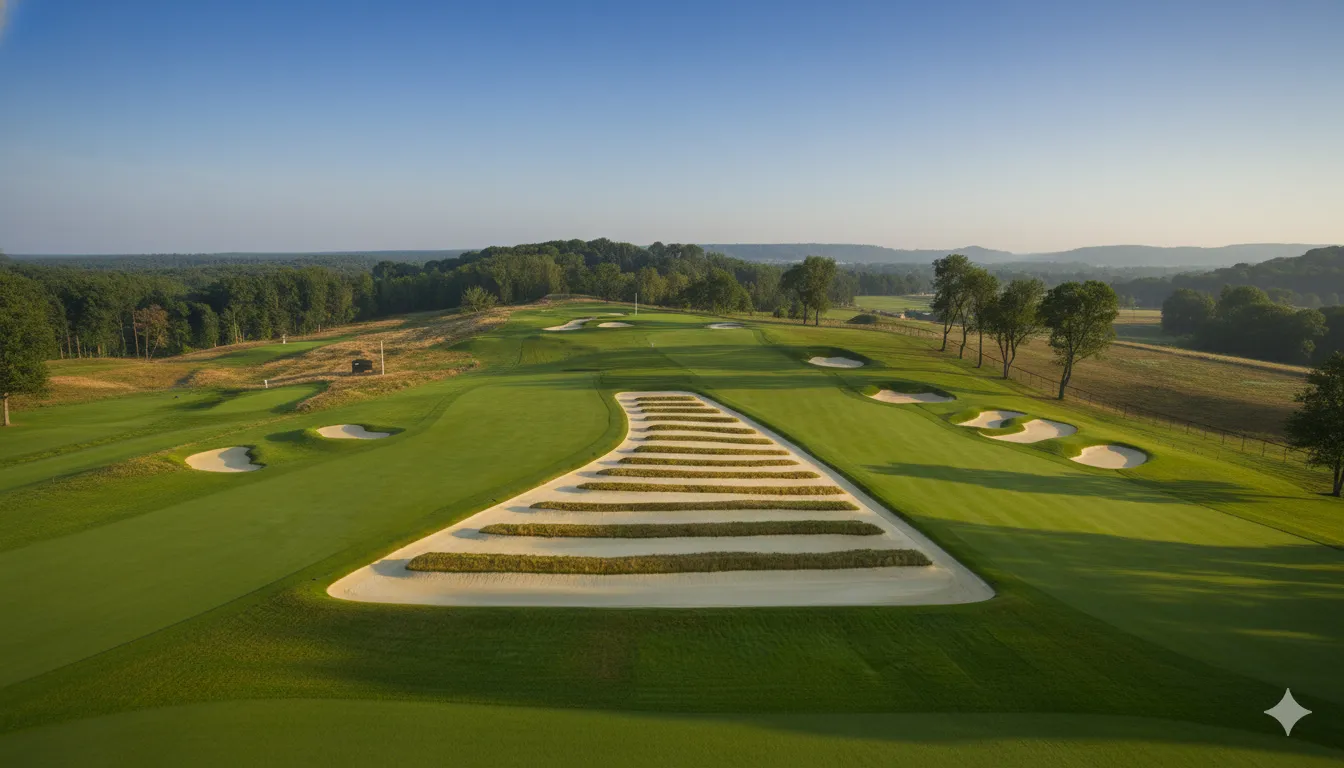
The greens run at speeds that border on unplayable during U.S. Open weeks. The Church Pews bunker complex swallows drives on the par-5 3rd and 4th holes, forcing layups from players who hit 320-yard drives. The rough grows thick enough to make advancing the ball 100 yards an achievement. And the course operates under philosophy established by founder Henry Fownes in 1903: championship golf should identify weaknesses, not reward strengths.
Ben Hogan won here in 1953, shooting 283 (+5) and calling it one of the toughest tests he’d faced. Johnny Miller shot 63 in the final round of the 1973 U.S. Open—still considered one of the greatest rounds ever played—and won at +1. Tiger Woods won in 2007 at +5. Dustin Johnson won in 2016 at -4, but only after the USGA declared Sunday’s greens “unplayable” and officials watered them repeatedly between groups.
Oakmont doesn’t care about your handicap, your equipment, or your preparation. The course asks one question: can you execute precision under pressure for four hours straight? Most golfers—including tour professionals—answer no.
The Design That Refuses Mercy
Henry Fownes founded Oakmont in 1903, then spent the next forty years refining it with his son William Fownes Jr. Their philosophy was simple: a great championship course should test mental toughness as much as physical skill. Every hole should demand thought and execution. There should be no let-up, no recovery time, no easy pars.
This philosophy permeates Oakmont’s design. William Flynn—who would later design Shinnecock Hills and Cherry Hills—consulted on revisions in the 1930s. More recent architects have made minor adjustments. But the essential character hasn’t changed: Oakmont is hard, has always been hard, and will remain hard regardless of equipment advances or conditioning techniques.
The opening hole establishes expectations. At 469 yards, it’s a genuine three-shot par-4 for most golfers. The drive must avoid bunkers left and trees right. The approach plays to a green that slopes from back to front and rejects anything struck without proper trajectory and spin. Par feels earned. Bogey feels acceptable. And you haven’t reached the difficult holes yet.
The 3rd and 4th holes feature the famous Church Pews—a bunker complex with twelve grass ridges creating thirteen separate sand channels between the two parallel fairways. These bunkers sit exactly where tour players want to hit drives. Miss into them and recovery often means a sideways shot back to the fairway. The holes are reachable par-5s in theory. In practice, they’re survival tests where par equals victory.
The greens create most of Oakmont’s difficulty. They’re enormous—averaging over 7,000 square feet—with severe contours and slopes that make distance control critical. During U.S. Opens, they run at stimpmeter readings approaching 14-15 feet. At those speeds, a putt from the wrong section of the green becomes nearly impossible to stop near the hole. Three-putts are common. Four-putts happen. Even tour players occasionally watch putts accelerate away from holes.
The par-3s offer no relief. The 8th plays 288 yards—longer than many par-4s—typically into wind, requiring woods or hybrids just to reach the green. The 13th plays a more manageable 183 yards but to a green so severely contoured that being in the wrong quadrant guarantees bogey. The 16th—just 152 yards—sits beside a deep bunker that has ruined countless U.S. Open dreams.
The closing stretch maintains intensity rather than building to crescendo. The 17th and 18th are difficult par-4s that demand precision when exhaustion and pressure peak. There’s no easy closing hole where you can exhale. Oakmont asks for execution until the final putt drops.
The Greens That Define Championship Golf
If one element separates Oakmont from other championship courses, it’s the greens. Not their size—though at 7,000+ square feet they’re among the largest in championship golf. Not their contours—though they’re severely sloped in ways that create distinct sections. The speed. During U.S. Open weeks, Oakmont’s greens run faster than any other venue in professional golf.
PGA Tour greens typically stimp at 11-12 feet. Major championship greens run 13-14 feet. Oakmont during U.S. Open week approaches 14-15 feet or higher. At those speeds, the margin for error disappears. Putts break more than players anticipate. Speed control becomes everything. A putt hit six inches too hard might roll eight feet past. Downhill putts become terrifying exercises in barely touching the ball.
The 2016 U.S. Open featured the most extreme example. Sunday’s greens were prepared to run at speeds approaching 15 feet. Players couldn’t stop balls near holes. Putts rolled away from cups after appearing to stop. After several groups, the USGA made the unprecedented decision to water greens between groups because they’d crossed from “difficult” to “unplayable.”
This wasn’t poor greenkeeping—it was Oakmont being Oakmont. The course has always featured the fastest greens in championship golf. It’s part of the club’s identity and philosophy. Henry Fownes believed fast greens separated great putters from good ones. His son William developed techniques to achieve faster speeds than anyone thought possible. Modern superintendents continue that tradition.
The greens’ size and contours complement their speed. Large greens with subtle slopes would be merely difficult. Large greens with severe slopes become puzzle boxes where finding the correct section matters more than just hitting the surface. During U.S. Opens, pin positions exploit these contours ruthlessly. A hole cut on the wrong tier creates situations where professionals aim 30 feet away from the hole because getting closer from the wrong angle risks three-putting.
This is strategic architecture at its most severe. The greens don’t trick you—you can see the slopes, read the breaks, understand the challenge. But seeing and executing are different. Oakmont asks: can you hit your approach to the correct section of a large, sloping green when you’re exhausted, nervous, and aware that missing means bogey or worse? Most players can’t. Even tour professionals struggle.
The Championships That Built The Legend
Oakmont has hosted nine U.S. Opens, more than any course except Baltusrol and tied with Shinnecock Hills. Each championship has reinforced Oakmont’s reputation as golf’s ultimate examination.
The 1953 U.S. Open featured Ben Hogan winning at +5 (283), one year after his famous triple-slam season. Hogan called Oakmont one of the toughest courses he’d ever played. Sam Snead finished six shots back. The course humbled even the era’s best players.
The 1962 U.S. Open saw Jack Nicklaus win his first major championship, defeating Arnold Palmer in an 18-hole playoff. Palmer, a Pennsylvania native, had hometown support. Nicklaus, the young challenger, won the playoff by three strokes. Oakmont crowned a new champion and signaled a changing of golf’s guard.
The 1973 U.S. Open produced Johnny Miller’s legendary final-round 63. Miller started Sunday six shots behind, shot a round that featured precision iron play in soft conditions, and won by one stroke. That 63 remains one of the greatest rounds in major championship history—partially because it came at Oakmont, where 63 seemed impossible.
The 1994 U.S. Open featured Ernie Els winning at -5 (279) in a three-way playoff, defeating Colin Montgomerie and Loren Roberts. The scoring was relatively low by Oakmont standards, but the championship featured the drama and pressure that defines great U.S. Opens.
The 2007 U.S. Open saw Tiger Woods win at +5 (283)—the same score Hogan posted 54 years earlier despite massive equipment improvements. Oakmont proved that even with modern technology, the course remained championship-caliber. Tiger’s victory demonstrated that strategic thinking and precision still mattered more than raw power.
The 2016 U.S. Open featured Dustin Johnson winning at -4 (276), though the championship is remembered as much for the green-speed controversy as Johnson’s victory. The USGA’s decision to water greens mid-round sparked debate about whether Oakmont had finally crossed from difficult to impossible. The club’s response: Oakmont has always tested limits. That’s the point.
Each U.S. Open at Oakmont has crowned worthy champions who executed under pressure, managed their games strategically, and handled conditions that exposed every weakness. The course doesn’t apologize for difficulty. It uses difficulty to identify champions.
What Oakmont Tests
Most great courses test specific skills. Augusta National tests precision with mid-irons and strategic thinking around greens. Pebble Beach tests nerve and execution under pressure. Pine Valley tests accuracy and punishes wayward shots severely.
Oakmont tests everything simultaneously:
Ball-striking: Oakmont’s fairways are wide enough to hit, but missing them into rough means losing strokes. The premium on accuracy increases pressure on every drive.
Iron play: Approach shots must find correct sections of large greens. Distance control matters more than direction. A shot to the wrong tier creates putting nightmares.
Short game: Missing greens at Oakmont means chipping to surfaces that might not hold the ball. Firm conditions and severe slopes make up-and-down difficult even from good positions.
Putting: The fastest greens in championship golf require perfect speed control and accurate reads. Three-putts are common. Two-putting from 40 feet feels like accomplishment.
Mental toughness: Oakmont never relents. There are no easy holes where you can recover confidence. The course demands focus and execution for 18 consecutive holes. Mental exhaustion rivals physical fatigue.
Strategic thinking: Club selection, target selection, and risk management matter constantly. Aggressive play can lead to disaster. Conservative play might not score well enough. Finding balance requires intelligence and discipline.
This completeness makes Oakmont exceptional. You can’t hide weaknesses here. If your putting is shaky, fast greens expose it. If your ball-striking is inconsistent, the rough punishes you. If your mental game is fragile, relentless pressure breaks you. Oakmont requires a complete game executed at high level for four hours straight.
Tour players talk about Oakmont with mixture of respect and relief that they don’t compete there regularly. It’s too demanding, too exhausting, too comprehensive in its examination. Playing Oakmont is like taking a final exam where every question is difficult and there’s no partial credit. You either know the material or you don’t.
If You’re Lucky Enough
Oakmont is intensely private. The club has approximately 200 members. Access requires invitation from a member. There are no charity auctions, no corporate outings, no alternate paths to tee times. If you don’t know a member, you won’t play Oakmont.
Occasionally, connections in golf circles provide opportunities. Friendships with members, business relationships, or professional networking might create paths to access. These chances are rare and should be treated as the privileges they are.
If access materializes, prepare appropriately. This isn’t a bucket-list round where you photograph holes and post about the experience. This is four hours of golf that will test every element of your game and probably humble you thoroughly.
Accept that par is unlikely. Scratch golfers regularly shoot mid-80s at Oakmont from member tees. Tour players struggle to break par from championship tees. Your goal should be playing smart golf and avoiding disasters rather than chasing scores.
Respect the greens. Oakmont’s greens run faster than anything you’ve experienced. Lag putting becomes critical. Speed control matters more than reading breaks. Expect three-putts and don’t let them ruin your round.
Play strategically. Oakmont punishes aggression more often than it rewards it. Conservative play—fairways, centers of greens, accepting pars—produces better scores than attacking pins and flirting with trouble.
Understand the history. You’re playing where Hogan, Nicklaus, Miller, Tiger, and others have competed for U.S. Open championships. The Church Pews have swallowed drives from the world’s best players. The greens have humbled major champions. This is golf history.
Most golfers will never play Oakmont. The exclusivity is real and access is nearly impossible. But the course’s influence extends far beyond its membership. Every architect studying championship design references Oakmont. Every discussion about green speeds mentions Oakmont as the standard. Every U.S. Open setup tries to replicate the comprehensive examination Oakmont provides.
What Oakmont Knows
Championship golf should be hard. Not quirky, not tricked-up, not dependent on perfect weather. Hard. Demanding. Exhausting. Testing every skill simultaneously and punishing any weakness.
Oakmont has known this since Henry Fownes founded the club in 1903. Nine U.S. Opens have proven it. Winning scores averaging near par—despite 122 years of equipment improvements—confirm it. Tour players speaking about Oakmont with mixture of respect and relief acknowledge it.
The course doesn’t apologize for difficulty. It doesn’t soften setup to produce low scores for television. It doesn’t compromise its philosophy to accommodate modern distance or equipment advances. Oakmont remains what it’s always been: the most comprehensive, demanding, and fair examination in championship golf.
Par is victory here. Not metaphorically—literally. Shoot even par at Oakmont during a U.S. Open and you’re probably leading. Make eighteen pars in a casual round and you’ve played exceptional golf. The course measures golfers by standards that haven’t changed in over a century: precision, strategy, mental toughness, and complete execution under pressure.
Some courses offer scenic beauty. Some provide quirky charm. Some deliver exclusive prestige. Oakmont offers none of these consolations. It offers only the opportunity to test yourself against golf’s most demanding examination—and the near-certainty that you’ll discover weaknesses you didn’t know existed.
The Church Pews still swallow drives. The greens still run faster than anywhere else. The rough still punishes wayward shots. And par still feels like victory. That’s not going to change. That’s Oakmont being exactly what it’s supposed to be: hard, fair, and unforgiving. The standard against which championship golf measures difficulty. The course where par isn’t just a score—it’s an achievement.