
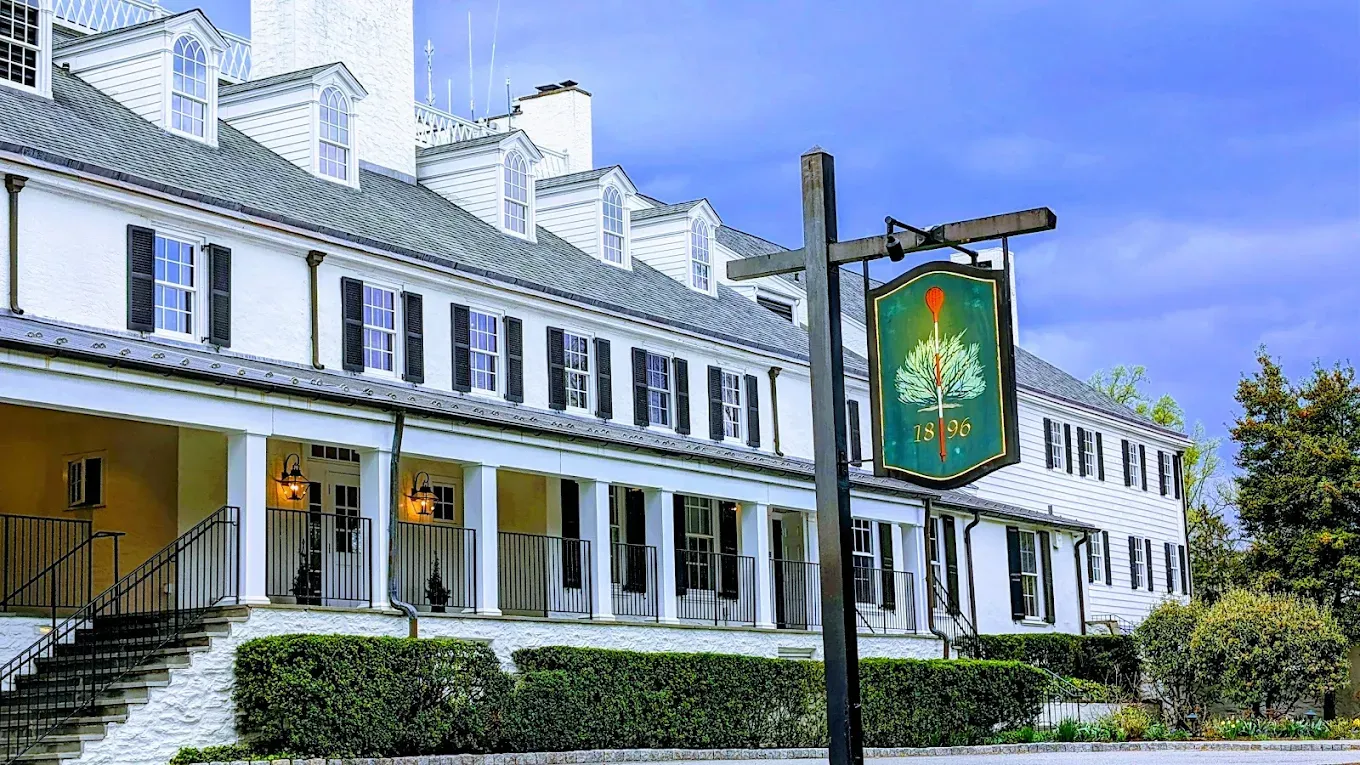
Merion Golf Club’s East Course occupies 126 acres. By modern standards, that’s barely enough land for twelve holes. Augusta National sprawls across 365 acres. Pine Valley claims 623. Contemporary championship courses routinely demand 200 acres or more, with buffers, practice facilities, and infrastructure consuming additional acreage.
Merion East proves all that space is optional.
On its compact plot in Ardmore, Pennsylvania, the course has hosted five U.S. Opens, the 1930 U.S. Amateur where Bobby Jones completed the Grand Slam, and the 1981 Open where David Graham played what many consider the finest final round in championship history. It has produced legends, broken dreams, and demonstrated repeatedly that greatness requires brilliance, not breadth.
The wicker baskets that serve as flagsticks wave above greens that would terrify players at courses twice Merion’s size. The white-faced bunkers—called the “White Faces of Merion”—frame holes with surgical precision. The routing threads through every available inch of terrain, creating a course that feels expansive despite its modest footprint. Merion East doesn’t have room for weak holes. It doesn’t need them.
Hugh Wilson’s Impossible Assignment
In 1910, Merion Golf Club faced a problem. Their existing course near Haverford was becoming surrounded by development. The club needed new land, and they needed someone to design a championship-caliber course on a constrained parcel near Ardmore.
They chose Hugh Wilson—a member with no professional design experience. He was an insurance broker who loved golf and studied the game seriously. The club sent him to Britain for seven months to study the great links courses. He returned with notebooks full of observations, ideas about green complexes and bunker placement, theories about how to create strategic challenge on limited land.
What emerged from those notebooks was the East Course, completed in 1912. Wilson died in 1925 at age 46, never fully recognized for what he’d created. But the course outlived him—hosting majors, challenging the world’s best players, earning recognition as one of the finest designs in American golf history.
Wilson understood something that many architects forget: constraints force creativity. With only 126 acres, he couldn’t rely on length or expanse. Every hole had to earn its place. Every green complex had to present genuine challenge. Every bunker had to serve strategic purpose. The result was a course dense with difficulty, where walking from green to tee sometimes means only a few paces, where beauty and terror coexist in remarkably tight quarters.
The routing itself represents a masterpiece of efficiency. Holes weave through and around each other, utilizing every contour and elevation change. The famous “Quarry Holes”—the 16th, 17th, and 18th—use an abandoned quarry as natural hazard and visual drama. Wilson didn’t need to manufacture drama. He found it in the land and amplified it through intelligent design.
The Finish Nobody Forgets
Merion’s final four holes present one of the most demanding closing stretches in championship golf. Starting at the 15th, players face a gauntlet that has decided U.S. Opens and ended careers.
The 15th plays 411 yards, dogleg right, with out of bounds tight along the right side. The approach must carry a creek to reach a green sloping away from play. Par feels earned. Birdie requires perfection.
The 16th—the first of the Quarry Holes—is a 430-yard par-4 that bends around an old limestone quarry. The second shot must carry the quarry to a green perched on its edge. Wind, distance, and sheer nerve all factor into club selection. This hole has ruined U.S. Open dreams for players who calculated wrong or flinched at the moment of commitment.
The 17th measures 246 yards, all carry, to a green nestled in the quarry’s embrace. It’s technically a par-3, but calling it that seems almost insulting. During the 2013 U.S. Open, players averaged 3.33 strokes—worst relative to par of any hole all week. Justin Rose made par on this hole in Sunday’s final round while others faltered, helping secure his championship.
The 18th runs 521 yards, uphill, toward the clubhouse. It’s played as a par-4 during major championships—an absurd, beautiful, terrifying conclusion to any round. Ben Hogan’s famous 1-iron approach during the 1950 U.S. Open landed here, captured in what became one of golf’s most iconic photographs. Lee Trevino chipped in for par on this hole during the 1971 Open playoff, proving that even the most demanding holes yield to brilliance.
These four holes together have produced enough drama for entire courses. They’ve crowned champions and crushed contenders. They’ve demanded everything players have and accepted nothing less than excellence.
The White Faces That Wait
Merion’s bunkers are legendary. The “White Faces” are steep-walled, brilliantly white sand traps that frame holes with precision and punish wayward shots with consistency.
The aesthetic is unmistakable. The flash of white against green fairway and rough creates visual drama that photographs beautifully and plays terrifyingly. From certain angles, the bunkers seem to glow, drawing attention to exactly where players shouldn’t hit their shots.
But the White Faces aren’t just beautiful. They’re strategic. Wilson and subsequent architects placed them precisely where players want to miss—catching the faded drive, the pulled approach, the cautious play that finds trouble despite avoiding obvious danger. The bunkers reward bold lines and proper angles while punishing safety and fear.
The faces themselves—steep and cut into the turf rather than built up with lips—create recovery challenges that vary based on where the ball comes to rest. A ball against the face demands explosion technique and limited expectations. A ball in the center of the bunker allows more ambitious recovery. The variety within each trap creates additional complexity beyond simple hazard placement.
During major championships, the White Faces become defining features. Television cameras capture players contemplating escape routes, weighing risks, sometimes accepting damage to avoid catastrophe. The bunkers at the 3rd, 11th, and 16th holes are particularly famous—beautiful, terrifying, and absolutely fair. Players who avoid them have earned advantage through skill. Players who find them have received exactly what their shots deserved.
When Jones Completed the Slam
On September 27, 1930, Bobby Jones stood on Merion’s 11th hole needing to close out Eugene Homans in the U.S. Amateur final. Jones had already won the British Open, British Amateur, and U.S. Open that year. The Grand Slam—all four major championships in a single season—seemed unimaginable. No one had done it. No one would do it again.
Jones won 8 and 7, finishing on the 11th green as thousands of spectators rushed the fairway. He completed the most remarkable season in competitive golf history at Merion, then retired from competitive play. He was 28 years old.
The course was worthy of the moment. Merion had already hosted the 1916 U.S. Amateur, where Jones—then 14—had made his national championship debut. It had hosted the 1924 U.S. Amateur, where Jones fell in the final to George Von Elm. For the 1930 championship, Merion provided the stage where history concluded.
A plaque now marks the spot on the 11th fairway where Jones hit his approach shot before the match ended. The hole itself—a 369-yard par-4 with one of Hugh Wilson’s finest green complexes—remains essentially unchanged from 1930. Golfers playing Merion today walk the same terrain where the greatest amateur in history completed something no one has matched.
This history permeates the property. The clubhouse contains artifacts from Jones’s era and beyond. The course itself feels weighted with significance—not in oppressive ways, but in the quiet awareness that greatness has walked these fairways before and left its mark.
The Modern Championship Test
Merion has adapted to modern golf while preserving its essential character. The 2013 U.S. Open—first at Merion since 1981—proved the course could still challenge the world’s best players despite its modest yardage.
At 6,996 yards for the championship, Merion was far shorter than typical U.S. Open venues. Critics predicted low scoring, assuming that modern distance would overpower Wilson’s design. They were wrong.
Justin Rose won at one-over par—the first U.S. Open since 1989 decided at over par. The course’s narrow fairways, strategic bunkering, and demanding greens negated the advantage of modern distance. Players who drove it long but crooked faced brutal recoveries. Players who found fairways but couldn’t control approaches struggled equally. Merion proved that defense doesn’t require 7,500 yards and forced carries. It requires intelligent design and proper conditioning.
The week also showcased Merion’s greens—small, undulating, and unreceptive to anything less than precise approach shots. Pin positions ranged from accessible to cruel. Putting surfaces ran fast and true, rewarding reading skill while punishing speed miscalculation. The combination of demanding approaches and challenging greens created scoring difficulty that length alone can’t replicate.
Rose’s victory clinched his first major championship, but the week’s broader lesson resonated throughout golf architecture. Courses don’t need expansion to remain relevant. They need strategic complexity, proper conditioning, and the confidence to let design do the work. Merion had been proving this for a century. The 2013 Open simply reminded everyone who’d forgotten.
What Brilliance Looks Like
Merion East’s significance extends beyond championship history. The course represents a design philosophy that modern architects are rediscovering: that precision beats expansion, that strategy defeats power, that greatness requires intensity rather than acreage.
Every hole demands attention. The 2nd—a 535-yard par-5—features a green complex considered among the finest in American golf. The 5th—a 429-yard par-4 called the “famous par-4”—requires a precisely placed drive to create angle for the approach. The 11th—where Jones completed his Slam—presents subtlety that reveals itself only through repeated play.
The course teaches golfers something about golf itself. Length matters less than placement. Power matters less than precision. Championship courses don’t need to overwhelm—they need to demand completeness. Merion East asks every question the game can pose, compressed into 126 acres that prove brilliance needs no excess.
Walking Merion—and members walk—means experiencing golf as Wilson imagined it. The transitions between holes happen quickly, the next challenge appearing almost before the previous one concludes. The course maintains intensity throughout, never offering respite, never apologizing for its demands. It’s exhausting and exhilarating, beautiful and brutal, historic and immediate.
The Standard That Endures
Merion Golf Club remains intensely private. Access requires member invitation, extended only to those who will appreciate what they’re visiting. The club maintains its course, its traditions, and its standards with the same precision that Wilson built into his design.
For those fortunate enough to play it, Merion East delivers on its reputation. The wicker baskets wave above greens that test the finest iron players. The White Faces glow in afternoon light, waiting for the slightest miscalculation. The quarry holes demand courage that transcends mere skill. The history hangs in the air, not as weight but as reminder that this ground has witnessed greatness and expects nothing less.
Major championships will return to Merion. The course has already proven it can host modern events despite modern distance gains. What Hugh Wilson designed in 1912—what he learned in Britain and adapted to Pennsylvania terrain—endures as template for what championship golf should be: demanding, fair, beautiful, and utterly unconcerned with trends or conventions.
Some courses rely on land. Some rely on length. Merion East relies on brilliance—the accumulated genius of an amateur designer who understood that great golf doesn’t need room to sprawl. It needs room to think. On 126 acres in Ardmore, Pennsylvania, there’s exactly enough room for both.