For nearly two decades, the property at Five Mile Point existed as golf’s worst-kept secret. Phil Friedmann, who co-purchased the 140-acre parcel with Mike Keiser in 2000, hosted a loosely routed collection of 13 greens designed by Tom Doak and Jim Urbina. No tee boxes. No fairways. No irrigation. Guests chose their own routing, playing to whichever green the wind and their imagination suggested. It was private, wild, and entirely unplayable by any standard definition of the word.
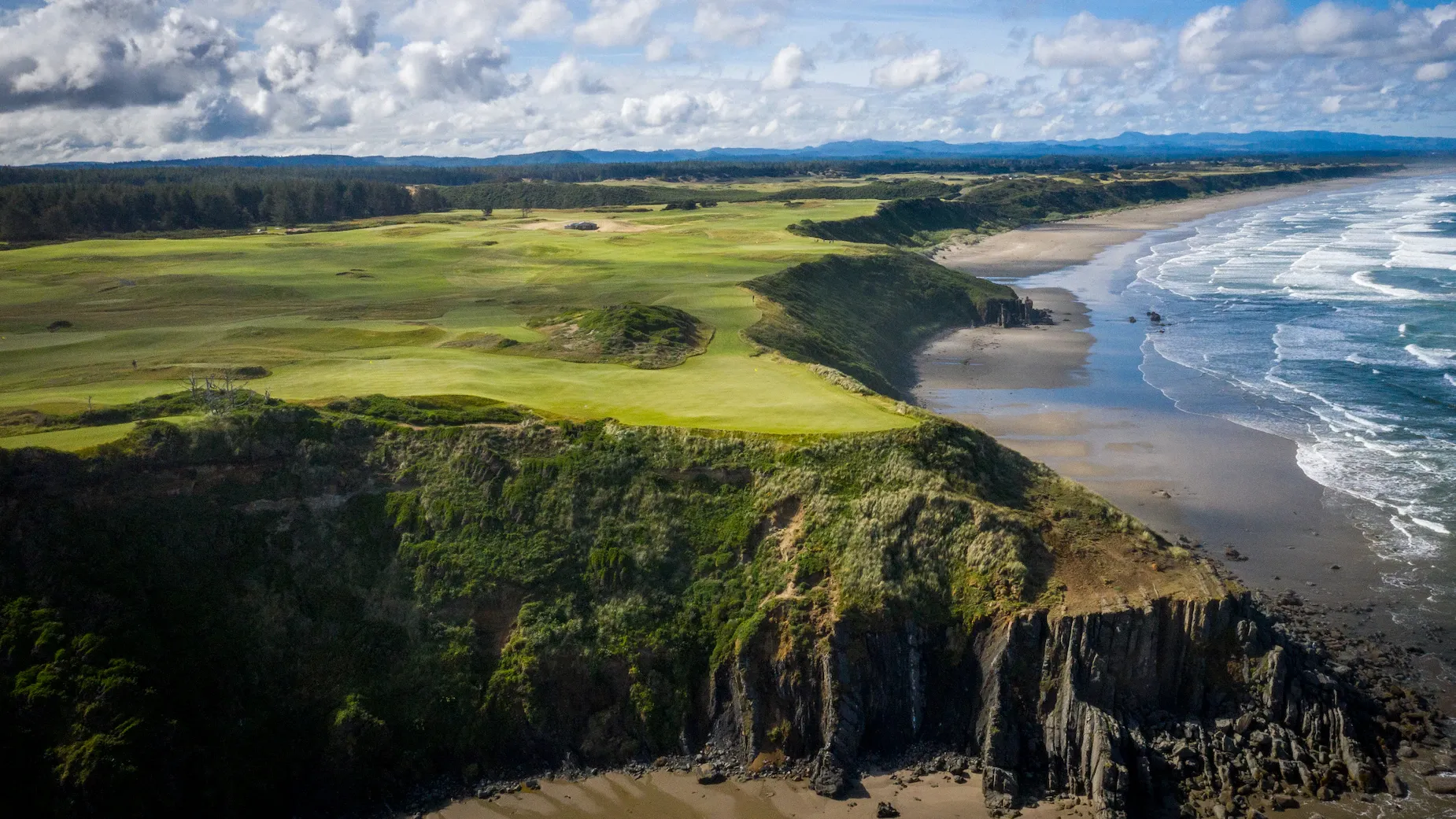
Bill Coore and Ben Crenshaw formalized Sheep Ranch in 2020, transforming Friedmann’s sanctuary into a championship course and the resort’s most radical proposition. The site offered a mile of unbroken Pacific coastline, the most exposed parcel on the property. It also offered wind violent enough to blow sand out of traditional bunkers. Coore and Crenshaw, drawing from Robert Hunter’s early golf texts, took the hint. They built zero.
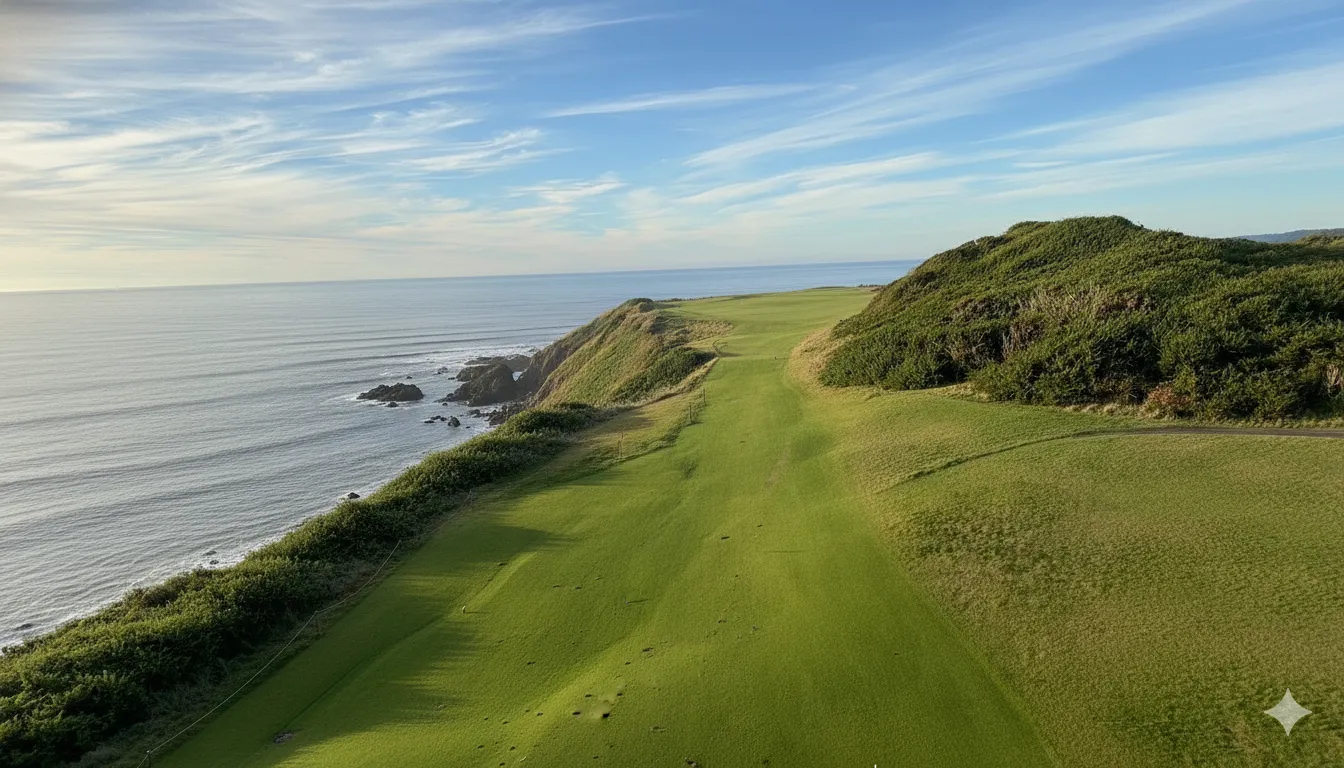
Sheep Ranch opened as a championship seaside links without a single sand hazard, defended instead by grass hollows, cliff edges, and the relentless Oregon wind. Gil Hanse, who was considered for the project, called it “the best site we’ve ever seen for a new golf course.” The ranking panels agreed immediately. An unorthodox 34-38 par split puts three par 3s in the first seven holes. On a calm day, Sheep Ranch plays as the most forgiving of Bandon’s championship layouts. When the wind hits 30 mph, which it does routinely, that forgiveness disappears without a trace.
Where the Cliffs Do the Talking
The 1st (par 5, 517 yards from the Green tees, 549 from the Black) begins with a deception. The tee shot plays inland, almost apologetically, toward a wide fairway framed by coastal forest. Favor the left side and catch a speed slot that tumbles the ball downhill toward the ocean. Then the fairway crests a ridge, and Oregon announces itself: the Pacific fills the horizon, and ghostly dead-tree snags frame the green below, their skeletal limbs bleached white against the sky. The opening hole at Sheep Ranch doesn’t build to the ocean. It ambushes the golfer with it.
The 6th (par 4, 431 yards from the Green tees, 460 from the Black) is the course’s most direct confrontation between golfer and cliff. The hole plays diagonally over the ocean, and the tee shot demands a commitment: how much coastline to carry. Bail out left for safety and the approach becomes a punishing uphill long iron into an elevated green perched near the bluff. Brave the coastal line, trust the swing through the crosswind, and a mid-iron approach is the reward. Two gorse-covered mounds mark the boundary between caution and conviction. Most golfers choose the wrong side of that line.
The 16th (par 3, 131 yards from the Green tees, 151 from the Black) sits atop Five Mile Point, the most exposed ground on the property and the site of one of Doak’s original greens that Coore and Crenshaw preserved from the secret layout. The massive double green, shared with the 3rd hole, sprawls across the promontory with the ocean flanking the left side. The yardage says wedge. The wind says otherwise. Experienced players ignore the number entirely, take two or three extra clubs, and punch a low driving shot that uses the ground to reach the surface. First-timers under-club, watch the wind carry their ball into heavy fescue, and learn the lesson every Sheep Ranch regular already knows: the yardage book is a suggestion. The wind is the authority.
Between these signature moments, the routing builds a cumulative case for elemental golf. Fescue turf runs firm and fast from tee to green, rewarding low ball flights and creative ground approaches. The greens are large and heavily contoured but cut slower than the other courses on the property, an architectural necessity: at standard resort speeds, the wind would blow balls off the putting surfaces entirely. Ghost trees and jagged cliff edges replace the visual definition that bunkers provide elsewhere. Fairways meld into their surrounds so seamlessly that the boundary between playing surface and natural landscape all but disappears.
The bunkerless design is not a gimmick. The grass hollows that replace traditional traps are unpredictable: sometimes offering clean lies, sometimes burying the ball in matted fescue. They demand a creativity that sand, for all its visual drama, does not. Players who possess a low, driving ball flight and a willingness to play the ground will score. Players who insist on high, spinning wedge shots will spend the round arguing with the wind and losing.
The honest caveat: the greens draw the most consistent criticism. Poa annua infiltration, combined with the necessity of keeping the grass longer to withstand wind, produces putting surfaces that can feel bumpy and slow, particularly during transitional weather months. And the complete absence of dunes or tree cover means a sudden squall hits players with the full force of the Pacific. Umbrellas are decorative objects at Sheep Ranch. Gore-Tex is mandatory.
Planning the Trip
Green fees vary by season and accommodation status.
| Item | Cost |
|---|---|
| Resort guest, peak season | $375 |
| Day guest, peak season | $425 |
| Off-season resort guest | $120–$140 |
| Replay round (same day) | ~Half price |
| Caddie per bag (before tip) | $125 |
| Forecaddie per person (before tip) | $40–$60 |
Confirm current rates at booking; fees adjust annually.
Caddies are strongly recommended and worth every dollar on a bunkerless course where conventional yardage calculations fail. Local caddies know the wind patterns, club selection adjustments, and green contours that realistically save three or four strokes on a first visit. Standard gratuity runs $30–$50 per bag. Request caddies through the golf shop or resort booking process; availability is not guaranteed. Bags must weigh under 25 pounds (lightweight stand bags required).
Booking demands patience. Tee times and lodging fill 18 months in advance during peak season. On-property guests receive priority for morning tee times; day guests face restricted access, with tee times limited to after 10:00 a.m. and lower priority in the booking queue. The practical strategy: book lodging first, a year and a half out, and the tee times follow. Winter months (November through February) offer dramatically lower rates and higher availability for golfers willing to accept Oregon’s worst weather.
When to Go
| Window | Why |
|---|---|
| Jan–Feb 🌧️ Avoid | Winter storms, soft turf, limited daylight; lowest rates for the committed |
| Mar–Apr 🌤️ Good | Rain tapering, course firming up, shoulder pricing |
| May–Jun ☀️ Prime | Firm turf, warming temps, manageable winds before summer northerlies peak |
| Jul–Aug 🌬️ Good | Driest and warmest, but fierce north winds routinely exceed 30 mph |
| Sep–Oct ☀️ Prime | Summer winds ease, turf at its firmest and fastest, shoulder rates return |
| Nov–Dec 🌧️ Avoid | Rainy season begins; only for links purists chasing winter rates |
Confirm the resort’s aeration schedule before booking shoulder-season trips; greens can take weeks to recover after punching.
The resort ecosystem makes Sheep Ranch part of a larger trip. Pacific Dunes, Bandon Dunes, Old Macdonald, and Bandon Trails are all within a ten-minute shuttle ride, and the resort’s complimentary 24/7 shuttle service eliminates the need for a rental car once on property. Add the Bandon Preserve (13-hole par 3), Shorty’s (19-hole par 3, opened 2024), and The Punchbowl (18-hole putting course) for lighter rounds between championship layouts. Southwest Oregon Regional Airport (OTH) in North Bend is a 35-minute drive; Portland International (PDX) is roughly four and a half hours.
Why the Wind Is Enough
Sheep Ranch is Bandon Dunes’ final answer to a question golf has been asking since architects first filled a hole with sand: how much construction does a great course actually need? Coore and Crenshaw’s answer is less than anyone expected. No bunkers. No tricks. A mile of cliff, a carpet of fescue, and whatever the Pacific decides to deliver on any given morning. The course that spent two decades as Phil Friedmann’s private secret turned out to be the most public statement about what golf becomes when the land and the elements do most of the work. Some courses defend themselves with architecture. Sheep Ranch defends itself with weather. The wind does not take days off.