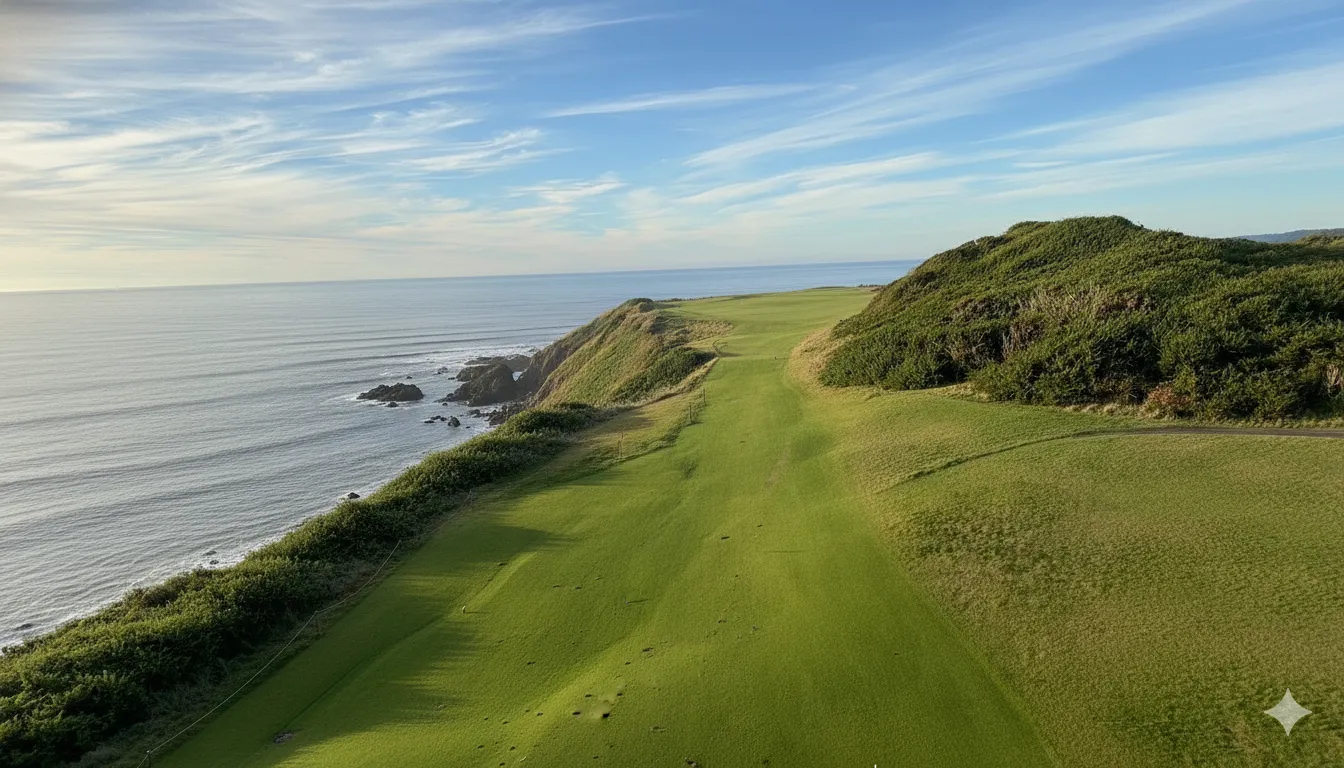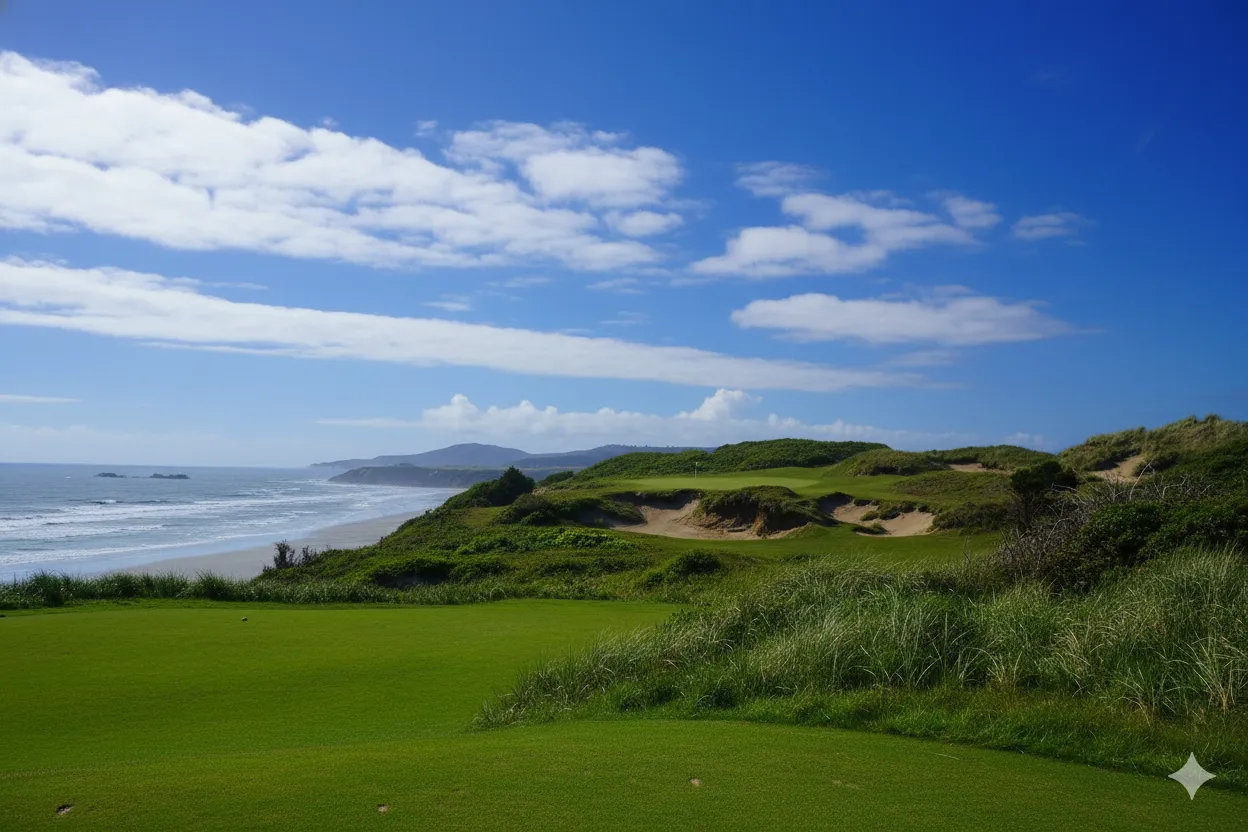
The rippling fairways of Pacific Dunes are not architectural features. They are the original contours of the Oregon coast, shaped by centuries of wind and tide before anyone considered planting a flag in them.
Tom Doak walked the coastal land for months in 2000. Sand dunes heavy with beachgrass and gorse, blowout craters carved by Pacific storms, terrain that had been sculpting itself long before anyone called it real estate. He made the decision that would define his career. He barely moved any earth. Pacific Dunes opened in 2001 and announced itself immediately.
The 2006 Curtis Cup confirmed what the architecture community already suspected: this was not a resort novelty. The United States defeated Great Britain and Ireland on a layout that looked and played as if it had existed for centuries. The USGA has returned repeatedly, and Pacific Dunes has held its ranking among the finest public courses in America for over two decades. No renovation has been required. The land handles its own defense.
What the Dunes Already Knew
Standard routing logic does not survive contact with this property. The front nine plays to a par of 36. The back nine plays to 35, loaded with four par-3s, three par-5s, and only two par-4s. Doak had always avoided placing consecutive par-3s. The 10th and 11th are consecutive par-3s. His explanation: “When God gives you two lemons, you make lemonade.” The 11th measures just 131 yards from the Green tees, the shortest hole on the course, with the smallest green. It looks like it was carved from the slope of a massive dune, framed by deep blowout bunkers with wispy beachgrass eyebrows. The yardage says easy. The wind and the bunkers say otherwise. That is the kind of routing that happens when the architect follows the land instead of the scorecard.
The 4th (par 4, 449 yards from the Green tees, 463 from the Black) is where Pacific Dunes announces what it is. The tee shot plays along a clifftop with the Pacific crashing onto the beach forty feet below and to the right. The safe play is left, but the fairway narrows around the 250-yard mark in a way that catches bailed-out drives. A good tee shot starts toward the ocean, draws gently, and lands in the left-center. Most golfers overcorrect and find deep fescue or gorse on the left. The green sits fully exposed to coastal wind; high spinning approaches bounce through the back. Low running shots that use the front slope are the play. Architectural critics call it one of the finest par-4s in the world. That probably undersells it.
The 13th (par 4, 390 yards from the Green tees, 444 from the Black) turns back toward the ocean after an inland stretch, and the contrast arrives like a physical sensation. The Pacific appears along the entire left side. A massive sand dune rises on the right, framing the green like the wall of a colosseum. The hole typically plays downwind in summer, which creates the impression of manageability right up until the uphill approach, the undulating putting surface, and the two-story dune backstop collectively remind the golfer that photography has been failing to capture this place for twenty-five years. Good players run the ball up using the right-side dune as a visual guide. Everyone else finishes below the hole on the left slope with a breaking putt they never prepared for.
The 17th (par 3, 189 yards from the Green tees, 208 from the Black) is a Redan: the green slopes severely from front-right to back-left, and the correct play is to start the ball right and trust the ground to feed it toward the hole. A massive bunker complex guards the left side. In spring, blooming gorse turns the amphitheater behind the green yellow. Good players aim twenty yards right of the flag. Average players aim at the flag, find the bunker, and carry that memory for years. When summer wind quarters in from the left, the shot must be flighted low and started well right of where instinct sends it, a correction that rewards preparation and punishes stubbornness in equal measure.
The course rewards playing the ground rather than through the air. Fescue turf runs firm and fast. Greens hold at a medium pace (around 10 on the Stimpmeter) because faster surfaces in a 30 mph coastal wind become unplayable. The greens are deceptively varied in size and contour, and so well integrated into their surroundings that the visual boundary between fairway and putting surface can be difficult to locate. High-trajectory approaches that work at most American courses accomplish nothing here. Knockdown punches, bump-and-runs, and the occasional Texas wedge from off the green produce results. Players who adapt to the ground game score. Players who insist on aerial target golf spend the back nine searching for balls in the gorse.
The back nine’s unconventional par distribution creates a scoring rhythm unlike any other course. Four par-3s mean four moments where bogey is one bad swing away. Three par-5s mean three chances to recover. The tension accumulates differently than a balanced routing can produce, and by the 17th tee most players are engaged with this course in a way that is genuinely rare.
Planning the Trip
Green fees depend on accommodation status and season.
| Item | Cost |
|---|---|
| Resort guest, peak season | $375 |
| Day guest, peak season | $425 |
| Replay round (same day) | ~$190–$215 |
| Caddie per bag (before tip) | $125 |
| Group caddie per person (before tip) | $40–$60 (varies by group size) |
Confirm current rates with the resort at booking; fees adjust annually.
Caddies are available and strongly recommended. Local caddies know wind patterns, green slope directions, and club selection adjustments that realistically save three or four strokes on a first visit. Standard gratuity runs $40–$50 per bag on top of the base fee. Request caddies well in advance through the resort’s caddie services department; availability is not guaranteed.
Booking requires the most lead time of any part of the trip. The resort runs a lottery-based pre-reservation system for resort guests, with registration windows closing months ahead of each season. Day visitors staying off-property typically end up with late-afternoon tee times even when booking a year in advance. The practical takeaway: securing on-property lodging at Bandon Dunes Resort is the single most effective move for getting desirable tee times.
When to Go
| Window | Why |
|---|---|
| Jan–Feb 🌧️ Avoid | Peak storm season; soft turf, short daylight, lowest rates |
| Mar–Apr 🌤️ Good | Weather improving, greens recovering, shoulder rates |
| May–Jun ☀️ Prime | Long days, manageable wind, firm turf before summer gusts peak |
| Jul–Aug 🌬️ Good | Warmest months, but prevailing north winds routinely hit 30–40 mph by afternoon |
| Sep–Oct ☀️ Prime | Summer winds ease, turf at its firmest and fastest, shoulder rates return |
| Nov–Dec 🌧️ Avoid | Winter storm patterns return; only for links purists chasing low rates |
Confirm the resort’s aeration schedule before booking; greens can take several weeks to recover after punching.
The four other championship courses on the property make a multi-day trip straightforward to justify: Bandon Dunes (David McLay Kidd, 1999), Bandon Trails (Coore & Crenshaw, 2005), Old Macdonald (Doak and Jim Urbina, 2010), and Sheep Ranch (Coore & Crenshaw, 2020). Most regulars recommend at least four rounds; five or six let the courses reveal their full characters. Bandon Crossings (Dan Hixson), an inland public layout fifteen minutes from the resort, runs $70–$96 with carts available, making it a legitimate rest-day option.
Getting to Bandon requires commitment. Southwest Oregon Regional Airport (OTH) in North Bend sits 35 minutes from the resort and serves United Express with connections through San Francisco year-round and Denver seasonally (May–October), but coastal fog delays are common. Eugene Airport (EUG) at 2.5 hours is more reliable. Portland International (PDX), 4.5 to 5 hours away, offers the most flights and the opportunity to drive south along Highway 101 through the Oregon coast, which is its own reason to take the longer route. The resort coordinates shuttle pickups from OTH; contact the concierge for current rates. A rental car is necessary from Eugene or Portland.
On-site dining at the Pacific Grill, located in the Pacific Dunes clubhouse, serves Pacific Northwest seafood with views over the property. McKee’s Pub near the main lodge draws post-round crowds for its meatloaf and a rotating selection of Pacific Northwest microbrews; it does not take reservations and wait times can be substantial.
Rounds stretch to five hours on packed tee sheets, and eighteen holes over undulating sand dunes in coastal wind covers more than six miles on foot. The course is strictly walking-only. Prepare physically, bring proper rain gear, more layers than the forecast suggests, and at least two pairs of waterproof shoes.
Why Nobody Has Built Anything Better
Pacific Dunes is twenty-five years old, the age when architectural reputations either hold or require explanation. No explanation has been needed. The course has not been renovated. The rankings have not drifted. The coastal land Doak declined to reshape keeps producing golf that courses designed with heavy machinery and manufactured drama consistently fail to replicate.
Keiser assembled the most significant collection of public golf courses in America. Pacific Dunes is the one most visitors name when asked which layout they would play again if they had one afternoon left on the Oregon coast. That is not sentiment. That is a routing that reveals new angles on the second and third visit, a playing surface that never presents the same wind-adjusted shot twice, and a piece of coastline that turned out, quite unexpectedly, to have been a golf course all along.
Book early. The lottery closes months before the season begins.