Mike Keiser wanted to rebuild the Lido. Tom Doak talked him out of it.
The Lido, Charles Blair Macdonald’s mythic Long Island links destroyed during World War II, had been golf architecture’s great lost chord for seven decades. Keiser asked Doak to recreate it hole for hole on the Bandon dunes. Doak and design partner Jim Urbina walked the site and delivered a counterproposal: forget the replica. Build the course C.B. Macdonald would have built if someone had handed him this coastline instead.
Old Macdonald opened in 2010, and it settled nothing. Architectural purists rank it among the finest strategic tests in modern American golf. Recreational players call the greens sadistic and the aesthetic barren. Both camps have a point. The course features nearly 300,000 square feet of putting surface, the largest greens in the world, with fairways sometimes stretching 100 yards wide and not a single tree to block the coastal wind. It is the easiest tee shot at Bandon Dunes and the hardest three-putt. That paradox is the point. Old Macdonald doesn’t test power. It audits spatial reasoning.
The 2011 U.S. Amateur Public Links arrived a year after opening, with medalist Corbin Mills posting a 4-under 67 in heavy coastal winds. The 2019 U.S. Amateur Four-Ball followed, decided on Old Macdonald’s closing stretch. A course built to honor an architect who died in 1939 keeps producing the kind of championship golf the USGA returns for.
Where the Ghosts Play
The third hole announces Old Macdonald’s intentions.
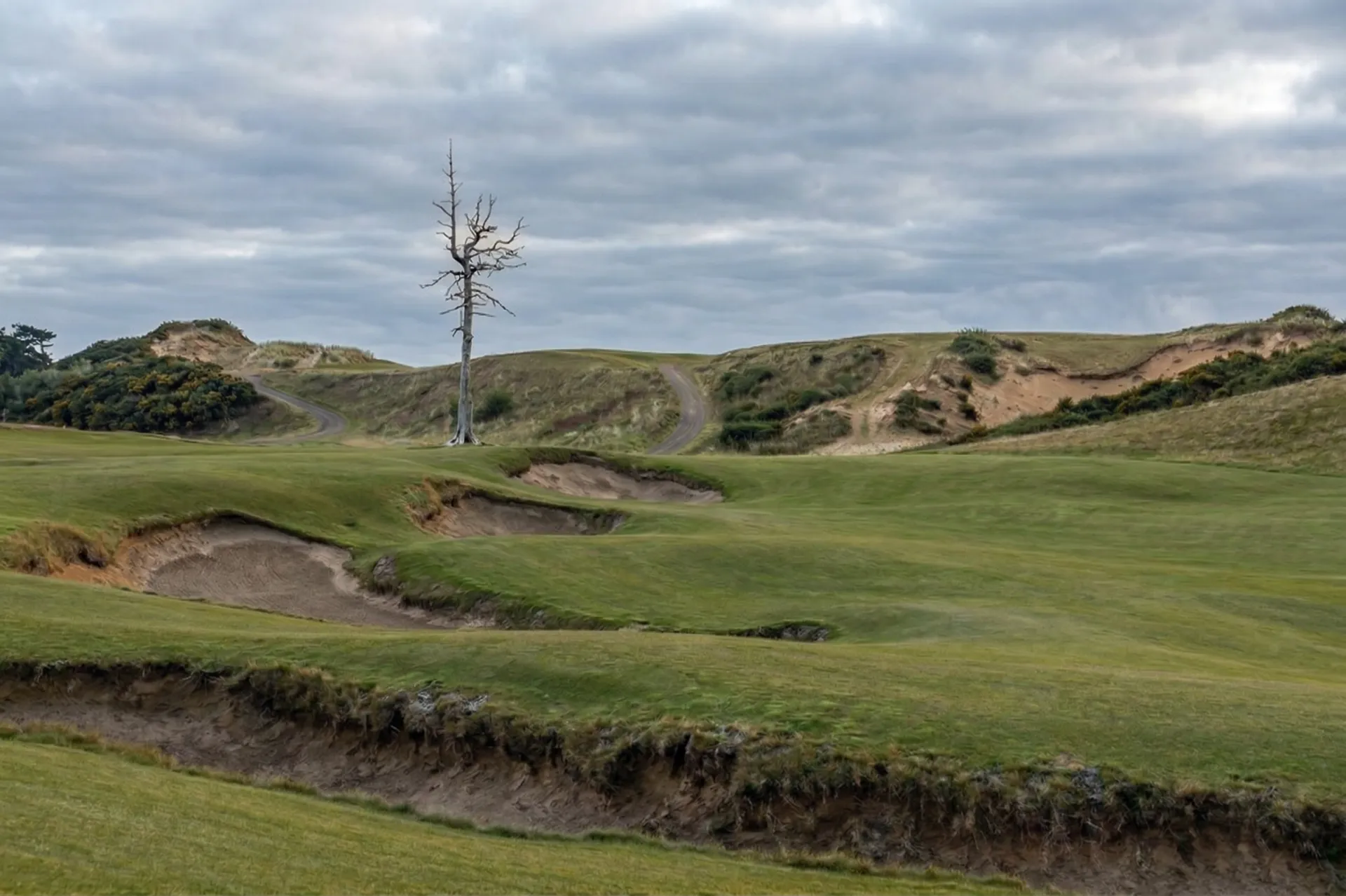
Called “Sahara,” it plays 345 yards from the Green tees and demands a blind tee shot over a 30-foot sand dune. The aiming point is a bleached, dead Port Orford Cedar known as the Ghost Tree, its skeletal limbs silhouetted against the Oregon sky like something from a Tim Burton storyboard. Players who trust the line and carry the right side catch a severe downslope that can funnel the ball to within wedge range of the green. Players who bail left face an awkward angle into a surface that does not reward awkward angles. The Sahara establishes the contract: Old Macdonald will present options, but it will not tell you which one is correct.
The 8th, “Biarritz” (par 3, 170 yards from the Green tees) may be the most visually disorienting shot on the property. The tee sits roughly 100 feet above the Pacific, fully exposed to crosswinds that turn a mid-iron into a guessing game. The green is bisected by a deep swale wide enough that balls hitting the front portion must roll down into the trough and climb back up to reach the pin. The instinct is to fly the ball directly at the flag. The correct play is a low, chasing shot that uses the front shelf as a launching pad, tracing a 40-yard path across the green’s internal topography. When the wind quarters across, even that plan becomes negotiable. Hundred-foot putts are not uncommon here. They are the design intent.
The 16th, “Alps” (par 4, 433 yards from the Green tees) is Old Macdonald at its most demanding and most archaic. Modeled after the 17th at Prestwick, the approach shot is completely blind, fired over a mountain of sand toward a hidden green guarded by a deep bunker. The smart play is often a layup to the right side, where a clear view and a straightforward up-and-down offer a more dignified path to par. Upon finishing, players ring a brass bell to signal the group behind. It is theatrical and unapologetically old-fashioned: the kind of golf C.B. Macdonald championed, before architects decided players deserved to see where their ball was going.
Between these signature moments, Old Macdonald builds a cumulative argument for the ground game. The fine fescue turf runs firm and fast, particularly in the dry summer months when balls roll 30 to 50 yards on well-struck tee shots. The greens average over 10,000 square feet (some approach 20,000) but run at moderate Stimpmeter speeds, around 9 to 10, because faster surfaces would become unplayable in the wind. Golfers who attempt to fly high wedges at flags will be punished. The course rewards imagination, the bump-and-run, and the ability to lag putt from distances most players encounter only on practice greens.
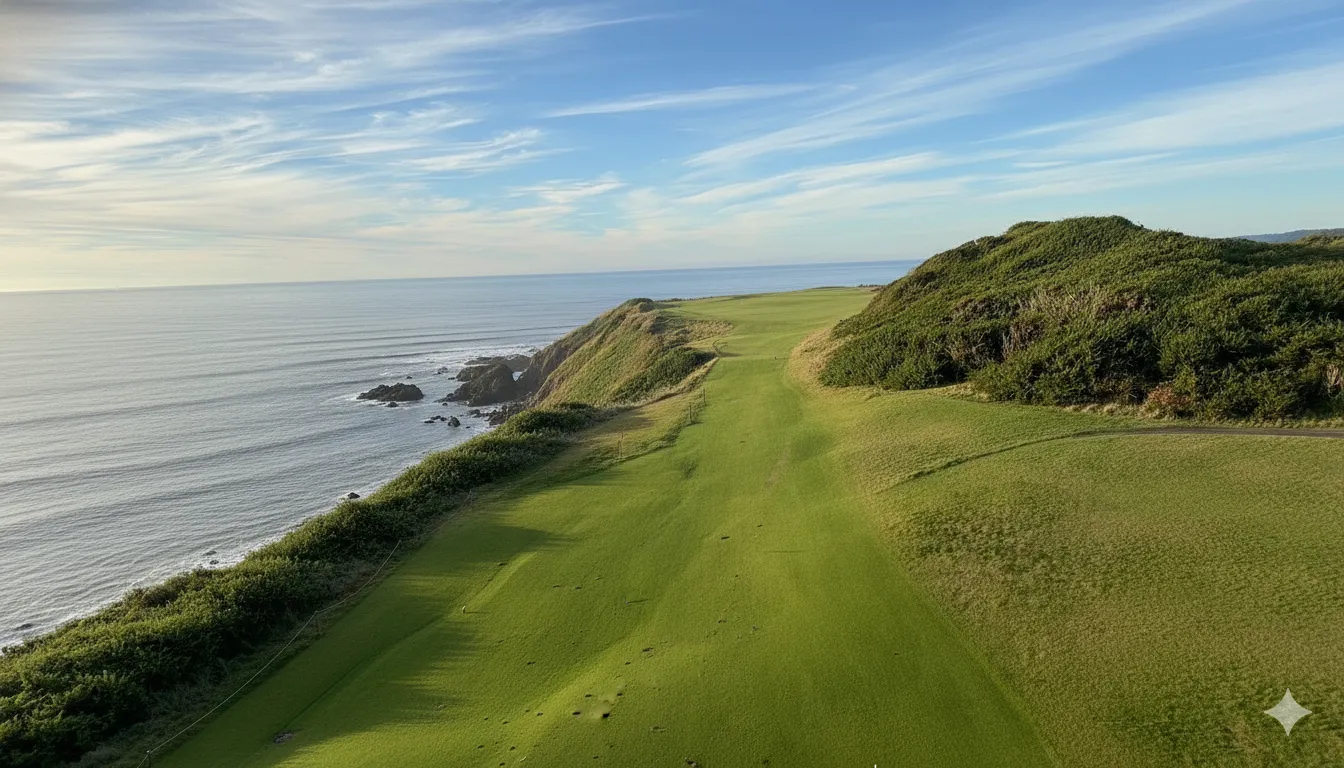
The routing itself has a narrative arc. The opening holes play somewhat sheltered. The third hole crests a dune and reveals the property’s full scale. The seventh climbs steeply uphill, and as the player reaches the elevated green, the Pacific appears for the first time, the roar of the surf arriving alongside the view. The back nine weaves through deeper dunes with an old-world rhythm before the 18th delivers a Punchbowl green: a massive, bowl-shaped surface that gathers everything toward the center and produces the kind of sweeping, dramatic putts that make golfers laugh out loud. It is as forgiving a finish as Old Macdonald offers, which is to say it only looks forgiving.
Planning the Trip
What It Costs
| Item | Cost | Notes |
|---|---|---|
| Resort guest green fee | $375 | Peak season; must be staying on property |
| Day guest green fee | $425 | Standard non-resort rate |
| Premium day guest | $475 | Advance booking with extended window |
| Replay rate | $190 | Resort guest second round, same day |
| Caddie fee | $100–$125 per bag | Base fee; $50+ tip customary |
| Pull cart | $5 | Locally called “rickshaws” |
Booking Strategy
Bandon Dunes operates a lottery system for 2026 and beyond. The year is divided into booking windows, and guests enter a drawing for their preferred dates. Selected guests receive a call from a reservationist to finalize lodging and golf. Resort guests receive priority. Day guests can book in advance at the premium rate ($475) or at the standard rate ($425) closer to the play date, but availability is limited either way. Walk-on singles can try the starter shack, but the odds are not charitable.
When to Go
| Window | Why |
|---|---|
| Jan–Feb 🌧️🌬️ Avoid | Heavy Pacific storms, soft turf, limited daylight |
| Mar–Apr 🌤️ Good | Weather breaks occasionally; wind manageable but rain still a factor |
| May–Jun ☀️ Prime | Long days, firm fescue, gorse in bloom; winds haven’t peaked |
| Jul–Aug 🌬️ Prime | Virtually no rain but fierce afternoon north winds; turf at its fastest |
| Sep ☀️ Prime | The best month: warm, calm, firm; winds ease and rain holds off |
| Oct 🌤️ Good | Fall golf is beautiful; winter storms loom but haven’t arrived |
| Nov–Dec 🌧️🌬️ Avoid | Wet season returns; the most exposed course on the property suffers most |
September is widely considered the ideal window. Morning rounds are calmer across all months; winds peak in the mid-to-late afternoon.
The Caddie Question
Caddies are not required but are strongly recommended. The blind shots on the 3rd and 16th, the multi-tiered green complexes, and the wind demand local knowledge that no yardage book can replace. Single-bag and double-bag caddies are available; request one when booking the tee time or call the caddie master in advance. Budget $150 to $175 total per bag including tip.
What Else to Play
Old Macdonald sits within a five-minute shuttle ride of five other championship courses at the resort. Pacific Dunes is the crown jewel, a cliffside Doak routing that draws the dramatic ocean comparisons Old Macdonald deliberately avoids. Bandon Dunes is the David McLay Kidd original that proved the whole concept could work. Bandon Trails (Coore & Crenshaw) offers forested routing for players craving visual contrast, and Sheep Ranch delivers bunkerless clifftop exposure. Bandon Preserve, a 13-hole par-3, and Shorty’s, a 19-hole par-3 opened in 2024, round out the property. A full Bandon destination guide covers itinerary planning and budget tiers.
Why the Template Still Teaches
Old Macdonald will never be the first course visitors choose at Bandon Dunes. Pacific Dunes has the ocean views. Bandon Dunes has the origin story. Sheep Ranch has the photographs. Old Macdonald has something harder to capture: a sustained conversation with a golfer who died in 1939.
C.B. Macdonald believed golf holes should present a question, not a command. The Redan asks how to use slope. The Biarritz asks how to use ground. The Alps asks how to play what cannot be seen. Doak and Urbina translated these questions onto Oregon sand, and the answers change with every shift in weather. The course does not demand strength or precision. It demands thought.
That is its gift and its challenge. Old Macdonald rewards the golfer who arrives curious and punishes the one who arrives certain. The fairways will always be wide enough. The question is whether the player is.