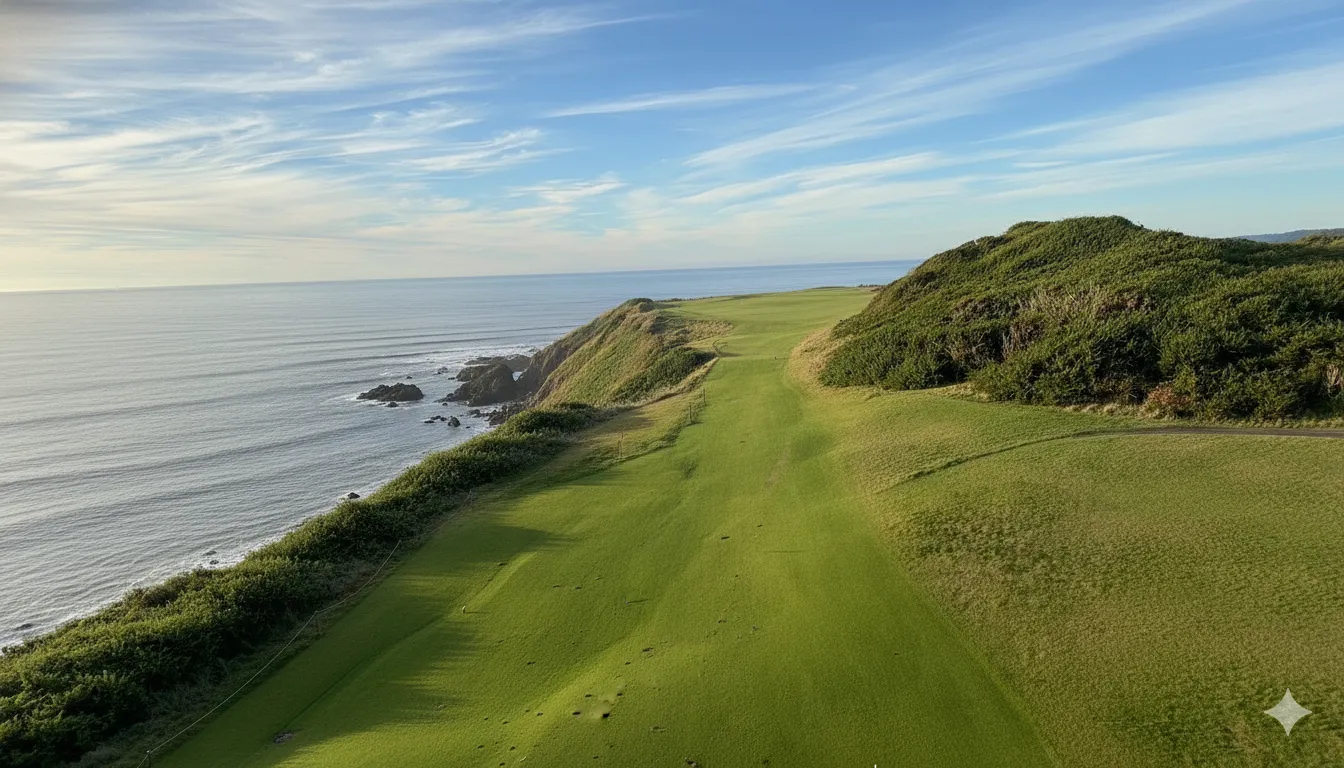
Bandon Dunes Resort has four championship courses with Pacific Ocean frontage. The fifth one, which turns its back on all of it, is the one the regulars rank first.
Bill Coore and Ben Crenshaw opened Bandon Trails in 2005 with the assignment no architect would choose: build a world-class course without the ocean. They responded by routing 18 holes through three distinct ecosystems (coastal dunes, open meadow, dense maritime forest) and creating the most cohesive journey on the property.
The USGA noticed. Bandon Trails co-hosted the 2020 U.S. Amateur, won by Tyler Strafaci, and the 2022 U.S. Junior Amateur, where seventeen-year-old Wenyi Ding became the first male golfer from China to win a USGA championship. Firm fescue and undulating greens tested the world’s best amateurs the same way they test every resort guest: with imagination, not force. The course that first-timers schedule as their backup round is the one architecture critics call Coore and Crenshaw’s finest work.
Three Ecosystems and a Shuttle Ride
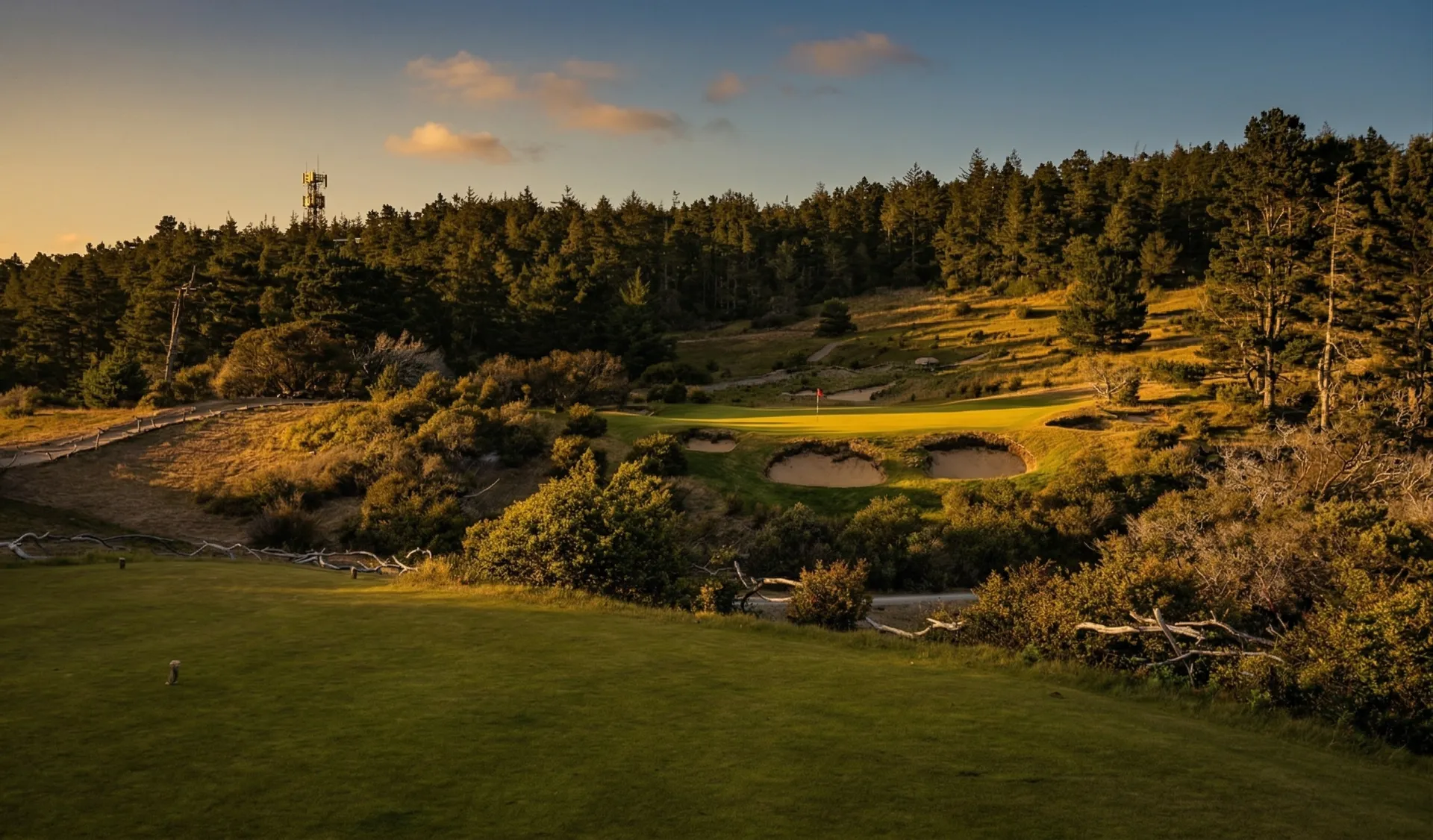
The routing is the argument. The opening holes play through rolling coastal dunes, firm and wind-exposed, fescue turf yielding massive rollouts that reward the ground game. The course transitions through an open meadow before climbing into a dark corridor of towering spruce and pine where wind vanishes and silence replaces the crash of the Pacific. The front nine finishes deep in the forest. The back nine stays there through the 13th before the course erupts back into the dunes for a windswept five-hole finish. The environmental shifts are not subtle. They feel like walking between rooms in a house where each room has its own weather.
The 5th (par 3, 124 yards from the Green tees, 133 from the Black) looks like charity on the scorecard. It is not. The green sits in three distinct tiers bisected by a massive swale, framed by a rustic fence of tree branches that belongs more to a national park than a golf course. Miss the correct tier by ten feet and the ball feeds into a different zip code. The smart play is center of the green regardless of pin position, because the slopes reward caution and punish flag-hunting with three-putts from 25 feet. It is one of the most beautiful holes on the property, and one of the most quietly destructive.
The 14th (par 4, 306 yards from the Green tees, 325 from the Black) is the most controversial hole at the resort and the most dramatic tee shot in Oregon. Players arrive via shuttle cart, the lone motorized concession at a walking-only resort, because the climb from the 13th green is so punishing that management installed the service after a medical emergency on the hill. Standing at the highest point on the property, the view opens to the forest canopy and the ocean beyond. The green below measures ten paces wide, guarded by a cavernous bunker on the right. Driving the green is possible, tempting, and usually punished. The smart play is a layup to wedge distance on the left side, using the firm terrain to bounce an approach onto the surface. Most golfers ignore that advice. The hole does not care.
The 17th (par 3, 159 yards from the Green tees, 180 from the Black) signals the return to the coast. After hours in the sheltered forest, the wind arrives without introduction. A tortoise-shell green wedged into the dunes features deep bunkers and rejects anything without proper trajectory. Players accustomed to calm forest air routinely come up short. The correct play is a low, driving shot that pierces the wind and holds the firm surface. This hole separates golfers who read conditions from golfers who read yardage books.
The course rewards imagination and ground game above all. Fairways run firm and fast on fescue turf. Greens are large but severely undulating, featuring false fronts (most notably on 13 and 18) that send near-misses rolling 30 yards backward. Wind changes character mid-round: exposed on holes 1–2 and 14–18, sheltered through the forest stretch. The constant recalibration is what gives Trails its reputation as the most cerebral course at the resort.
The honest cost is physical. Trails is the hardest walk on the property by a significant margin, with elevation changes around holes 7, 13, and the climb to 14 that exhaust players, particularly on the second 18 of a 36-hole day. Schedule Trails as a fresh morning round. The architecture rewards the kind of attention that physical fatigue destroys.
Earning the Tee Time
Green fees depend on accommodation status and season.
| Item | Cost |
|---|---|
| Resort guest, peak season | $375 |
| Day guest, peak season | $425 |
| Resort guest, winter | $130 |
| Replay round (same day) | ~50% off |
| Third round (same day) | Free |
| Caddie per bag (before tip) | $125 |
| Group caddie per person (before tip) | $40–$60 |
Confirm current rates with the resort at booking; fees adjust annually.
Caddies are available and strongly recommended, particularly for a first visit. Local caddies know the blind landing areas, green contours, and the forest-to-dunes wind adjustments that realistically save three to four strokes. Standard gratuity runs $40–$50 per bag on top of the base fee. Request caddies when confirming your reservation; availability is not guaranteed.
Booking requires more planning than most golf trips. The resort runs a lottery-based reservation system for 2026, with registration windows closing months before each season. Day visitors staying off-property typically receive late-afternoon tee times even with advance planning. The practical takeaway: securing on-property lodging is the single most effective move for desirable tee times and lower green fees. Flexible travelers can also call the reservation desk about cancellations within a two-week window; singles have the best luck.
When to Go
| Window | Why |
|---|---|
| Jan–Feb 🌧️ Avoid | Pacific storms, soft turf, limited daylight; February offers deep-discount rates for the brave |
| Mar–Apr 🌤️ Good | Greens recovering, occasional showers, shoulder pricing |
| May–Jun ☀️ Prime | Firm turf, long days, forest shelter tames the afternoon wind |
| Jul–Sep ☀️ Prime | Peak conditions; driest months of the year; forest holes provide relief on windy days |
| Oct 🌤️ Good | Shoulder rates return, playable weather, cooling temperatures |
| Nov–Dec 🌧️ Avoid | Winter storms off the Pacific; daylight drops below nine hours |
Aeration typically occurs in early spring and late fall; confirm the schedule with the pro shop before booking.
The four other championship courses on the property make the trip worth extending: Bandon Dunes (Kidd, 1999), Pacific Dunes (Doak, 2001), Old Macdonald (Doak and Urbina, 2010), and Sheep Ranch (Coore & Crenshaw, 2020). Two par-3 courses, Bandon Preserve and the newer Shorty’s, fill afternoon gaps. Most regulars recommend at least four championship rounds; five or six let the courses reveal their full characters.
Southwest Oregon Regional Airport (OTH) in North Bend sits 35 minutes from the resort with United Express connections through San Francisco year-round and Denver seasonally. Coastal fog delays are common. Eugene Airport (EUG) at 2.5 hours and Portland International (PDX) at 4.5 hours offer more reliability and flight options. A rental car is necessary from Eugene or Portland; the resort coordinates shuttle pickups from OTH. Bring proper rain gear, more layers than the forecast suggests, and physical preparation for the most demanding walk in American resort golf.
Why the Regulars Keep Coming Back
Bill Coore once said he wanted his holes to look like landscapes that just happen to include a golf course. Bandon Trails is the fulfillment of that philosophy: 18 holes that look and feel like three different walks through the Oregon wilderness, each with a course hiding inside it.
The ocean courses at Bandon provide the photographs. Trails provides the round that players reconstruct shot by shot over dinner, the one where every hole demanded a different calculation and the routing never let the mind drift. It is the course that architecture obsessives rank first and first-timers schedule last, and that gap between reputation and discovery is half the pleasure. The other half is earning it.
Book the morning tee time. The hill will explain why.