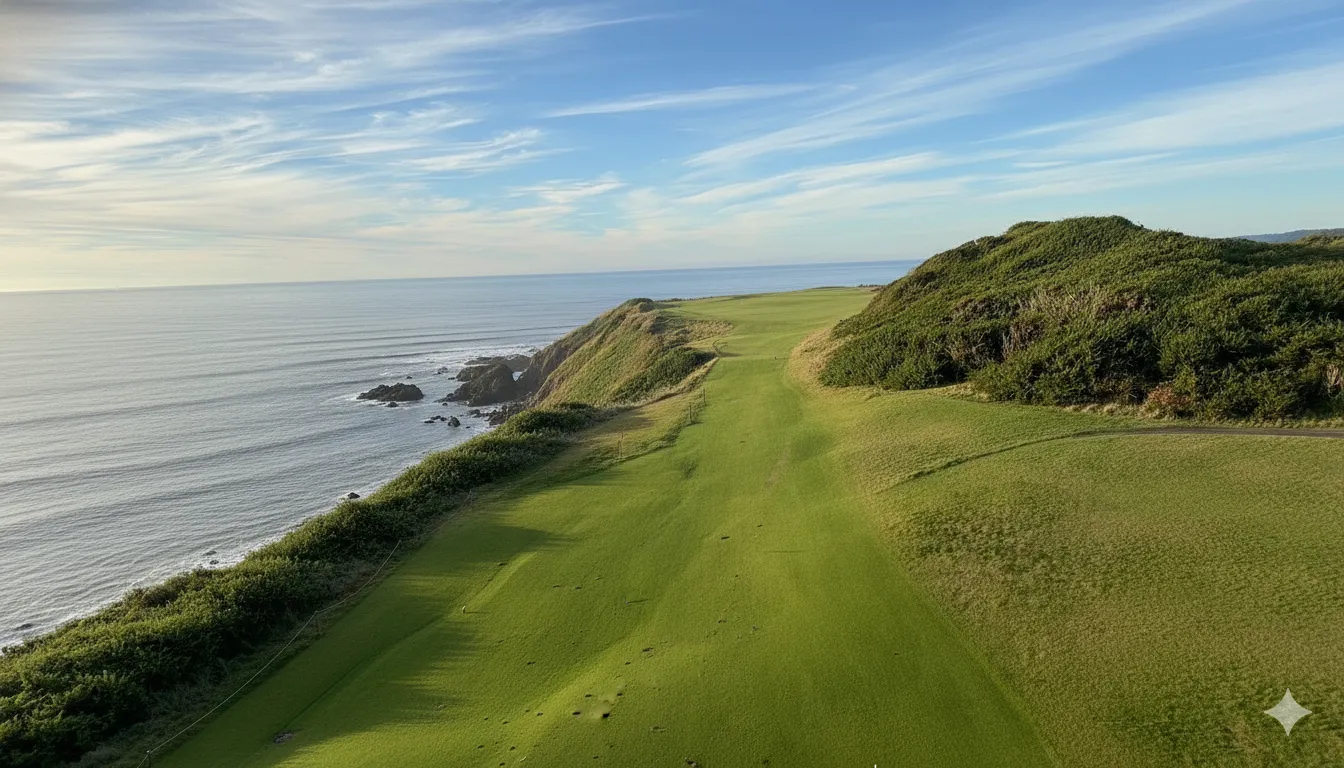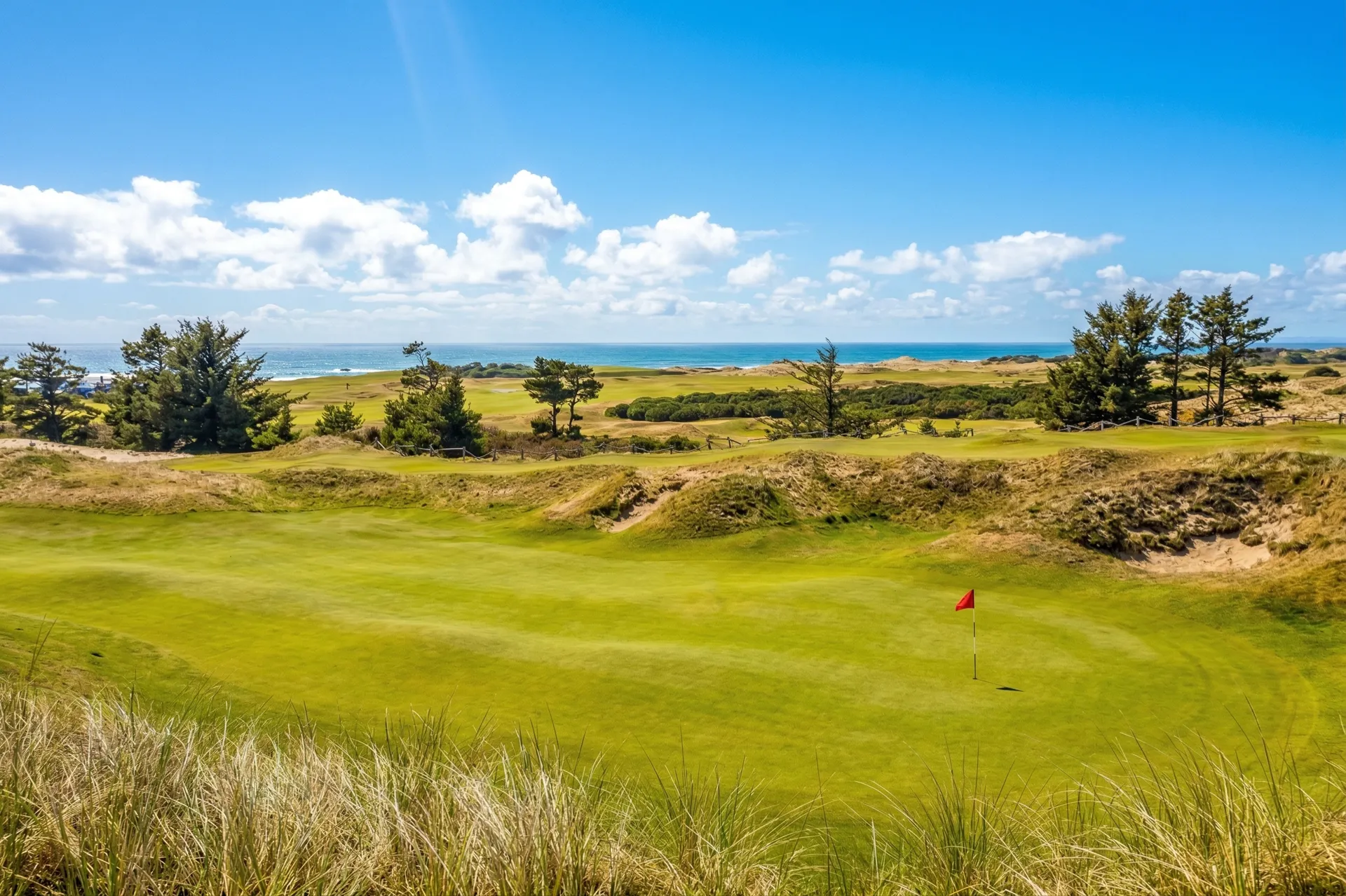
Every course at Bandon Dunes Resort occupies dramatic terrain. Bandon Preserve got the most dramatic parcel of all and built the smallest course on it. That is precisely the point.
Bill Coore and Ben Crenshaw opened the Preserve in 2012 as a 13-hole, par-3 layout stretched across 22 acres of plunging coastal dunes so exposed the championship routing teams left them alone. The land was choked with invasive European beachgrass and dense shore pines. Beneath that tangle, the Silvery Phacelia, a wildflower listed as threatened, was vanishing. Construction cleared the invasives. The phacelia population rebounded from 6,115 plants in 2014 to over 32,500 by 2020. Mike Keiser mandated that 100% of net green fee revenue fund the Wild Rivers Coast Alliance (now the Bandon Dunes Charitable Foundation), tying every round played to the preservation of Oregon’s southern coastline.
Keiser’s brief to the architects was specific: build par-3 holes that could stand alongside the best short holes on the championship courses. Not a practice facility. Not an afterthought. Real architecture on the most exposed land the resort owns, with the Pacific visible from every tee and every green. Coore and Crenshaw delivered the finest public short course in the country.
Where 100 Yards Demands Everything
The routing begins high atop a sand dune adjacent to the Bandon Trails clubhouse and tumbles downhill toward the Pacific through expanding ocean panoramas. It reaches its lowest point at the sheltered 6th hole, then climbs back through natural amphitheaters and coastal gorges to a dramatic downhill finish. Thirteen holes, 1,609 yards from the back tees, par 39. No hole longer than 150 yards from the back tees. None forgettable.
The turf is the same fine fescue as the championship courses: firm, fast, and hostile to high-spinning wedge shots. Afternoon winds off the Pacific routinely hit 30 to 40 mph, turning an 80-yard hole into a punch 5-iron and a 140-yard downwind shot into a wedge. The scorecard is decorative. Imagination is the only club that works every time.
The 6th (77 yards from the front tees, 131 from the back) delivers the most demanding tee shot on the course. The green is narrow, benched into a hillside, with a steep embankment on the right and four deep bunkers guarding the left. Sheltered by a dense treeline at the property’s lowest elevation, the hole feels claustrophobic after the wide-open ocean views of the preceding holes. The smart play targets short-right, using subtle contours to feed the ball onto the surface. The common outcome is the left bunkers.
The 13th (75 yards front, 109 back) was never supposed to exist. The course was designed as 12 holes. When clearing exposed a spectacular green site plunging steeply toward the ocean, the architects recognized its potential immediately. It plays dramatically downhill to a boomerang-shaped green fronted by tightly mown fairway that funnels ground shots toward the putting surface. This is the hole where players pull the putter from 100 yards, sending the ball down the natural half-pipe while the Pacific crashes below. It works. It may be the most fun shot in American golf.
The greens throughout are generously sized for the short distances, featuring dramatic undulations, punchbowls (the blind 8th is a particular gem at just 40 yards from the front tees), and natural funnels designed to accept bounding approaches. They reject aerial assaults: miss the wrong side of a slope and the ball rolls into collection areas or Coore and Crenshaw’s signature blowout bunkers. The course rewards creativity and the ground game above all else. It punishes anyone who insists on flying wedges at flags in a coastal gale.
The honest cost of the atmosphere is worth noting. The resort permits groups of up to eight, and afternoon rounds can turn festive and loud. Players looking for serene, fast-paced conditions should tee off early or accept the circus.
Making It Happen
The peak-season green fee is $125 for 13 holes (off-season and shoulder rates range from $60–$115). That strikes some golfers as steep when a championship replay costs roughly the same, but the counterargument is 90 minutes of the best short-game golf in the country, with every dollar of profit funding coastal conservation.
| Item | Cost |
|---|---|
| Green fee | $125 |
| Caddie per bag (before tip) | $125 |
| Standard caddie gratuity | $50–$100 |
| Pull cart | Free |
| Carry bag (from starter) | Free |
Caddies are not required but worth the investment for first-timers navigating blind shots and severe green contours. Purchase “Caddie Cash” at the front desk to pay caddies in cash after the round.
Booking strategy is simple: play the championship courses in the morning and schedule the Preserve as the afternoon wind-down. Walk-on availability is decent in late afternoon because the course plays fast and the starter fills gaps. For guaranteed tee times, enter the resort’s seasonal lottery drawings; registration windows open months before each season, and on-property lodging is essentially required for preferred access.
When to Go
| Window | Why |
|---|---|
| Nov–Feb 🌧️ Avoid | Pacific storms, heavy rain, limited daylight; deep-discount rates for the committed |
| Mar–Apr 🌤️ Good | Unpredictable weather, recovering turf, shoulder pricing |
| May–Jun ☀️ Prime | Firm conditions, long days, gorse in bloom; afternoon winds build to 30 mph |
| Jul–Aug ☀️ Prime | Peak warmth, driest conditions, strongest afternoon gales |
| Sep ☀️ Prime | Best month overall; winds ease, temperatures hold |
| Oct 🌤️ Good | Shoulder rates, cooling temps, variable weather |
Aeration schedules shift annually; confirm with the resort before booking.
The Preserve sits adjacent to the Bandon Trails clubhouse, accessible via the Trails End restaurant. The five championship courses fill the rest of the trip: Bandon Dunes (Kidd, 1999), Pacific Dunes (Doak, 2001), Bandon Trails (Coore & Crenshaw, 2005), Old Macdonald (Doak and Urbina, 2010), and Sheep Ranch (Coore & Crenshaw, 2020). Shorty’s, a newer 19-hole par-3 course, offers another short-game option. Southwest Oregon Regional Airport (OTH) in North Bend is 30 to 45 minutes from the resort with United Express connections through San Francisco year-round and Denver seasonally. Eugene (EUG) at 2.5 hours and Portland (PDX) at 4.5 hours offer more flight options but require a rental car.
Why the Shortest Walk Stays with You
Bandon Preserve does not compete with the championship courses for prestige or rankings. It does something harder: it proves that 1,609 yards of golf, played on the wildest ground the resort owns, can be the most talked-about round of a five-day trip.
Coore and Crenshaw will tell you it is supposed to be fun. It is. It is also the round where the wind forces invention, the conservation story adds weight beyond any scorecard, and the 13th hole rewards the golfer willing to putt from the tee box. Every great resort needs a course like this. Bandon built the standard.