In the 2020 U.S. Amateur final, Tyler Strafaci stood in the 18th fairway with the match all square through 35 holes. Marine fog had swallowed the course. He pulled a 4-iron from 245 yards, aimed into the void, and pleaded out loud: “Oh please be good.” The ball carried the bunkers, settled near the pin, and delivered the Havemeyer Trophy. He never saw where it landed.
That moment captures something essential about Bandon Dunes. Mike Keiser, a Chicago greeting card magnate, hired a 27-year-old Scotsman named David McLay Kidd to design it. The course opened in 1999 for golfers Keiser believed would drive five hours from Portland for walking-only links on sand dunes above the Pacific. The land dictated the routing. The weather dictated the strategy. The golfer walked every yard of it. Within three years, tee times were selling out a year in advance.
Bandon Dunes is not the prettiest layout at the resort (Pacific Dunes claims that) or the most strategically complex (Old Macdonald). It is the one that proved firm fescue, coastal wind, and a walking-only mandate could anchor a destination golf empire on the most remote stretch of the American coastline. The course that six subsequent designs were built to complement, not replace. The USGA agreed with the premise, committing 13 national championships to the resort through 2045. The tee sheet filled up long before the trophy case did.
Where the Ocean Enters the Conversation
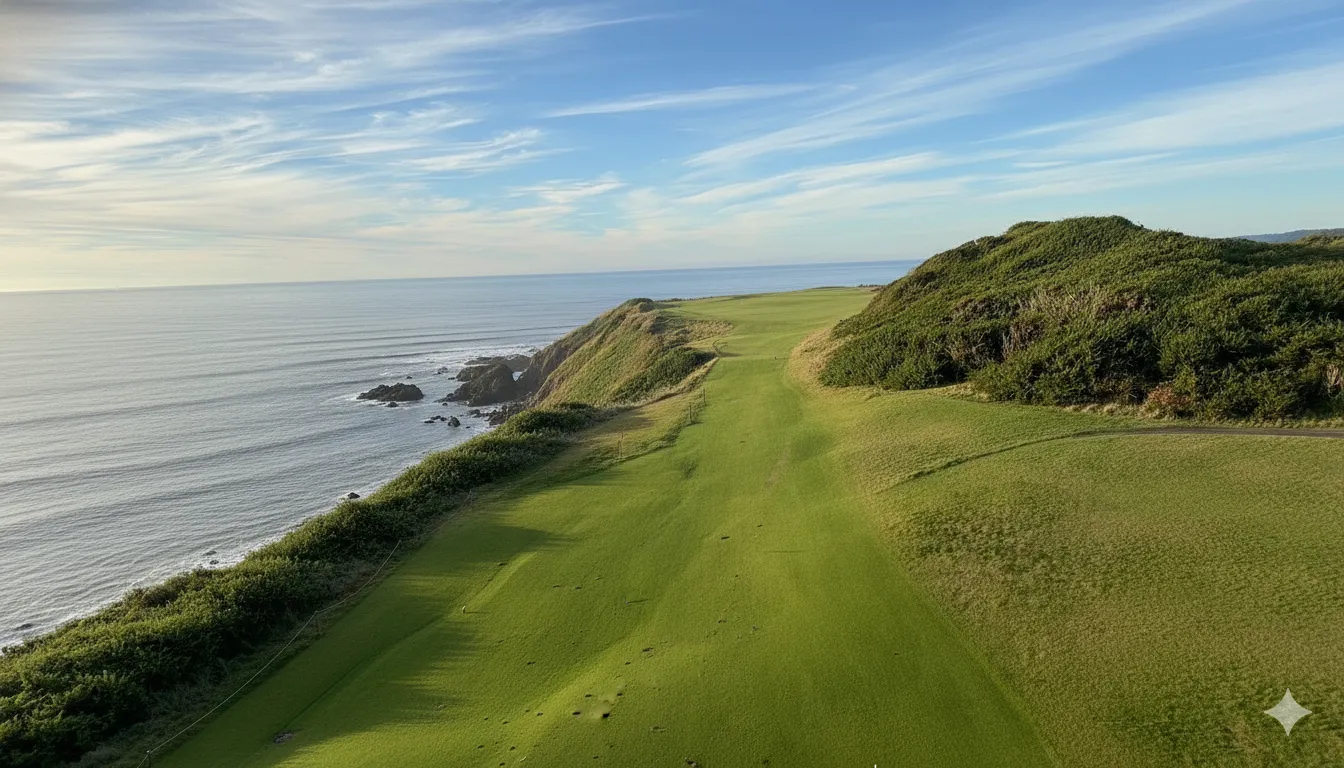
The routing builds like a controlled narrative. Three opening holes move through gorse-lined dunes and coastal forest, protected enough from wind to let the fescue turf introduce itself. The ball runs. The fairways are firm. The greens accept approaches along the ground. By the 3rd, a reachable par 5 that threads through natural drainage basins, the ground game has announced itself as non-negotiable.
Then the 4th hole changes everything.
The 4th (par 4, 410 yards from the Black tees) plays inland off the tee to a wide, undulating fairway. The reveal comes on the approach: the green sits on the bluff’s edge with the full Pacific filling the backdrop, surf crashing against the cliffs below. First-time visitors lose their approach shot to the view. Return visitors know the green slopes toward the cliff, the wind shoves everything right, and anything long vanishes into fescue that doesn’t return what it takes.
Holes 5 through 8 run along the coastal bluffs, fully exposed to wind that can shift 20 mph between shots. The temperature drops. The game compresses into low, running shots played beneath the weather. Wind is the course’s primary defense, sometimes demanding a 4-iron from 150 yards when summer northwesterlies are at full strength. This is where Kidd’s routing earns its reputation: the ocean stretch doesn’t merely change the scenery, it changes the sport.
The 15th (par 3, 163 yards from the Black tees) looks manageable from the tee. A heavily undulating green funnels aggressively toward a deep right bunker that dominates both the visual field and the outcome. Miss right and bogey is optimistic. The smart play is short-left, trusting a bump-and-run to find the putting surface, but it takes discipline to aim away from a flag the green itself is defending.
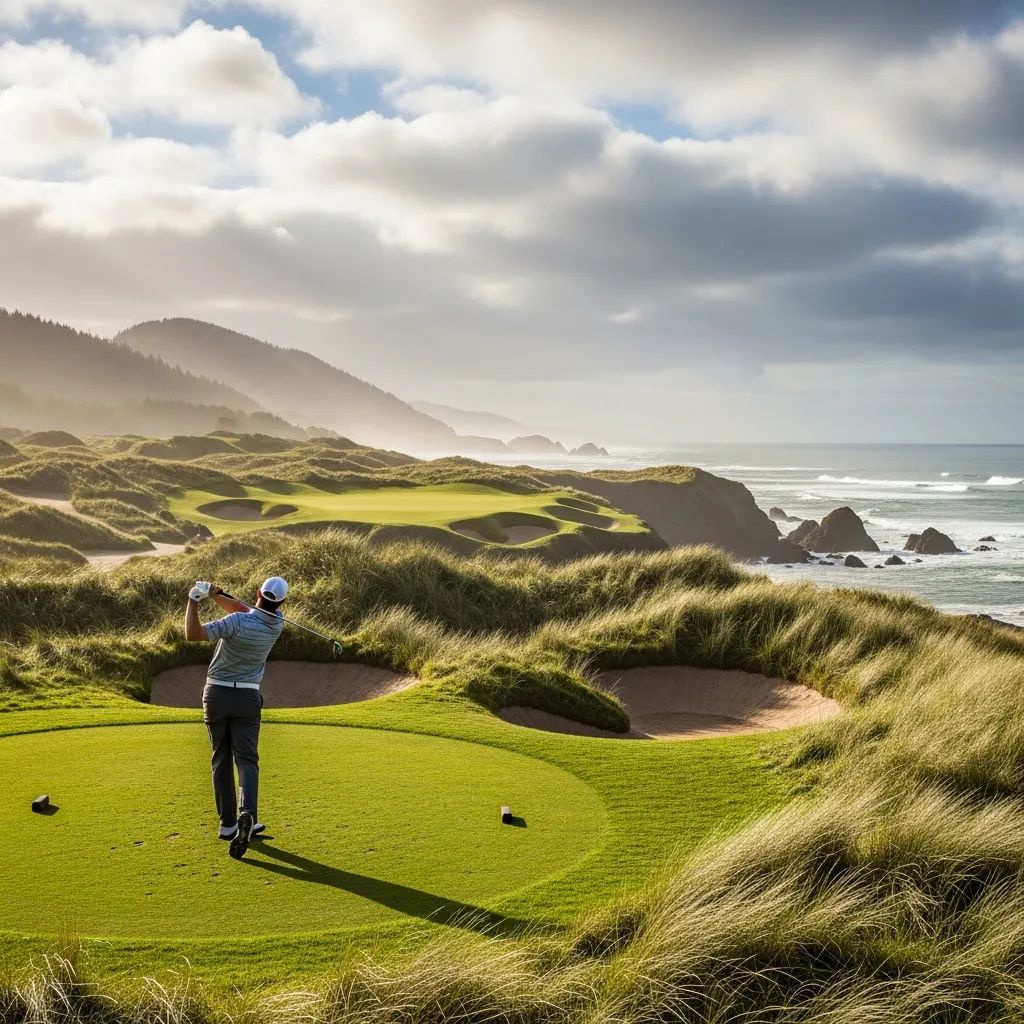
The 16th (par 4, 363 yards from the Black tees) is the course’s definitive risk-reward hole and one of the most photographed in Oregon. A gorge separates tee from fairway, and the green perches on a plateau with the Pacific immediately beyond the cliff edge. Big hitters can drive the green. Average golfers who try lose balls to the ocean. The disciplined play is a long iron off the tee and a precise wedge to a surface that punishes imprecision. The wind decides whether discipline or ambition is the correct strategy on any given day.
The back nine returns inland through rolling dunes where wind swirls rather than blasts. The 17th, surrounded by gorse with a green that evokes Royal Dornoch, captures the spirit of the inland stretch: natural hazards, subtle contours, and a demand for placement over power. Fescue fairways yield massive rollouts in dry conditions, and the greens are generous enough to putt from 40 yards off the surface.
Fine fescue on both fairways and greens produces a playing surface most American golfers have never encountered: firm, fast, and hostile to the high-spinning aerial approaches that work everywhere else. The course demands what links purists call the ground game. Players who adapt score. Players who resist spend the round arguing with the wind.
Planning the Trip
The course plays 6,732 yards from the Black tees (slope 143, rating 73.5) and 6,221 from the Green tees (slope 133, rating 71.1). The yardage is not what makes it difficult. The coastal elements are.
Costs
| Item | Cost | Notes |
|---|---|---|
| Green fee (resort guest, peak) | $375 | Staying on-site is the only reliable path to prime tee times |
| Green fee (day guest, peak) | $425 | Non-resort guests pay a premium |
| Replay rate | Half price | Second round same day |
| Caddie (single bag) | $125 + tip | Standard tip: $50–$80 per bag |
| Group caddie (per person) | $40 + tip | For a foursome; $50 for three, $60 for two |
Caddies are not mandatory but strongly recommended for first-time visitors. They know how the wind affects each hole at different times of day, where to miss, and which club the firm conditions actually require. A first round with a good caddie teaches more about links play than a week of tutorials. Light, single-strap bags under 25 pounds are expected.
When to Go
| Window | Why |
|---|---|
| Dec–Feb 🌧️ Avoid | Pacific storms, gale winds, heavy rain, limited daylight |
| Mar–Apr 🌤️ Good | Weather begins to break; rain gear remains non-negotiable; spring rates |
| May–Jun ☀️ Prime | Firm, fast conditions emerge as rain dissipates; excellent shoulder-season value |
| Jul–Aug ☀️ Prime | Warmest and driest months; strongest N/NW winds and peak pricing |
| Sep ☀️ Prime | Often the best month: winds ease, warmth holds, turf at its firmest |
| Oct 🌤️ Good | Fall shoulder season with great value before heavy rains return |
| Nov 🌧️ Avoid | Winter storm patterns return; heavy precipitation |
Aeration schedules vary by year, typically in spring and fall shoulder seasons. Check with the resort before booking.
Booking and Getting There
Tee times and lodging sell out 12 to 18 months in advance. The resort periodically opens calendar blocks for the following year, and a lottery system governs peak-season allocation. Staying on property is essential for booking priority and the discounted resort guest rate. Budget-conscious players targeting January or February can find day-guest rates near $180, though winter storms test commitment as thoroughly as they test waterproofing.
Southwest Oregon Regional Airport (OTH) in North Bend is 35 minutes away but serves limited routes, primarily United via San Francisco and Denver. Eugene Airport (EUG) offers more commercial options at 2.5 hours by car. Portland International (PDX) is a 4.5-to-5-hour drive down the coast. A rental car is necessary from EUG or PDX; shuttle services run from both airports for groups.
What Else to Play
The resort holds five championship courses and two shorter layouts. Pacific Dunes (Tom Doak) is consistently ranked the best course on the property, with spectacular cliffside holes. Bandon Trails (Coore & Crenshaw) routes through inland dunes and coastal forest. Old Macdonald (Doak & Urbina) offers enormous greens and template holes. Sheep Ranch (Coore & Crenshaw) delivers a mile of ocean frontage and zero sand bunkers. Bandon Preserve is a 13-hole par-3 where net proceeds benefit the Bandon Dunes Charitable Foundation.
A five-day trip is the minimum to play all five championship courses with a rest window. The physical toll is real: 36 holes means walking 12 to 14 miles in coastal wind over undulating terrain, and rounds routinely stretch past five hours. Most return visitors embrace it, using the replay rate to maximize their time on a property that rewards endurance.
Why the Original Still Anchors the Pilgrimage
Pacific Dunes is more dramatic. Old Macdonald is more cerebral. Sheep Ranch has more ocean. Every course built after the original has had the advantage of knowing the destination would succeed.
Kidd didn’t have that luxury. He designed on faith: faith that the fescue would take, that the wind would become a feature rather than a flaw, that golfers would embrace a course where carts don’t exist and the weather is half the challenge. The result is a layout that doesn’t compete with its neighbors for spectacle. It competes with every course its visitors have ever played for honesty.
The USGA has committed 13 championships to the resort through 2045. The tee sheet fills months in advance. Strafaci couldn’t see where his 4-iron landed that day in the fog. He trusted the shot, trusted the course, trusted the conditions. That’s the whole argument for Bandon Dunes, compressed into a single swing.