Every great golf destination has a course the locals claim as their own. At Bandon, it is not on the resort.
Dan Hixson had never designed a full 18-hole course when Rex and Carla Smith hired him in 2005 to build one on 340 acres of former cattle ranch a few miles inland from the Pacific. The former club professional spent nearly 200 days on site, burning stumps through the winter of 2006 to reveal the ancient sand dunes buried beneath coastal forest and impassable gorse. The result opened in 2007 to national acclaim, routed through terrain most architects never get to touch. What happened next is more telling: roughly 18 percent of rounds at Bandon Crossings are played by caddies and pros who work at Bandon Dunes Resort. They come for the power carts (forbidden up the road), the shelter from coastal gales, and green fees that start at $96 instead of $375.
The people who play the best links in America every day choose Crossings on their days off. Not out of obligation. Out of preference for a course that delivers strategic golf without the physical toll or the price tag.
Heathland on a Cattle Ranch
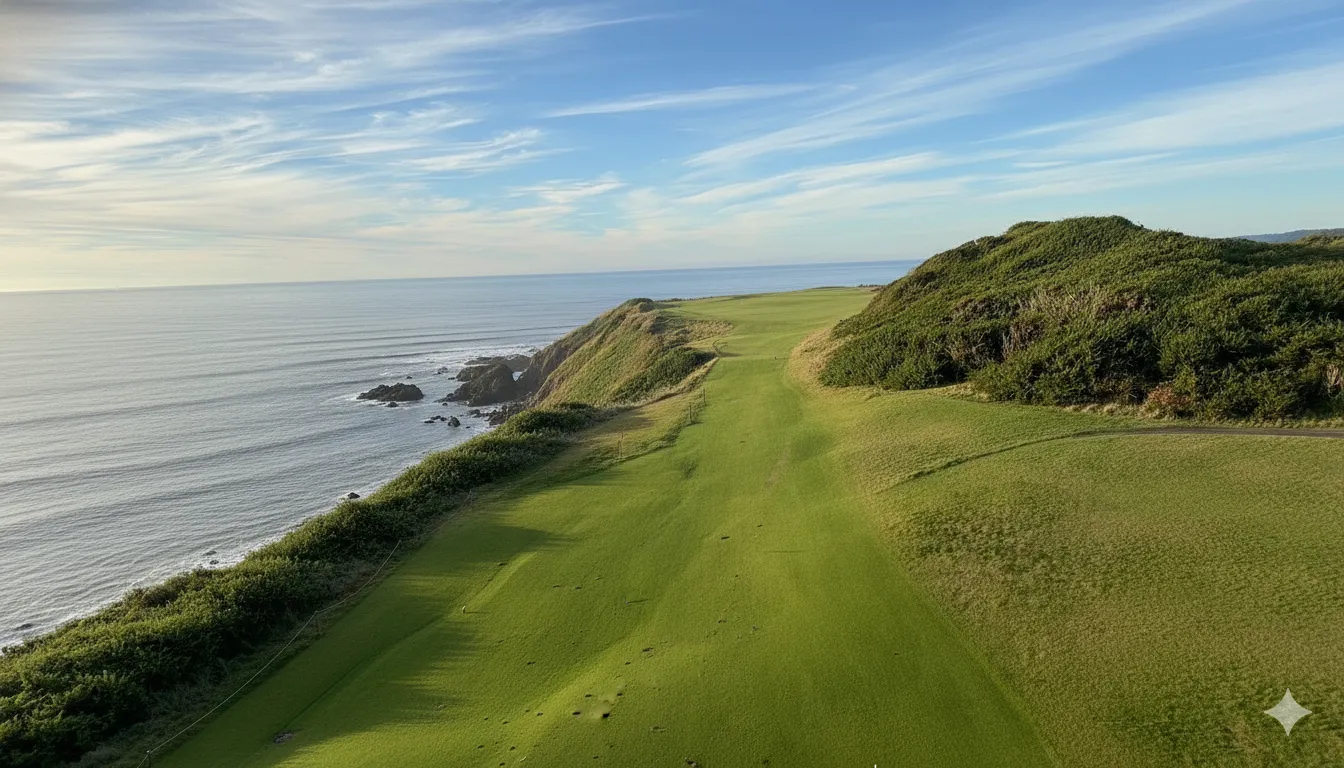
The routing splits into two distinct personalities. The opening and closing holes play through wide-open, rolling heathland dunes and marshland crossings over Twomile Creek, gorse and native scrub stretching toward the Coast Range in a landscape that owes more to Sunningdale than St Andrews. The middle stretch shifts into tight corridors of towering coastal pine and madrone where the wind vanishes and shotmaking replaces distance. Old corrals and rustic fencing from the property’s ranching days surface throughout the round, quiet evidence that this was grazing land before it was golf.
What ties both halves together is the greens. A-4 bentgrass surfaces with severe back-to-front slopes serve as the primary defense. Several (notably the 15th and 17th) are shallow enough to make distance control the defining skill. Leave the ball above the hole and the downhill putt runs ten feet past. There are no gimmes on Hixson’s greens.
The 14th (par 3, 155 yards from the White tees, 190 from the Black) is called “The Drop,” and the name is earned. The tee sits atop a promontory; the green is 90 feet below. Club selection becomes an exercise in faith: the ball hangs in the air long enough to question every decision that led to this tee box. Most players fly the green because the elevation drop makes everything play two clubs shorter than the card suggests. The correct play is smooth tempo with less club, trusting gravity to do the work.
The 18th (par 5, 495 yards from the White tees, 570 from the Black) demands a decision before the backswing. A lone bunker guards the inside of the dogleg; carrying it (a 250-yard-plus commitment from the Black tees) opens the green in two. The safer line left leaves a third shot over a deep ravine bisecting the fairway. Players who clear the ravine find a right-side contour that acts as a funnel, rewarding a bump-and-run approach onto the green. The three-shot route is smart. The two-shot route is what gets discussed over beers. Both end at a green framed by marshland and the clubhouse beyond, a natural finishing amphitheater for a course that never needed a grandstand.
The course rewards positional play and ground game above pure distance. Hixson’s fairways offer generous initial landing zones, but missing by more than seven yards in either direction often means a lost ball in native hazard. The heathland turf runs firm and fast on winter rye fairways, rewarding the same bump-and-run game the resort neighbors demand. The honest caveats: several blind tee shots over dune crests punish first-timers without local knowledge, green severity borders on punitive when summer conditions firm up, and the clubhouse offers sandwiches and beer rather than white tablecloths. Nobody comes here for the amenities. They come for the golf.
Getting a Tee Time (For Almost Nothing)
| Item | Cost |
|---|---|
| 18 holes, walking (peak) | $96 |
| 18 holes, with cart (peak) | $120 |
| 9 holes, walking (peak) | $60 |
| Super Walker after 5:30 PM | $30 |
| 18 holes, walking (winter) | $70 |
| Caddie per bag (before tip) | $110 |
Tee times are bookable online or by phone. No lottery, no resort reservation required, no months-long planning window. Walk-on play is generally accommodating outside of summer mornings. For peak season, book mornings early; the twilight rate makes 18 holes cost less than a single resort replay round.
Caddies are available by advance arrangement but not required. The more popular choice is a cart, and arguably the smarter one: Crossings serves as physical recovery from the walking-only resort courses. Schedule it mid-trip to rest the legs without sacrificing quality golf.
When to Go
| Window | Why |
|---|---|
| Jan–Mar 🌧️ Avoid | Pacific storms, soft turf, heavy rain; winter rates drop to $70 walking |
| Apr–May 🌤️ Good | Spring recovery, firming fairways, fewer crowds |
| Jun–Sep ☀️ Prime | Warm, dry, firm turf; inland location runs up to 10°F warmer than the coast |
| Oct 🌤️ Good | Crisp fall weather, thinning crowds, shoulder pricing |
| Nov–Dec 🌧️ Avoid | Wet season returns; limited daylight |
The inland location shields Crossings from the worst coastal fog and wind that can make the resort courses uncomfortable in July and August.
The five championship courses at Bandon Dunes Resort sit 15 minutes up the road: Bandon Dunes, Pacific Dunes, Bandon Trails, Old Macdonald, and Sheep Ranch. Crossings operates independently with no resort affiliation, making it an ideal rest-day round or a cheaper addition to any Bandon itinerary. Guests staying at partner properties like Bandon Vistas receive discounted “Crossings Club” rates.
Southwest Oregon Regional Airport (OTH) in North Bend is a 35-minute drive, with United Express connections through San Francisco and Denver. Eugene (EUG, 2.5 hours) and Portland (PDX, 4.5 hours) offer more flight options. A rental car is non-negotiable.
Why the Locals Built Their Own
Rex and Carla Smith didn’t build Bandon Crossings because the area needed another course near a world-famous resort. They built it because the area needed a course that wasn’t one. A place where green fees don’t require a financial advisor, where a cart is available after three days of walking 36, and where the golf is demanding enough that the professionals who work at the best public courses in America choose it when the choice is entirely theirs.
That’s not a budget alternative. That’s a verdict.