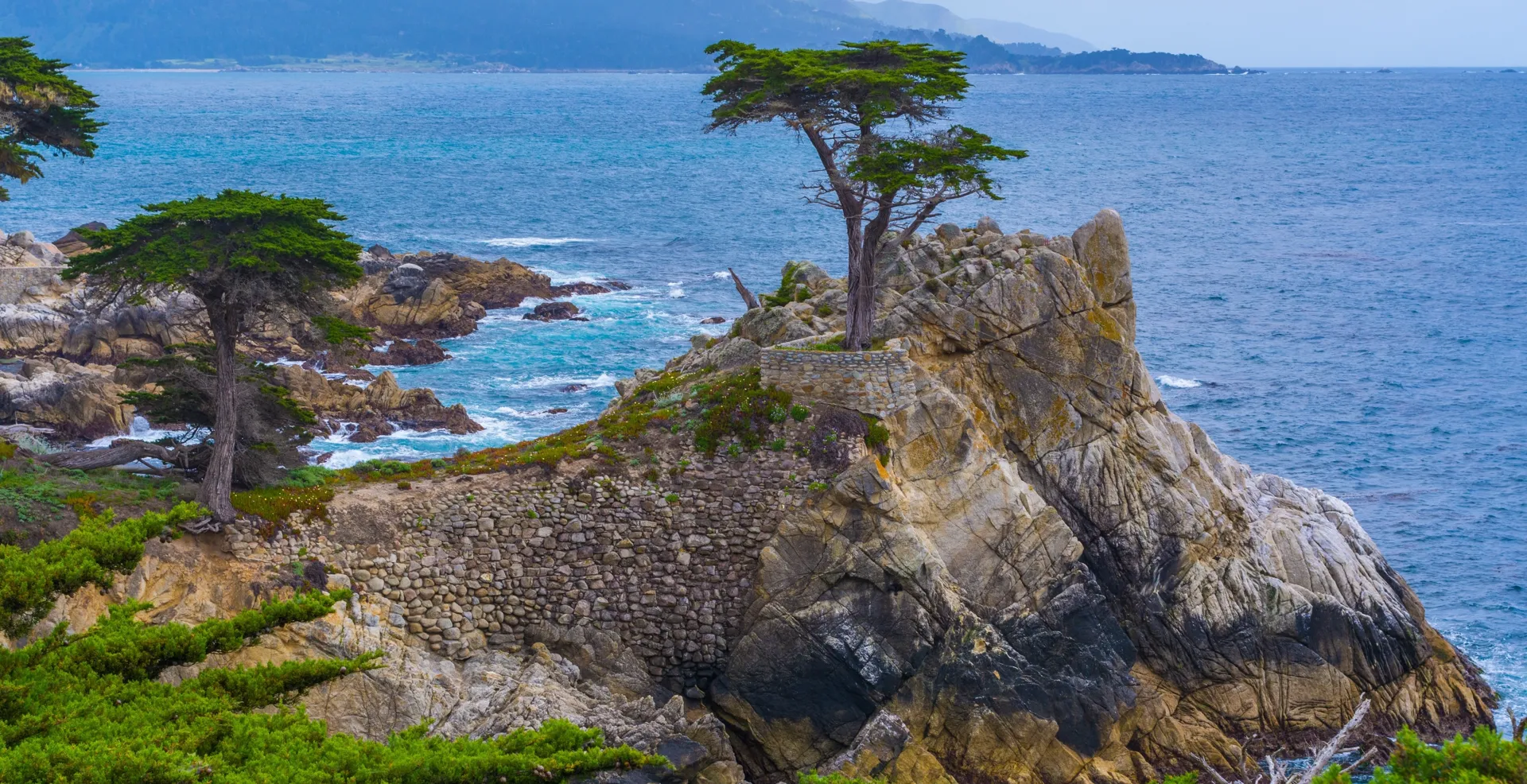
Jack Nicklaus once observed that Pebble Beach and Cypress Point make golfers want to play. Spyglass Hill, he said, makes them want to go fishing. He was not being entirely unfair.
Robert Trent Jones Sr. built Spyglass Hill in 1966 on a stretch of Monterey Peninsula terrain that Robert Trent Jones Sr. would later describe to his son as “a diamond field”: coastal dunes tumbling into dense Monterey pine forest, with the Pacific providing unsolicited commentary from the west. Jones did what Jones did best. He made it beautiful, he made it strategic, and he made it hurt. The course carries a slope of 145 from the Blue tees, co-hosts the PGA Tour’s AT&T Pebble Beach Pro-Am annually, and has hosted two U.S. Amateur Championships (1999, 2018). During the 1999 qualifying rounds, the world’s best amateur golfers posted a stroke average north of 79. Spyglass Hill does not grade on a curve.
The naming tells everything about the personality. Originally slated as “Pebble Beach Pines,” the course was renamed Spyglass Hill by Del Monte Properties chairman Samuel F.B. Morse. NCGA executive director Bob Hanna then named every hole after characters and locations from Robert Louis Stevenson’s Treasure Island: Billy Bones, Blind Pew, Long John Silver. A course named for pirates has no obligation to be forgiving, and Spyglass Hill honors that obligation with remarkable consistency.
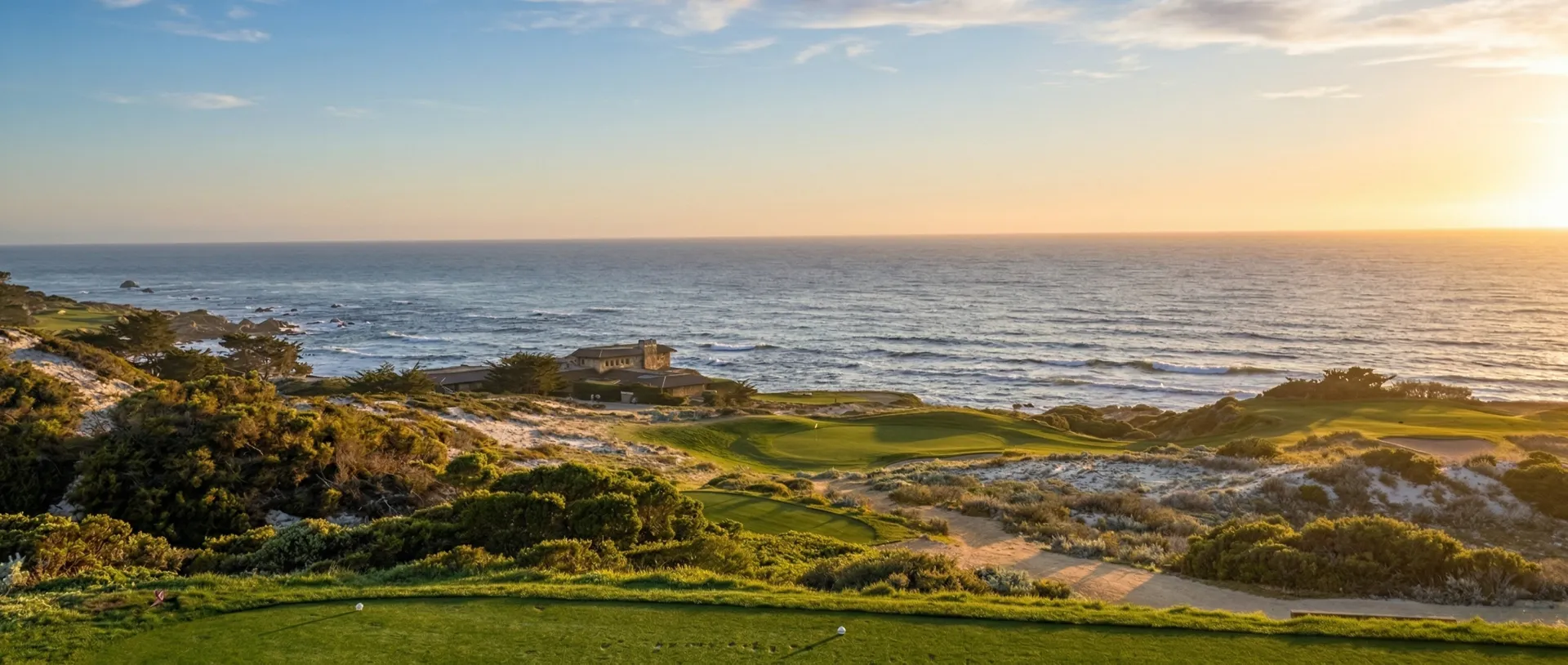
What makes it architecturally singular is the collision. The first five holes play as a rugged coastal links, wind-whipped and visually stunning, with the Pacific stretching to the horizon. The remaining thirteen plunge into the Del Monte Forest for a claustrophobic, target-golf reckoning among towering pines. Two courses, one scorecard, zero mercy.
Where the Ocean Ends and the Forest Begins
The opening holes set the terms. The 1st drops steeply from an elevated tee through a sweeping par-5 dogleg, the Pacific glittering beyond the dunes. The fairway is generous, the views are extraordinary, and the scoring feels manageable. This is Jones being polite before he stops being polite.
The 3rd, “The Black Spot” (par 3, 165 yards from the Blue tees), plays downhill toward the Pacific Ocean. The green sits exposed among sandy waste and ice plant, the surf crashing beyond it, the wind determining everything. An onshore headwind can demand three extra clubs from a yardage that looks like a comfortable 8-iron on the scorecard. From the green, Cypress Point’s clubhouse appears close enough to study the lunch menu, a reminder that the most exclusive club in America operates within shouting distance. The play is to ignore the flag, flight a low iron to the center of the putting surface, and treat a two-putt par as the achievement it is.
The 4th, “Blind Pew” (par 4, 370 yards from the Blue tees), was Jones’s self-proclaimed favorite par 4. A dogleg left requiring a 220-yard placement drive to stay right of the coastal waste, followed by an approach to a green that measures 10 paces wide and more than 50 yards deep. Thirty feet of width. One hundred sixty-five feet of depth. The target looks like a green ribbon wedged between dunes, and the slope runs severely front to back, rewarding the counterintuitive play of landing the approach long. Jones called it “one of the most challenging par-fours I have ever designed.” Given the breadth of his portfolio, the claim carries weight.
The 6th tee marks the pivot. The routing turns uphill into the Del Monte Forest, the ocean vanishes, and the character of the round changes entirely. Wind gives way to stillness, panoramic views compress to corridors of Monterey pine, and shot demands shift from low, ground-game creativity to high, soft approaches into elevated, heavily bunkered greens. The 8th, rated the number-one handicap hole, delivers a punishing uphill approach to an undulating green that rejects anything less than precision. The 13th plays 460 yards from the Blue tees through a tree-lined chute requiring two perfectly struck shots with no margin for lateral error. The forest section does not photograph as memorably as the coastline, but it is where the scorecard absorbs its real damage.
The 14th, “Long John Silver” (par 5, 560 yards from the Blue tees), is the longest hole in the forest section, a serpentine three-shot par 5 winding through dense pines. No fairway bunkers, but the landing areas are choked by trees, and the green is elevated with a pond guarding the front right. The temptation to reach in two is the trap. Smart play maps backward from the pin, laying up to 110 yards on the left side to take the water entirely out of play for the wedge approach. The green complex reflected in the fronting pond creates a scene worth pausing for, assuming the scorecard allows it.
Two features define the Spyglass experience across all eighteen holes. The Poa annua greens grow throughout the day, producing bumpy, unpredictable putting surfaces by late afternoon (a morning tee time is less a suggestion than a strategy). And the Bermuda-fescue rough in the forest sections is dense enough that locals describe hacking through it as “swinging through Velcro.” Spyglass rewards the player who works backward from the green, controls trajectory, and understands that position matters more than power.
Planning the Trip
What It Costs
| Item | Cost | Notes |
|---|---|---|
| Green fee | $550 | Resort guest and public rate |
| Cart fee | $60 | Cart-path only; waived for some resort packages |
| Pull cart | $20 | Available at the pro shop for walkers |
| Single caddie | $160 per bag | Plus $70–$100 recommended gratuity |
| Forecaddie | $55 per person | Minimum 3 players; plus $35–$50 gratuity |
| Club rental | $115–$130 | Premium rental sets available |
A caddie is worth the investment. Spyglass has enough blind shots, deceptive green contours, and hidden collection areas that local knowledge measurably improves the round. Book through CaddieMaster at least 72 hours in advance; fulfillment is based on availability and not guaranteed.
Booking Strategy
Resort guests at The Lodge at Pebble Beach or The Inn at Spanish Bay can book tee times up to 18 months in advance. Non-resort guests can book 90 days out. The optimal approach: mark the calendar and call the reservation line at 7:00 a.m. PST on the 90-day mark, requesting a morning tee time. Spyglass is the easiest of the resort’s three championship courses to secure for outside play, but afternoon slots fill quickly. For same-day cancellations, call the Spyglass Hill pro shop directly at 6:00 a.m.
When to Go
| Window | Why |
|---|---|
| Jan–Feb 🌧️ Avoid | Pacific storms, soft turf, limited daylight |
| Mar–Apr 🌤️ Good | Spring warmth arrives; watch for early April greens aeration |
| May–Jun ☁️ Good | ”May Gray” and “June Gloom” bring thick morning marine fog; clears by afternoon |
| Jul–Aug ☀️ Prime | Warm, dry, essentially zero rain; expect peak pricing |
| Sep–Oct ☀️ Prime | Best window: warmest temps, clearest skies, no marine layer, thinning crowds |
| Nov 🌤️ Good | Shoulder rates begin; cooling temperatures, occasional rain |
| Dec 🌧️ Avoid | Cold, frequent rain, heavy marine moisture |
Aeration windows typically fall in early April and late September. Greens may be sandy and bumpy for 10–14 days following core aeration; discounted rates are occasionally available during these periods.
Where to Stay
| Property | Nightly Rate | Booking Advantage |
|---|---|---|
| The Lodge at Pebble Beach | $1,100+ | 18-month advance golf booking; 5 minutes to the course |
| The Inn at Spanish Bay | $850+ | Same 18-month window; sunset bagpiper included |
| Monterey Plaza Hotel | $350–$550 | Best waterfront option off-property; 15 minutes |
| Stilwell Hotel, Carmel | $250–$400 | Best value; charming downtown Carmel-by-the-Sea |
Getting There
Monterey Regional Airport (MRY) is a 10–15 minute drive, with direct flights from SFO, LAX, Phoenix, Dallas, Denver, and Seattle. San Jose International (SJC) is 90 minutes north; San Francisco International (SFO) is roughly two hours. A rental car provides the most flexibility, though resort guests have access to complimentary Lexus shuttle service between Pebble Beach properties. Golfers with confirmed tee times enter via the 17-Mile Drive at no charge.
What Else to Play
The Monterey Peninsula packs more architecturally distinct golf per square mile than any comparable American destination. Pebble Beach Golf Links ($695, five minutes) is the obvious pairing. Poppy Hills ($350) offers a firm-and-fast forest alternative inside the Del Monte Forest gates. Pacific Grove Golf Links ($70–$90, ten minutes) sends its back nine along the ocean for a fraction of the resort price, earning its local nickname: “the poor man’s Pebble Beach.” For the full trip-planning framework, including itineraries and budget tiers, see the Monterey Peninsula destination guide.
Why the Pirate Ship Is Worth Boarding
Every course on the Monterey Peninsula sells something slightly different. Pebble Beach sells the coastline. Cypress Point sells the dream. Spyglass Hill sells the reckoning.
It will never be the most famous course in the Del Monte Forest. The photographs from Pebble’s 7th hole will always win the desktop-wallpaper competition. But Spyglass asks a question the prettier courses do not: can a golfer play two entirely different games, back to back, under conditions that shift from open coast to sealed forest with no transition and no apology? The players who answer that question well, flighting it low through Pacific wind at the 3rd and shaping it high through the pines at the 14th, tend to consider the $550 green fee one of the better investments on the peninsula. They are not wrong.
Pulitzer Prize-winning columnist Jim Murray once wrote that if Spyglass Hill were human, it would have “a knife in its teeth, a patch on its eye, a ring in its ear, tobacco in its beard, and a blunderbuss in its hand.” Six decades later, the pirate hasn’t mellowed. It still takes what it wants.