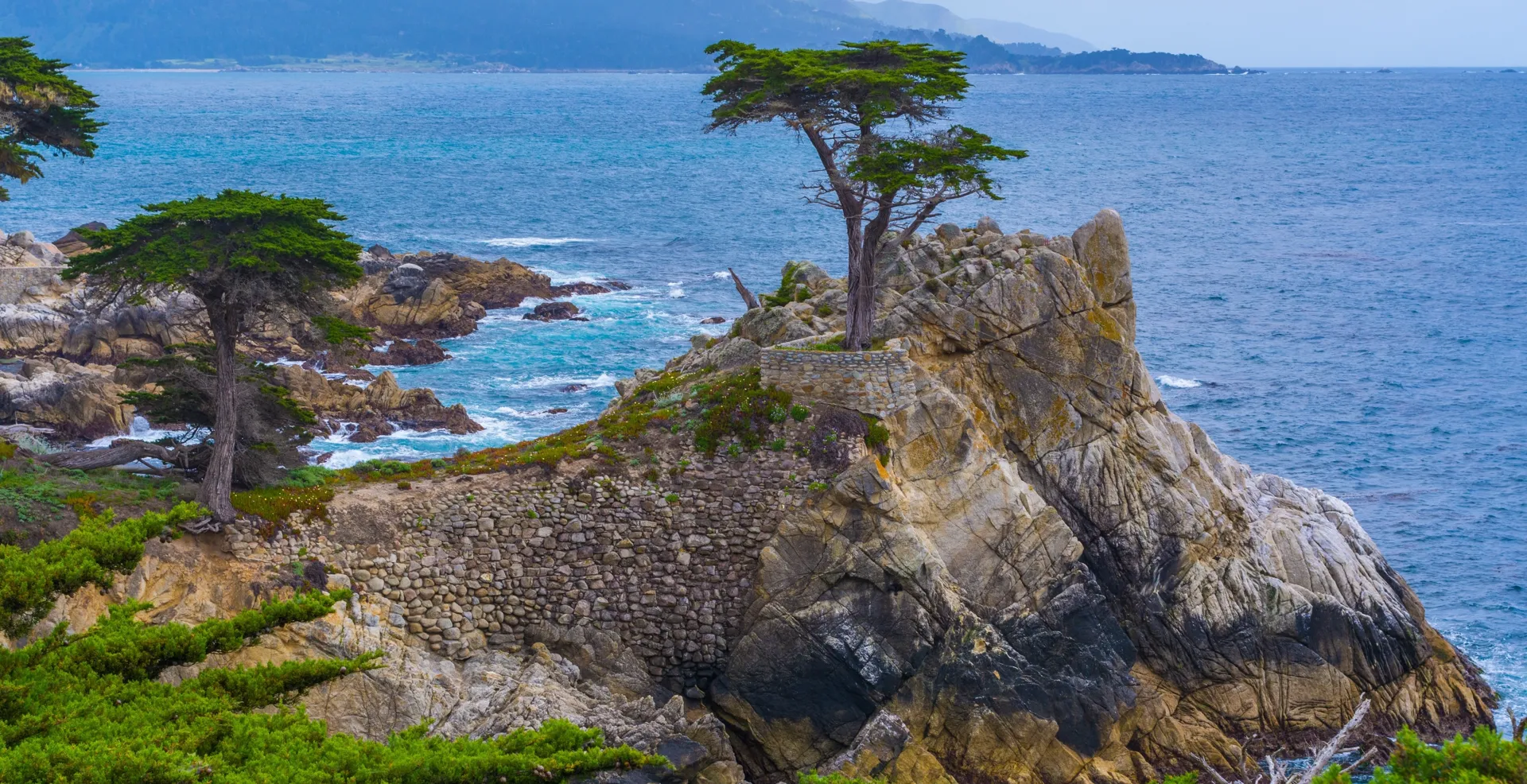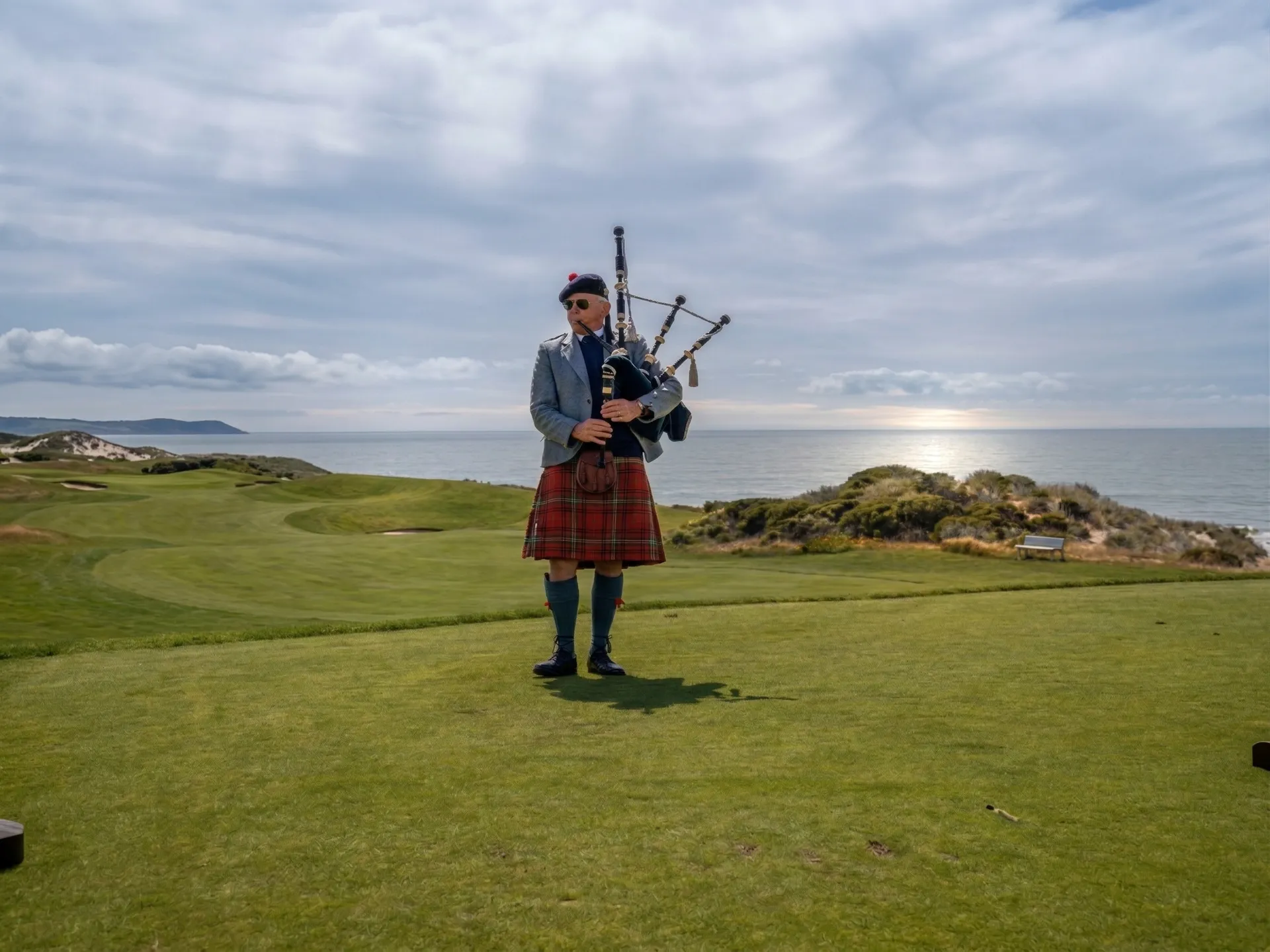
Tom Watson played every links course worth playing in Scotland before he helped design one in California. On November 5, 1987, he walked The Links at Spanish Bay for the first time and shot 67, a course record that still stands nearly four decades later. Stepping off the 18th green, Watson offered his assessment: the coastal winds and rolling dunes felt so much like Scotland that only a bagpiper was missing. Pebble Beach Resorts took him literally. Every evening since, a lone piper has marched down the first fairway at sunset, serenading the Pacific.
The bagpiper turned out to be the most enduring design decision at Spanish Bay. The course itself, shaped by Robert Trent Jones Jr., Watson, and Sandy Tatum from a reclaimed sand mine on the Monterey Peninsula’s western edge, has spent its life caught between two identities: the ground-game links its creators envisioned and the penal target-golf layout they actually built. Excessive mounding, blind tee shots, and forced carries over environmentally sensitive dune habitat gave the routing a split personality that $350 and a bagpiper couldn’t quite resolve.
As of March 2026, Spanish Bay is closed. Gil Hanse and Jim Wagner are leading a 13-month renovation projected to reopen in spring 2027, widening fairways by 30%, expanding greens by 40%, and stripping away the 1980s architectural clutter that kept the site from living up to its setting. The par shifts from 72 to 71, the current 13th hole gives way to an all-new par-3, and championship tees stretch to 7,115 yards. The timing is deliberate: the 2027 U.S. Open returns to neighboring Pebble Beach Golf Links, and the peninsula’s third course intends to reopen as a peer, not an afterthought.
Where the Dunes Meet the Forest
The routing at Spanish Bay moves through three distinct moods. The opening five holes dart through coastal dunes, where the Pacific fills the periphery and Northwest winds dictate club selection on every swing. The middle holes climb into the Del Monte Forest, trading sea spray for pine canopy and demanding a parkland precision that feels like a different course entirely. The closing stretch plunges back toward the beach for a wind-swept finale, the ocean reclaiming both the soundtrack and the scoring threats.
The 1st hole (par 5, 500 yards from the Blue tees) announces Spanish Bay’s intentions. It tilts downhill from the clubhouse directly toward the crashing Pacific, the sound of surf arriving before the first swing leaves the clubface. The prevailing wind pushes everything right, toward dune grass that swallows golf balls without apology. Longer hitters who thread a penetrating tee shot through the crosswind can reach the green in two; the safer play requires a layup that still demands accuracy between encroaching native areas on both sides. It is the course at its most honest: beautiful, exposed, and punishing the moment concentration wavers.
The 5th hole (par 4, 454 yards from the Blue tees) is the number-one handicap hole and the most strategically compelling on the property. Three pot bunkers split the fairway at driving distance, forcing a decision that defines the rest of the hole. Play left for safety and face a longer approach into the prevailing wind. Squeeze the ball up the narrow right corridor and earn a wedge to a green set against an ocean backdrop that makes the aggressive line irresistible and the consequences for failure severe. The 5th captures what Spanish Bay can be when the architecture steps aside: genuine risk-reward, framed by natural terrain, with the Pacific as both scenery and accomplice.
Conditions and Character
Fairways run a rye-fescue blend that plays firmer than typical resort turf, though softer than true Scottish links. The Poa annua greens are heavily contoured, with multiple tiers that reject approaches landing on the wrong level. Wind is the constant: Northwest trades off the Pacific sweep across the layout most afternoons, regularly reaching 40 knots and transforming manageable morning holes into survival exercises. The afternoon gusts, in particular, make the back nine’s coastal return feel less like golf and more like negotiation.
Players who control trajectory thrive here. A low, penetrating ball flight handles the wind; high-spin aerial attacks get punished. The environmentally sensitive areas scattered throughout the routing add an unusual complication: errant shots landing in protected dune habitat require mandatory free drops, which sounds generous until it happens three times in nine holes. Pace of play suffers accordingly; five-hour rounds are common, driven by lost balls, cart-path-only restrictions, and heavy resort traffic.
Planning the Trip
Spanish Bay is closed for the Hanse renovation, with a projected spring 2027 reopening. The details below reflect pre-renovation conditions; green fees and course specifics will likely change when the new layout debuts.
Costs
| Item | Cost |
|---|---|
| Green fee | $350 |
| Cart fee | $55 (included for resort guests) |
| Pull cart rental | $20 |
| Single caddie | $155–$160 per bag (gratuity not included) |
| Forecaddie | $52.50–$55 per person (min. 3 players) |
| Club rental | $115 per bag |
Caddies are recommended but not required. Book at least 72 hours in advance through Caddie Services.
Booking Strategy
Resort guests staying at The Inn at Spanish Bay, The Lodge at Pebble Beach, or Casa Palmero can reserve tee times up to 18 months in advance. Non-resort guests face a six-month window. Singles and twosomes have the best luck filling cancellation slots; call the pro shop at 7:00 AM Pacific exactly 24 hours ahead. Midweek afternoons offer the most realistic walk-on access.
Where to Stay
| Property | Nightly Rate | Notes |
|---|---|---|
| The Inn at Spanish Bay | $1,000+ | On-site; ocean views, nightly bagpiper |
| The Lodge at Pebble Beach | $1,100+ | 3 miles; overlooks Pebble Beach 18th green |
| Portola Hotel & Spa | $250+ | 6 miles; solid mid-range option in Monterey |
| Tradewinds Carmel | $300+ | 5 miles; boutique option in Carmel-by-the-Sea |
When to Go
| Window | Why |
|---|---|
| Dec–Feb 🌧️ Avoid | Pacific storms, cold winds, soft turf |
| Mar–May 🌤️ Good | Spring conditions, moderate winds, lingering rain risk |
| Jun–Aug ☁️ Good | Marine fog delays mornings; afternoon winds build; pack layers |
| Sep–Oct ☀️ Prime | Clearest skies, warm days, firm turf, no marine layer |
| Nov 🌤️ Good | Shoulder rates, cooling temps, shorter days |
Aeration historically falls in mid-August. Post-renovation scheduling may shift.
What Else to Play
Spanish Bay sits at the center of American golf’s richest cluster. Pebble Beach Golf Links ($695) is ten minutes away and needs no introduction. Spyglass Hill ($550) delivers arguably the toughest test on the peninsula, blending coastal dunes with deep pine forest. For a gentler start, Del Monte Golf Course ($150) is the oldest continuously operating course west of the Mississippi, and The Hay ($75), Tiger Woods’ nine-hole par-3 design, makes a perfect arrival-day warm-up. Pacific Grove Golf Links ($66–$89), known locally as the “poor man’s Pebble,” features a stunning oceanfront back nine at municipal prices.
Getting There
Monterey Regional Airport (MRY) is a 20-minute drive, with regional jet service from SFO, LAX, DFW, and other major hubs. San Jose International (SJC) is 90 minutes out and offers broader flight options. All resort-bound traffic enters via 17-Mile Drive; resort guests have the toll waived.
Why the Accent Is About to Get Real
The question at Spanish Bay was never whether the setting deserved a great golf course. Reclaimed sand dunes, Pacific headlands, wind that tests every club in the bag: the raw material was always extraordinary. The question was whether the course built on it in 1987 measured up. For nearly four decades, the answer was a polite shrug — and a consolation bagpiper.
Gil Hanse’s renovation is the peninsula’s acknowledgment that the original design fell short of the site’s potential. Wider fairways, expanded greens, and the removal of artificial mounding won’t just improve playability; they’ll let the landscape speak for itself. When Spanish Bay reopens in 2027, it will debut alongside the U.S. Open at Pebble Beach, and for the first time in its history, it won’t be the course visitors play because they couldn’t get on the other two — it will be the one they choose.
The bagpiper, for the record, is staying.