Two amateur golfers designed Pebble Beach. No degrees, no apprenticeships, no portfolio of previous work to point to. In 1919, Jack Neville and Douglas Grant walked the Monterey Peninsula, looked at one of the most dramatic coastlines on earth, and essentially said: “We should probably not ruin this.” It remains the most important design decision in American golf history, and it required doing almost nothing.
Pebble Beach Golf Links is what happens when the Pacific Ocean does ninety percent of the work and two amateurs have the good sense to let it. The cliffs were already there. The coves were already there. Stillwater Bay was already doing its thing, which primarily involves looking spectacular and swallowing golf balls. Neville and Grant’s genius was routing: finding the holes the land had been holding for centuries, waiting for someone to notice. The land had been patient. The land had been very patient.
Six U.S. Opens have been decided here: Nicklaus wire-to-wire in 1972, Watson’s impossible chip-in in 1982, Tiger’s 15-stroke demolition in 2000. The names carved into Pebble Beach history are the names carved into the sport’s mythology, and the course is public. Tomorrow, for $695 and whatever remains of your dignity, anyone can stand on the same first tee. The Pacific will not care who you are. The Poa annua greens will not care who you are. The wind coming off Carmel Bay will treat your carefully planned draw exactly the way it treats everyone else’s: with complete indifference.
More than a century on, that combination (world-class difficulty, democratic access, financial pain delivered with a smile) remains an extraordinary thing. Pebble Beach charges you the equivalent of a mortgage payment to suffer beautifully. Thousands of golfers a year consider this a bargain.
The Holes That Make the Argument
The first three holes operate as a polite introduction. The routing climbs inland through the Del Monte Forest, trees closing in, the ocean audible but not yet visible. It feels like the course is hiding something, which it is. Then the 4th reaches toward the cliffs, the 5th delivers the first full confrontation with Stillwater Cove, and by the time the routing arrives at the 7th, the Pacific has seized editorial control of the round and has no intention of giving it back.
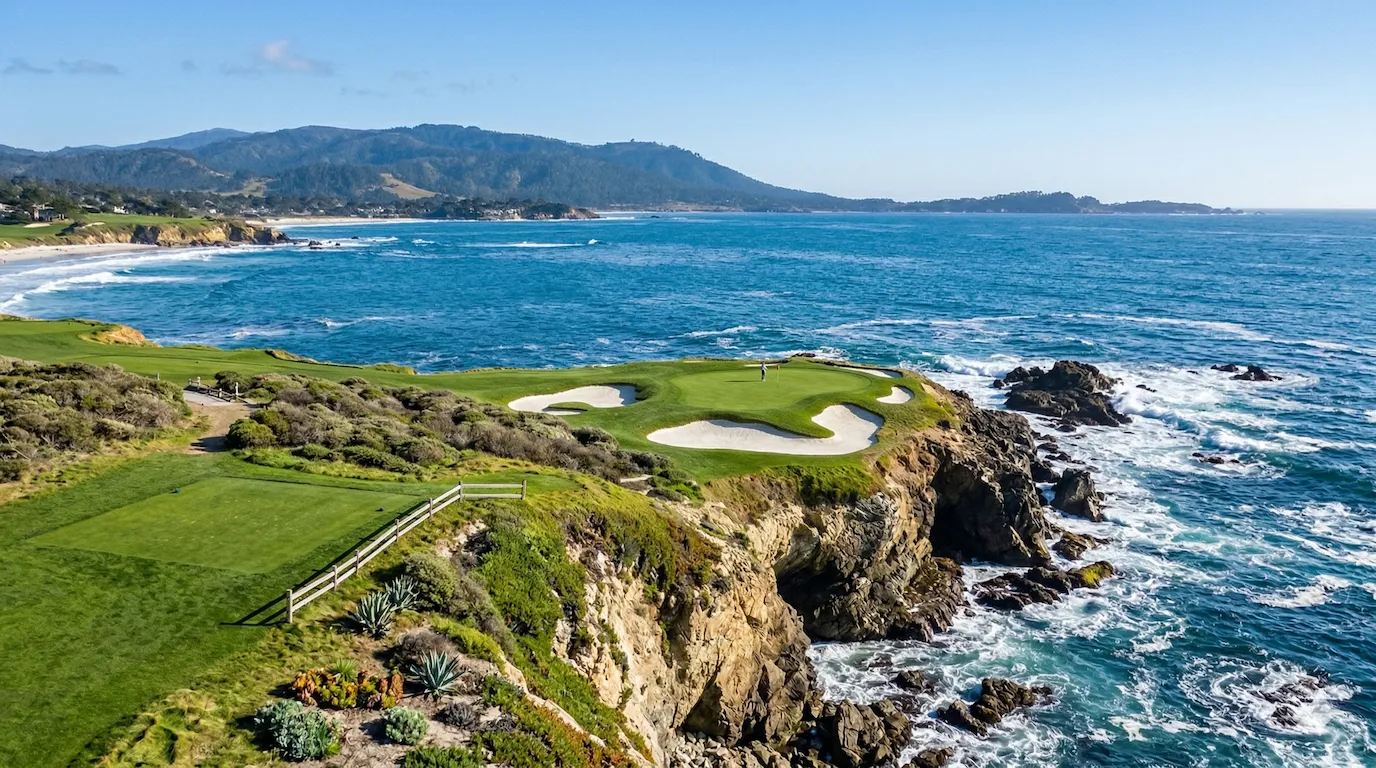
The 7th hole (par 3, 106 yards from the Blue tees) is the most photographed par 3 in America and, on windy days, the most profane. A postage stamp of green perched on a rocky outcrop, surrounded on three sides by the Pacific, playing steeply downhill from an exposed tee. The yardage is almost irrelevant; the club is determined by wind, and wind alone. On calm days it’s a sand wedge. In the Pebble Beach Pro-Am, touring professionals have used 7-irons and still been blown off line. Finding the greenside bunkers here is not a mistake. It is an achievement. The alternative is the kelp beds directly below, which do not offer a preferred lie.
The 8th hole (par 4, 427 yards from the Blue tees) is the one Jack Nicklaus calls the greatest approach shot in all of golf. The tee shot is blind — launched from beside the 7th green across terrain players cannot see, requiring faith that the fairway is where the routing says it is. This is a lot to ask from a golf course that has spent the previous seven holes demonstrating that it cannot be trusted. Those who navigate the blind tee ball to the cliff’s edge then face a mid-iron across a gaping oceanic chasm to a green that slopes aggressively back-to-front. Miss long and recovery comes from the beach side, which sounds romantic until you’re standing there with a sand wedge and a seagull evaluating your technique.
The back nine retreats into the forest, and the course temporarily pretends to be reasonable. Holes 11 through 14 demand concentration through uphill gradients, blind tee shots, and shallow greens that deflect approaches the way a nightclub bouncer deflects names not on the list. They are difficult and honest, the kind of holes that don’t photograph well but show up aggressively on the scorecard. After the coastal fireworks of holes 5 through 10, they serve as necessary recalibration before the 17th refuses to let the round end quietly.
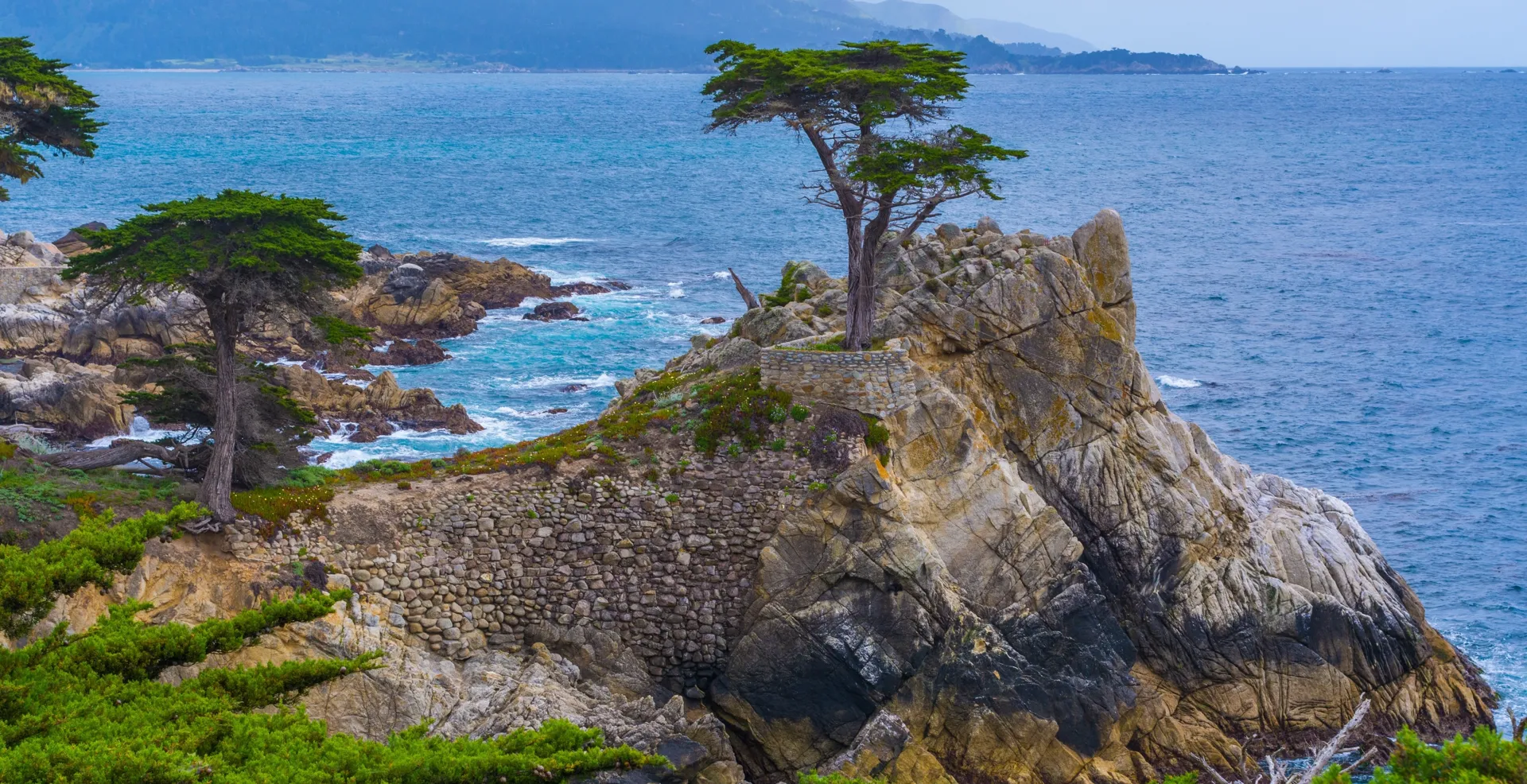
The 18th hole (par 5, 543 yards from the Blue tees) is the benediction. Originally a modest par 4, it was extended into a sweeping par 5 by W. Herbert Fowler in 1920, and the revision became the defining closing gesture of American golf. A dogleg left wrapping around Stillwater Cove, bounded on the left by a rock seawall above the Pacific and on the right by out-of-bounds stakes. The tee shot must carry ocean to find the fairway. A massive cypress tree sits directly in the second-shot corridor, demanding either a shape out over the water or a conservative layup. A bunker runs the entire left length of the final green — the last line of sand between the putting surface and the sea. It is the most dramatic finishing hole in American golf, and it knows it. The 18th has been posing for cameras since before cameras were any good.
One condition worth understanding honestly: the Poa annua greens. Pebble Beach’s putting surfaces are notoriously unpredictable, particularly late in the afternoon when the coastal grass’s irregular growth patterns cause putts to deviate from their intended lines in ways that would make a physicist weep. Reading these greens without local knowledge is an exercise in creative fiction. A caddie is not a luxury at Pebble Beach. A caddie is the difference between three-putting from twelve feet and merely three-putting from twenty.
Planning the Trip
Costs
| Item | Cost |
|---|---|
| Green fee | $695 |
| Cart (cart-path only) | $55–$60 per person |
| Pull cart | $15 |
| Equipment rental | $115 |
| Walking caddie | $105–$155 per bag (before gratuity) |
| Fully outfitted round (fee + caddie + tip) | ~$900+ per player |
How Booking Works
Pebble Beach operates a two-tier system designed to reward people who spend money on lodging with the privilege of spending more money on golf. Guests staying at The Lodge at Pebble Beach or The Inn at Spanish Bay can reserve tee times up to 18 months in advance; guests at the ultra-private Casa Palmero, 12 months out. High-season stays (September through November) require a three-night minimum; the off-season (December through August) requires two nights. Everyone else gets 24 hours: the public window opens at precisely 7:00 AM PST the day before desired play. Single players succeed at this more often than groups; four people attempting a walk-on in September are engaged in optimistic speculation.
The Duke’s Club Alternative
For travelers who want the peninsula without resort rates, the Duke’s Club membership ($595 annually) provides substantial discounts at Spyglass Hill (42% off the green fee) and The Links at Spanish Bay (45% off), extending to guest players in the group. The strategy: stay in Monterey or Carmel at standard hotel rates, book guaranteed rounds at Spyglass and Spanish Bay months ahead, and attempt the 24-hour public window for Pebble Beach itself. Think of it as the financially responsible way to do something financially irresponsible.
What Else to Play
Spyglass Hill Golf Course begins in the Del Monte Forest before breaking onto ocean holes, a genuine top-100 routing that lives in permanent shadow because it had the misfortune of being built next to the most famous course in America. The Links at Spanish Bay, designed by Robert Trent Jones Jr., Tom Watson, and Sandy Tatum, provides a links-style experience on the peninsula’s northwest edge and comes with a complimentary bagpiper at sunset, which is either the highlight of the trip or the moment you realize you’ve been on the peninsula too long. Cypress Point Club, two miles up the 17-Mile Drive, is among the greatest courses in the world: private, invitation-only, and worth any social capital required to access it. Start being nicer to people who might know members. Start now.
When to Go
| Window | Why |
|---|---|
| Dec–Feb 🌧️ Avoid | Pacific storms, soft turf, 3+ inches of rain per month |
| Mar–Jun 🌤️ Good | Recovering greens, coastal flora in bloom, more availability; low-to-mid 60s |
| Jul–Aug ☁️ Good | Marine fog blankets coastal holes until midday; pack layers, book afternoon tees |
| Sep–Oct ☀️ Prime | Warm, clear, firm conditions; no marine layer; the peninsula’s “Secret Season” |
| Nov 🌤️ Good | Shoulder rates, cooling temps, occasional rain |
The Pebble Beach Concours d’Elegance generates week-long hotel rate surges and inventory shortages across the peninsula each mid-August. Plan around it, not through it.
Lodging
| Property | Rate/Night | Notes |
|---|---|---|
| The Lodge at Pebble Beach | $1,145+ | Beside 18th green and 1st tee; 18-month advance booking window |
| The Inn at Spanish Bay | $1,100+ | Adjacent to Spanish Bay links; nightly bagpiper tradition at dusk |
| Casa Palmero | $1,345+ | Ultra-private Mediterranean estate with spa; 12-month booking window |
| Monterey Plaza Hotel & Spa | $200–$500 | On the water at Cannery Row; Duke’s Club strategy base |
| Hyatt Carmel Highlands | $200–$500 | Dramatic cliffside views from the south side of the peninsula |
All three resort properties provide the 18-month Pebble Beach booking advantage and fill well ahead for fall weekends.
Getting There
| Airport | Distance | Notes |
|---|---|---|
| Monterey Regional (MRY) | 15 min | Nonstop service from SFO, DFW, and other hubs |
| San Jose (SJC) | 1.5 hr drive | More direct flight options |
| San Francisco (SFO) | 2 hr drive | Most flight options; scenic coastal route via Hwy 1 |
A rental car is essential. Resort properties offer private car service from all three airports for guests who prefer not to drive, which is a polite way of saying “for guests on the resort pricing plan.”
Championship Planning
The U.S. Open returns in 2027, with contracted dates in 2032, 2037, and 2044 under the USGA anchor-site partnership. The U.S. Women’s Open returns in 2035, 2040, and 2048. Agronomic preparation requires facility closures weeks before each championship. Travelers planning trips around Open years should confirm availability well in advance and expect the region’s already-limited inventory to compress further.
Why Neville’s Routing Is Worth the Flight
The case for Pebble Beach doesn’t rest on the scenery, and it doesn’t rest on the price. It rests on the routing.
Neville and Grant built a course in 1919 that professional architects with decades of experience could not have designed better — not because they were geniuses, but because they were honest about what was already there. The land told them where to put the holes. Every subsequent generation has had the sense to mostly agree. Fowler extended the 18th. Nicklaus improved the 5th. The course has been maintained, refined, and stewarded through more than a century of championship golf, and what has emerged is a routing where every hole asks the same question: are you paying attention?
The Pacific, for its part, will keep asking whether you answer or not.