In 1929, Alister MacKenzie was the most sought-after golf course architect on the planet. He was simultaneously finishing Cypress Point on the Monterey Peninsula and consulting on what would become Augusta National in Georgia. He could have lived anywhere. He chose a hillside above the 6th fairway at Pasatiempo Golf Club in Santa Cruz, California, and he stayed there until he died in 1934. His ashes were scattered across the course from an airplane.
When the architect behind some of golf’s most celebrated and exclusive designs picks one course to spend eternity with, that is not a recommendation. That is a verdict.
Pasatiempo opened on September 8, 1929, with an exhibition match featuring Bobby Jones, Marion Hollins (the visionary developer who bankrolled and co-designed the project), Glenna Collett, and Cyril Tolley before a gallery of 2,000 spectators. Jones was so taken by MacKenzie’s routing, its optical illusions and strategic bunkering, its relentless demand for thinking over hitting, that the round directly precipitated his decision to hire MacKenzie for Augusta National. Pasatiempo is the architectural bridge that made the home of The Masters possible.
Ranked 93rd on Golf Digest’s “America’s 100 Greatest” and 11th among public-access courses by Golf Magazine, Pasatiempo operates as a semi-private club 45 minutes north of Monterey. Unlike Cypress Point or Augusta, which exist behind walls of exclusivity impenetrable to anyone lacking the right connections, Pasatiempo sells tee times to the public at $425 per round. The genius of MacKenzie’s most personal design is available to anyone willing to pay for it.
Where Camouflage Meets Contour
The front nine plays inland through corridors of mature cypress and eucalyptus, climbing and descending the Santa Cruz hills with the restless energy of a routing that refuses to repeat itself. At 6,495 yards from the Gold tees with a slope of 141, the course is modest on paper but punishing in practice: the difficulty comes not from length but from forced carries over ravines, severe elevation changes, and putting surfaces that reject anything less than precisely aimed. The back nine transforms entirely. Natural ravines, called barrancas, slash across the landscape, demanding heroic carries that test nerve as much as ball-striking. No two holes share a mood, which was the point. MacKenzie believed constant visual and strategic variety was the hallmark of great design, and Pasatiempo might be his most complete expression of the principle.
Tom Doak, among the foremost MacKenzie scholars working in golf architecture, led an incremental restoration from 1996 to 2007 that recovered bunker shaping and green contours softened by decades of maintenance. Then, from April 2023 to December 2024, Jim Urbina and Justin Mandon completed a full reconstruction of all 18 greens and bunkers, converting the putting surfaces from bumpy Poa annua to Pure Distinction bentgrass and rebuilding every green complex to its original 1929 dimensions. The result is a course playing closer to MacKenzie’s intent than at any point since the Depression.
Those greens deserve attention. MacKenzie favored shapes best described as amoebic: multi-pronged, asymmetrical surfaces that swell and narrow at angles designed to punish careless approaches. They feature severe segmentation, counter-slopes, and pronounced false fronts that reject anything imprecise. Missing on the wrong side leaves a pitch from well below the hole with virtually no green to work with. Power is subordinated to precision here. Iron play and distance control matter far more than driver speed.
Mornings often begin under heavy marine fog rolling in off Monterey Bay, the kind of coastal blanket that burns off by midday to reveal clear skies and stiffening afternoon winds. The wind alters club selection on exposed holes, particularly the downhill 1st and the elevated 8th. Travelers expecting the lush isolation of a private estate should know that Pasatiempo sits within a residential development: homes border several fairways, and power lines cross directly over the 6th and 17th (a local rule allows a free replay if a ball strikes a wire). These are cosmetic compromises, not architectural ones, but they exist.
The 3rd hole (par 3, 200 yards from the White tees) is MacKenzie the military camouflage expert at his most devious. A cross bunker sits roughly 50 yards short of the actual putting surface, placed to disrupt depth perception and convince the eye that the green is closer than it is. Average players trust their vision, come up woefully short, and curse the sand. The hole rewards the golfer willing to trust arithmetic over instinct and commit to a long iron aimed at a target the brain insists is too far away.
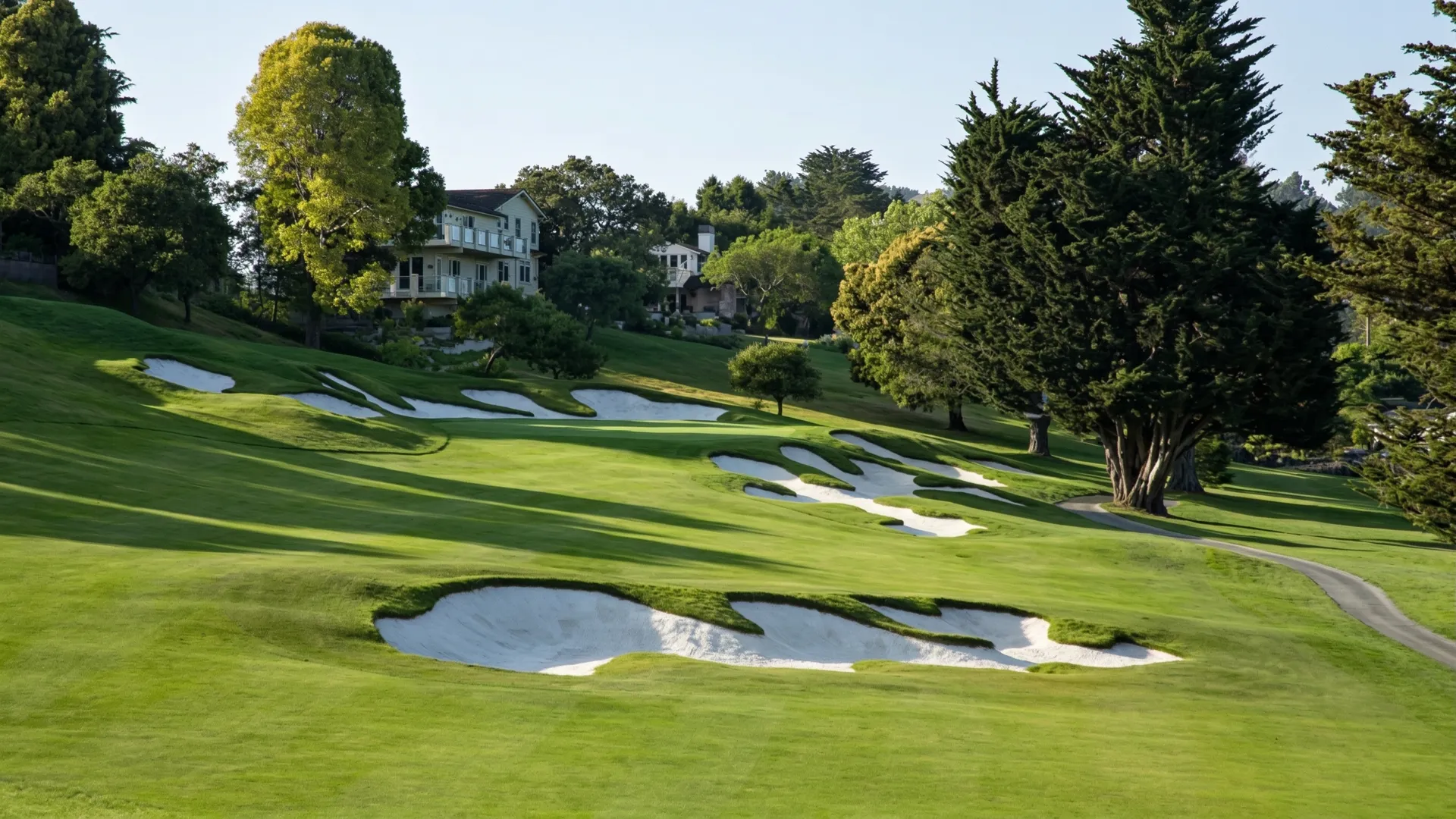
The 16th hole (par 4, 367 yards from the White tees) carries the number-one handicap rating and is widely considered one of the finest two-shot holes MacKenzie ever built. The tee shot bends left around a blind dogleg, setting up an approach that must carry a deeply incised natural ravine to reach a massive, three-tiered “whale tail” green restored to its full 1929 glory during the Urbina renovation. The visual intimidation is deliberate: the gorge yawns below, the bunkers flash white against the hillside, and the pin position determines not just where to aim but which tier to target. Landing on the wrong tier means three putts are more likely than two. MacKenzie called this “the best two-shot hole I know,” and his ashes were scattered over this course from an airplane in 1934, a detail that adds a certain gravity to the proceedings.
The 18th hole (par 3, 145 yards from the White tees) is an unconventional, almost iconoclastic finish. Where most courses close with a muscular par 4 or a sprawling par 5, MacKenzie ends with a mid-length par 3 across a gaping ravine. The terrace above doubles as an amphitheater, spectators watching from the clubhouse as the final swing of the round carries (or fails to carry) the hazard below. Par here feels earned. The pressure of performing for an audience, on a forced carry, with the entire round on the line, turns 145 yards into something considerably longer.
Planning the Trip
Costs
| Item | Cost |
|---|---|
| Green fee (walking) | $425 |
| Green fee (riding) | $470 |
| Pull cart rental | $15 |
| Club rental | $60 |
| Priority booking fee | $35 per golfer (non-refundable) |
| Caddie (with gratuity) | ~$150–$200 per bag |
How to Book
Pasatiempo uses a two-tier reservation system. Standard bookings open seven days in advance, online or by phone. The Priority Reservation option, at $35 per golfer, unlocks a 365-day booking window and locks in the current green fee rate. For anyone planning a trip around other commitments, the priority fee is effectively mandatory.
Because Pasatiempo is semi-private, prime weekend and holiday mornings are reserved for shareholders. Public players should target weekday mornings or mid-to-late morning weekend tees. Caddies are available and highly recommended for navigating the green complexes; call the pro shop at least 24 hours ahead to reserve one. Groups of 16 or more require direct coordination with the head golf professional.
When to Go
| Window | Why |
|---|---|
| Jan–Feb 🌧️ Avoid | Pacific storms, soft turf, limited daylight |
| Mar–Apr 🌤️ Good | Spring recovery, occasional showers; April aeration possible |
| May ☀️ Prime | Warm, lush conditions before summer fog settles in |
| Jun–Aug ☁️ Good | Marine fog holds until midday; afternoon tee times best for clear skies |
| Sep–Oct ☀️ Prime | The best window: warm, clear, firm turf, no marine layer |
| Nov 🌤️ Good | Cooling temperatures, rain risk increases late in the month |
| Dec 🌧️ Avoid | Coastal winter conditions with highest chance of washouts |
The Western Intercollegiate (mid-April) limits public tee time availability during tournament week. Spring aeration typically occurs in late April; confirm timing with the pro shop.
Lodging
| Property | Rate/Night | Notes |
|---|---|---|
| The Inn at Pasatiempo | $150–$250 | Adjacent to the course; home of the Back Nine Grill & Bar |
| Hilton Santa Cruz/Scotts Valley | $180–$280 | 2 miles away; reliable mid-range option |
| The Lodge at Pebble Beach | $1,000+ | 45 miles south; essential if adding the Pebble Beach resort courses |
Getting There
| Airport | Distance | Notes |
|---|---|---|
| San Jose (SJC) | 45 min | Most practical entry; strong domestic network |
| Monterey Regional (MRY) | 45 min | Smaller carrier options; scenic route south to Pasatiempo |
| San Francisco (SFO) | 75 min | Most flight options; avoid Highway 17 in rush hour |
A rental car is essential, particularly for travelers combining Pasatiempo with the Monterey Peninsula courses 45 minutes to the south. Highway 1 southbound offers Pacific coastline views that justify the drive on their own.
What Else to Play
Santa Cruz sits between two of California’s premier golf corridors. Forty-five minutes south, the Monterey Peninsula offers Pebble Beach Golf Links ($695, resort), Spyglass Hill ($550, resort), and The Links at Spanish Bay ($350 pre-renovation, resort; closed for renovation through spring 2027). Forty-five minutes inland, CordeValle ($525, resort) provides a secluded valley layout with luxury accommodations. A three-day itinerary pairing Pasatiempo with two Monterey Peninsula rounds is the most efficient way to experience MacKenzie’s genius alongside the coastal drama of Pebble Beach.
Why MacKenzie Stayed
The case for Pasatiempo is not the case for a hidden gem, because it is not hidden and it is not merely a gem. Ranked among the top 100 courses in America, freshly restored to its 1929 architectural intent, and accessible to anyone with a tee time and $425, it occupies a rare position: world-class design, world-class stewardship, and a door that actually opens.
MacKenzie spent his career building courses for the wealthiest clubs on earth. Cypress Point, Augusta National, Royal Melbourne: names so revered they function as passwords in certain social circles. He could have retired to any of them. He chose a hillside in Santa Cruz where he could watch golfers wrestle with his greens every morning, and where his ashes would eventually be scattered from an airplane over the fairways and greens he shaped.
That choice says more about Pasatiempo than any ranking ever will.