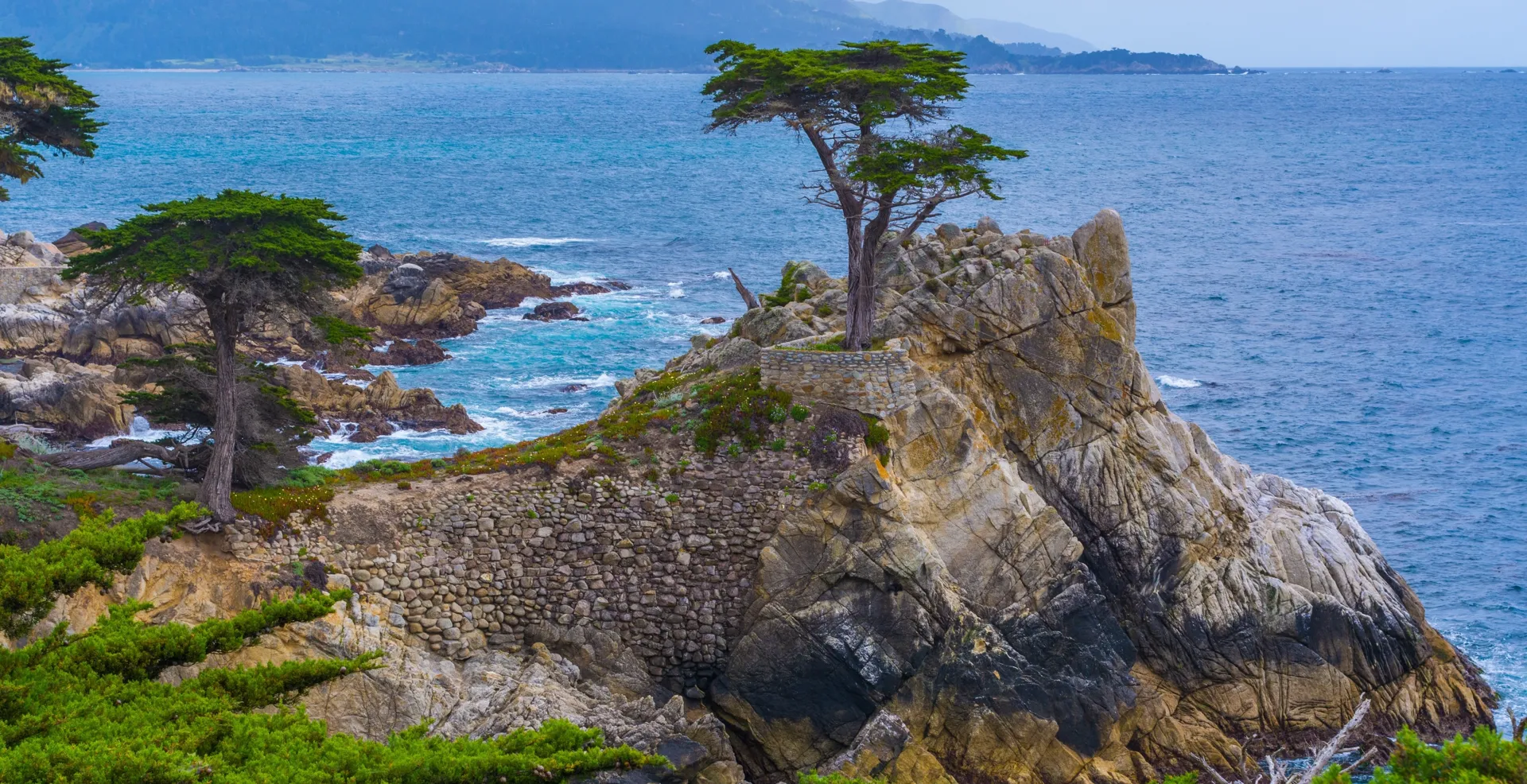
Jack Neville designed Pebble Beach Golf Links in 1919. Forty-one years later, he walked down the coast to Pacific Grove and routed nine holes through the same oceanside dunes for a fraction of the fanfare. That back nine, hugging the Pacific past the oldest continuously operating lighthouse on the West Coast, remains one of the best value propositions in American golf. The green fee is $66 on weekdays, $89 on weekends.
To be clear: this is a municipal course, owned by the City of Pacific Grove, maintained on a municipal budget, and loved with a ferocity that no private club could manufacture. The front nine winds through residential streets under Monterey pines, quiet and polite. The back nine explodes onto the coastline with harbor seals barking approval from the rocks below. It is two courses stitched together by a single scorecard, and the seam is the entire point. The first nine holes cost $89 because the city is generous. The last nine holes are worth $89 because Jack Neville understood what the land was offering.
Two Courses, One Scorecard
Pacific Grove begins in a whisper. H. Chandler Egan, a two-time U.S. Amateur champion, laid out the original nine holes in 1932 after helping Alister MacKenzie renovate Pebble Beach. His routing threads through a residential neighborhood with the courtesy of a Sunday morning stroll: narrow, tree-lined fairways, deer grazing on kikuyu grass, the occasional backyard fence serving as an out-of-bounds stake. The par sequence opens with two consecutive par 3s, followed by two par 4s and two par 5s, a quirky rhythm that resulted from the 1960 rerouting when Neville’s back nine forced the front nine to reorganize around a new clubhouse.
None of these holes will appear on a greatest-hits reel. That is not the point. The Egan nine is the appetizer, quiet and unremarkable, designed to make the 11th tee feel like stepping through a portal.
The 11th hole (par 4, 273 yards from the Blue tees) delivers the reveal. After nine holes in the trees, the player steps onto an elevated tee and the Pacific Ocean fills the entire horizon. This short par 4, benched into a natural dune ridge, dares aggressive players to drive the green while the coastal scrub on the left collects the overconfident. Most players lay up with an iron and take par gratefully. The smart ones don’t care about the score; they stand on the tee for an extra thirty seconds and look.
The 17th hole, “Crespi Pond” (par 3, 138 yards from the Blue tees), is the postcard. A freshwater pond guards the front, the Monterey Bay crashes to the left, and the green slopes severely back to front, punishing anything above the hole. Wind dictates the entire club selection, sometimes by two or three clubs. The local women’s club calls errant shots into the pond “rafters,” which is the kind of insider vocabulary that only a course played by the same community for ninety years can produce.
Between these two signature moments, the back nine unfolds along Ocean View Boulevard through a windswept dunescape that feels imported from the British Isles. The 12th, a 497-yard par 5, forces a decision at the massive cross-dune that bisects the fairway: carry it in two and earn a look at eagle, or lay up and face a blind third shot. The 16th drops downhill from a tee perched beside the Point Pinos Lighthouse, the entire Monterey Bay opening below like a reward for reaching the final stretch.
The Kikuyu grass fairways are spongy and forgiving when the ball sits up, but the rough grabs clubheads with the tenacity of coastal vegetation that wants its territory back. The Poa Annua greens run slow and can get bumpy by afternoon, small and tilted in a single direction. This is not Pebble Beach conditioning. It is municipal conditioning, honest about its limitations and unconcerned with impressing anyone who expected otherwise.
Planning the Trip
Pacific Grove is a walking course, flat and compact, and playing it on foot is the correct decision. An electric cart costs $18 to $25 per rider depending on the day; save the money and walk.
| Item | Cost |
|---|---|
| 18 holes, walking (Mon–Thu) | $66 |
| 18 holes, walking (Fri–Sun/Holidays) | $89 |
| Twilight, walking (Fri–Sun/Holidays) | $59 |
| Junior rate (17 & under) | $20–$30 |
| Push cart rental | $8–$15 |
| Club rental (18 holes) | $65 |
Tee times open 60 days in advance for groups of two to four. Singles must call the pro shop within seven days of their preferred date. Weekend mornings fill quickly; book the moment the window opens. For the smoothest greens, play early before the Poa Annua grows uneven in the afternoon sun. For the best light on the back nine, book a twilight round and accept the possibility of finishing in the glow rather than the glare.
The course is short enough at 5,727 yards that fit walkers can play 36 holes in a day, a genuinely practical option during the long daylight of June and July. Pace of play is the honest drawback: weekend rounds regularly stretch past four and a half hours. The course is beloved, the tee sheet is packed, and patience is part of the price of admission.
When to Go
| Window | Why |
|---|---|
| Dec–Feb 🌧️ Avoid | Pacific storms, coldest temps, soft turf |
| Mar–May 🌤️ Good | Spring clearing, breezy, fewer crowds |
| Jun–Jul ☁️ Good | Morning fog burns off by midday; longest daylight for 36-hole days |
| Aug ☀️ Prime | Clearest skies, peak summer warmth, zero rain days |
| Sep–Oct ☀️ Prime | Warmest month (Sep), ideal conditions, crowds thin in Oct |
| Nov 🌤️ Good | Shoulder pricing, cooling temps, rain returns late in the month |
Monarch butterfly season runs October through February, and golfers visiting in autumn will see migrants crossing the fairways from the nearby sanctuary. Pacific Grove calls itself “Butterfly Town, U.S.A.” and means it.
What Else to Play
Pacific Grove sits at the doorstep of some of the most celebrated golf on the continent. The course borders the 17-Mile Drive; players can finish a round here and be on the first tee at Spanish Bay or Pebble Beach in under ten minutes. That proximity is the key to Pacific Grove’s role in a Monterey Peninsula trip: it is the value anchor that keeps the budget from spiraling after a morning at Pebble Beach ($695) or Spyglass Hill ($525). A twilight round at Pacific Grove after a morning splurge at one of the resort courses is the smartest double-header on the peninsula.
Poppy Hills, owned by the Northern California Golf Association, offers pristine bentgrass greens and forest routing for $95 to $175. Bayonet & Black Horse provides two military-themed courses with sweeping bay views from $50. Neither will empty a wallet the way the Pebble Beach Resorts trifecta does, and both reward the kind of golfer who values the round over the logo on the scorecard.
Why the Lighthouse Matters
Pacific Grove Golf Links exists because S.F.B. Morse sold the City of Pacific Grove an inland parcel for a $10 gold coin in 1931, with one condition: maintain and irrigate it as a golf course for at least five years. Nearly a century later, the city has honored that commitment far beyond what was required. The course has not been privatized, has not been sold to a resort conglomerate, and has not raised its green fee to a point where the locals who sustain it can no longer afford to play.
The front nine will never win an architecture award. The conditioning will never rival the manicured perfection across the fence at Pebble Beach. But when the player steps onto the 11th tee and the Pacific unfolds from Lovers Point to the lighthouse, none of that matters. Jack Neville knew exactly what he was doing when he came back in 1960 and routed those final nine holes through the dunes. He had already built the most famous oceanside course in the world. Then he built one the rest of us could actually play.