Hasso Plattner co-founded SAP, bought the San Jose Sharks, and acquired 1,700 acres of oak-studded California foothills south of San Jose. Then he hired Robert Trent Jones Jr. to build a golf course through the middle of it, put a guard at the gate, and built exactly one house on the entire property: his own. CordeValle opened in 1999 not as a real estate development with golf attached, but as the opposite: a golf course with almost nothing attached, unless you count the winery sitting a lob wedge from the 6th green.
That philosophical clarity has produced results. Ranked among Golf Digest’s Top 100 Public Courses and host of the 2016 U.S. Women’s Open (the first ever contested in the Bay Area), CordeValle earned its championship credibility by also hosting four consecutive PGA Tour events (Frys.com Open, 2010-2013) and two PGA Cups. The course operates as a resort, accessible only to guests of the on-site Rosewood hotel or members with keys to the gate. The combination of RTJ Jr.’s mature design, a comprehensive 2019-2022 renovation that rebuilt every green complex, and the kind of turf conditioning that $525 green fees sustain has created one of Northern California’s most complete golf experiences.
Sixty-Eight Bunkers and a Lob Wedge to the Winery
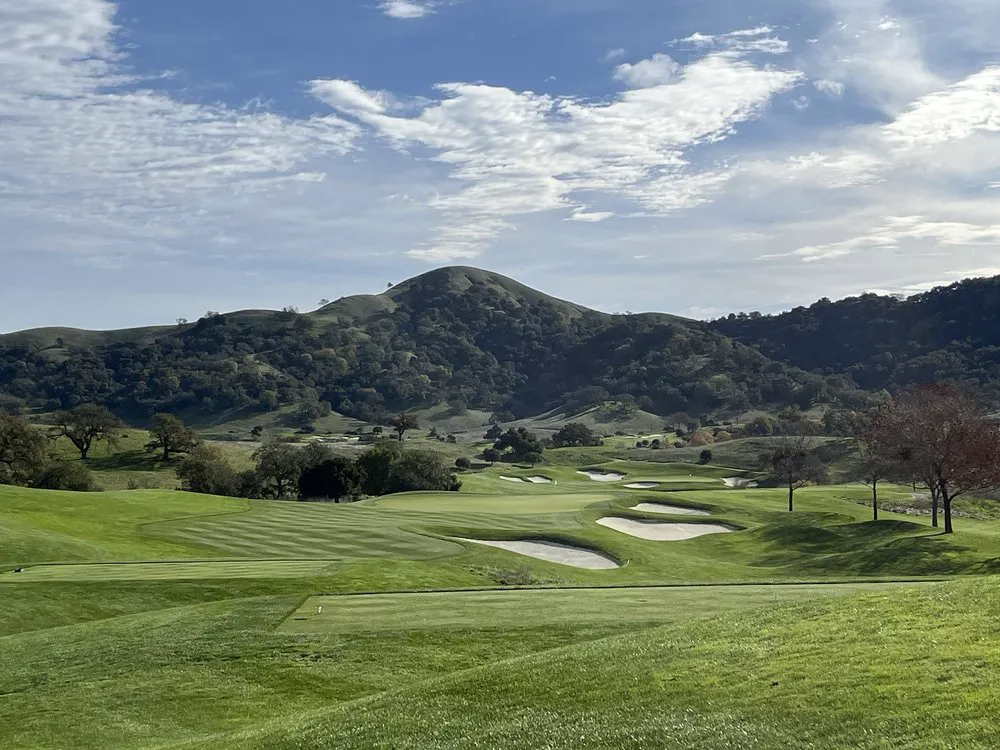
RTJ Jr. shaped CordeValle’s mounding to mirror the surrounding Santa Cruz Mountains foothills, creating an inland course that looks like it grew from the terrain rather than was imposed on it. The routing moves through 150 feet of total elevation change across broad meadows, oak-dotted hillsides, and water features that feel organic rather than engineered. Sixty-eight brilliant white-sand bunkers, the kind that recall Augusta National more than Scottish links, cover over 11 acres with steep faces that enforce a strict half-shot penalty. This is a course built for aerial precision: the greens are firm, often elevated, and reject low-trajectory approach shots with the indifference of a bouncer checking IDs.
The 2019-2022 renovation by Bruce Charlton (of RTJ II Golf Course Architects) rebuilt every green from scratch, resurfacing them with bentgrass that rolls pure and fast over subtle, deceptive undulations. The shapes vary dramatically: some round and traditional, others long and narrow, a few short and wide. Perennial ryegrass fairways provide lush emerald contrast against the golden hillside, a color palette that is distinctly Californian and distinctly not the coast. RTJ Jr. has described his courses as “symphonies with dominant themes,” and CordeValle’s front nine weaves through meadows and water with a composer’s pacing before the back nine tightens into the hillside, climbing and dropping with more purpose. Afternoon breezes funnel through the Santa Clara Valley and effectively lengthen the inward half, particularly the par-4 13th, which plays directly into prevailing wind through corridors of mature sycamores and oaks.
The 8th hole (par 4, 296 yards from the Green tees) is the drivable risk-reward gamble that separates the bold from the solvent. A pond guards the green, a creek protects the right edge, and the entire hole whispers go for it while the scorecard suggests otherwise. Big hitters who find the putting surface are rewarded with an eagle look. Big hitters who don’t find the putting surface are rewarded with a penalty stroke and a lesson in probability. The smart play is a mid-iron to the layup area, which makes birdie possible and double bogey unlikely, which is exactly why most golfers ignore it.
The 18th hole (par 5, 499 yards from the Green tees) closes the round with textbook risk-reward architecture. The tee shot launches from an elevated position toward a fairway bisected by a creek at roughly 300 yards. Beyond the creek, a lake flanks the entire left side from fairway to green, shimmering in the peripheral vision of anyone contemplating going for it in two. Bail right and birdie is still achievable with a solid wedge. Chase eagle left and the lake makes the final decision. The clubhouse watches from above with the practiced patience of a building that has seen this movie before.
Honest assessment: the routing plays dead straight more often than a top-tier design should. CordeValle lacks the sharp doglegs and directional variety that define the great strategic layouts, relying instead on bunkering and water for its defensive architecture. The result is a course that impresses with conditioning and visual beauty more than routing intrigue. Valley-basin geography also produces frost delays on winter mornings, and summer heat can bake the greens into concrete, causing approach shots to bounce over the back. These are seasonal hazards rather than design flaws, but they narrow the optimal window considerably.
Planning the Trip
Costs
| Item | Cost |
|---|---|
| Green fee | $525 (includes cart, range access, on-course snacks) |
| Walking caddie (single bag) | $120 + gratuity |
| Walking caddie (double bag) | $100/person + gratuity |
| Forecaddie (min. 3 players) | $50/person + gratuity |
| Caddie referral fee | $30 (paid at check-in) |
| Club rental | $80–$125 |
| Shoe rental | $25 |
Caddies are mandatory. Standard gratuity runs $50-$100 per bag depending on service, so a fully loaded round for a single player approaches $750 before lunch.
How to Book
CordeValle does not sell tee times to the general public. Access requires either a membership or a reservation at the Rosewood CordeValle resort, where rooms start around $600 per night and climb past $2,000 for villas. The property operates behind a guarded gate with zero walk-on availability. Golf packages bundled with room reservations are the only reliable path in. A strict 72-hour cancellation policy applies: cancel inside that window and the full stay amount is forfeited.
When to Go
| Window | Why |
|---|---|
| Jan–Feb ❄️ Avoid | Cold, wet, heavy frost delays in the valley basin |
| Mar 🌤️ Good | Warming temperatures, but rain remains possible |
| Apr–Jun ☀️ Prime | Spring blooms, lush turf, minimal rain, ideal conditions |
| Jul–Aug ☀️ Good | Peak heat; greens firm up fast; fairway aeration likely |
| Sep–Oct ☀️ Prime | Heat breaks, firm conditions, clear skies, no frost risk |
| Nov 🌤️ Good | Cooling temps; frost risk builds late in the month |
| Dec 🌧️❄️ Avoid | Cold, short days, rain, and valley frost |
Greens are vented monthly. Fairway aeration occurs 3-5 times annually, with at least two summer sessions.
Lodging
| Property | Rate/Night | Notes |
|---|---|---|
| Rosewood CordeValle | $600–$2,100 | On-site bungalows and villas with fireplaces, soaking tubs, and direct course access |
| CordeValle Fairway Homes | $1,900–$2,100 | Multi-bedroom homes for groups or corporate retreats |
| The Inn at Pasatiempo | $150–$250 | 45 min away; budget-friendly if combining with Santa Cruz golf |
Getting There
| Airport | Distance | Notes |
|---|---|---|
| San Jose (SJC) | 30 min | Best option; strong domestic carrier network |
| San Francisco (SFO) | 75 min | Most flight options; avoid Bay Area rush hour traffic |
A rental car is useful for exploring the Santa Clara Valley Wine Trail, though private car services from SJC work fine for guests staying exclusively on the resort grounds.
What Else to Play
Pasatiempo Golf Club ($425, semi-private) is 45 minutes west in Santa Cruz, where Alister MacKenzie built his personal masterpiece and then built his house beside the 6th fairway and never left. Freshly restored with new bentgrass greens, it pairs naturally with CordeValle for a two-day inland California golf trip. Coyote Creek Tournament Course ($100+, public), a Jack Nicklaus design, sits 15 minutes north for a more accessible warm-up round. Cinnabar Hills Golf Club ($100+, public) offers 27 mountainous holes 25 minutes away with dramatic elevation changes and resident wildlife.
Why the Gate Is Part of the Design
The financial barrier at CordeValle is real and deliberate. Between the green fee, the mandatory caddie, and the resort minimum, a single round runs north of $1,350 before accounting for the flight. That kind of money narrows the audience by design, which is exactly why the conditioning stays pristine and the fairways stay empty.
What it buys, beyond the golf, is disappearance. No residential developments crowding the fairways. No public roads cutting through the layout. Just 1,700 acres of California foothills, 68 white-sand bunkers, a winery within wedge range, and the distant sound of a train whistle echoing through the valley like something from a decade that moved slower. RTJ Jr. designed the course as a symphony. Plattner built the concert hall. The price of admission is steep, but the acoustics are flawless.