Most golf courses open with a ribbon-cutting and a prayer that the turf cooperates. Wickenburg Ranch Golf & Social Club waited seven years for its ribbon-cutting. The turf had no complaints.
Built in 2008 by Bill Brownlee and Wendell Pickett, two developers with no formal architectural pedigree, the course was finished just as the economy cratered. The surrounding Trilogy residential community stalled, the gates stayed closed, and a maintenance crew spent seven years grooming eighteen empty holes while zero rounds were played. When Wickenburg Ranch finally opened in February 2015, it possessed a turf maturity that no new course had any right to claim. Golf Digest named it a Top 10 Best New Course. The booking phones melted so fast that a club official compared the frenzy to “trying to get tickets to a Justin Bieber concert.”
The routing defied convention: six par 3s, five par 5s, and seven par 4s across rolling high-desert terrain an hour northwest of Phoenix. Two amateur architects ignoring the rulebook and landing on a national best-new list is the kind of origin story that sounds invented. Wickenburg Ranch simply played too well for anyone to argue.
The Course the Desert Wasn’t Supposed to Have
Wickenburg Ranch sits at 2,400 feet in the shadow of Vulture Peak, where prospector Henry Wickenburg struck a $30 million gold vein in 1863. The rusted iron signage, adobe clubhouse, and leather-bound yardage books honor that frontier heritage. The bentgrass does not.
Bentgrass greens are a rarity in southern Arizona, and Wickenburg Ranch maintains them year-round thanks to the elevation and relatively mild summers, delivering putting surfaces that run fast and firm. The fairways — bermudagrass overseeded with ryegrass in winter — offer lush, carpet-like lies through the cooler months. The greens are massive, multi-tiered, and unforgiving to lag putts. Hitting one in regulation means nothing when the pin sits on a shelf 80 feet from where the ball landed. Three-putts here are honest math, not poor putting.
The 6th, “Gutz” (par 4, 343 yards from the Black tees), earns its name at the tee box. A drivable par 4 with a pond separating tee from a severely elevated green, it poses one question: carry the water or bail left? Long hitters launch over the hazard and use a deep greenside bunker as a backstop, setting up birdie putts. Everyone else lays up to the safety fairway, faces a 35-foot uphill wedge from an awkward angle, and hopes for par. From the White tees (281 yards), the question is less philosophical and more practical. Most golfers choose survival. The hole doesn’t judge them for it.
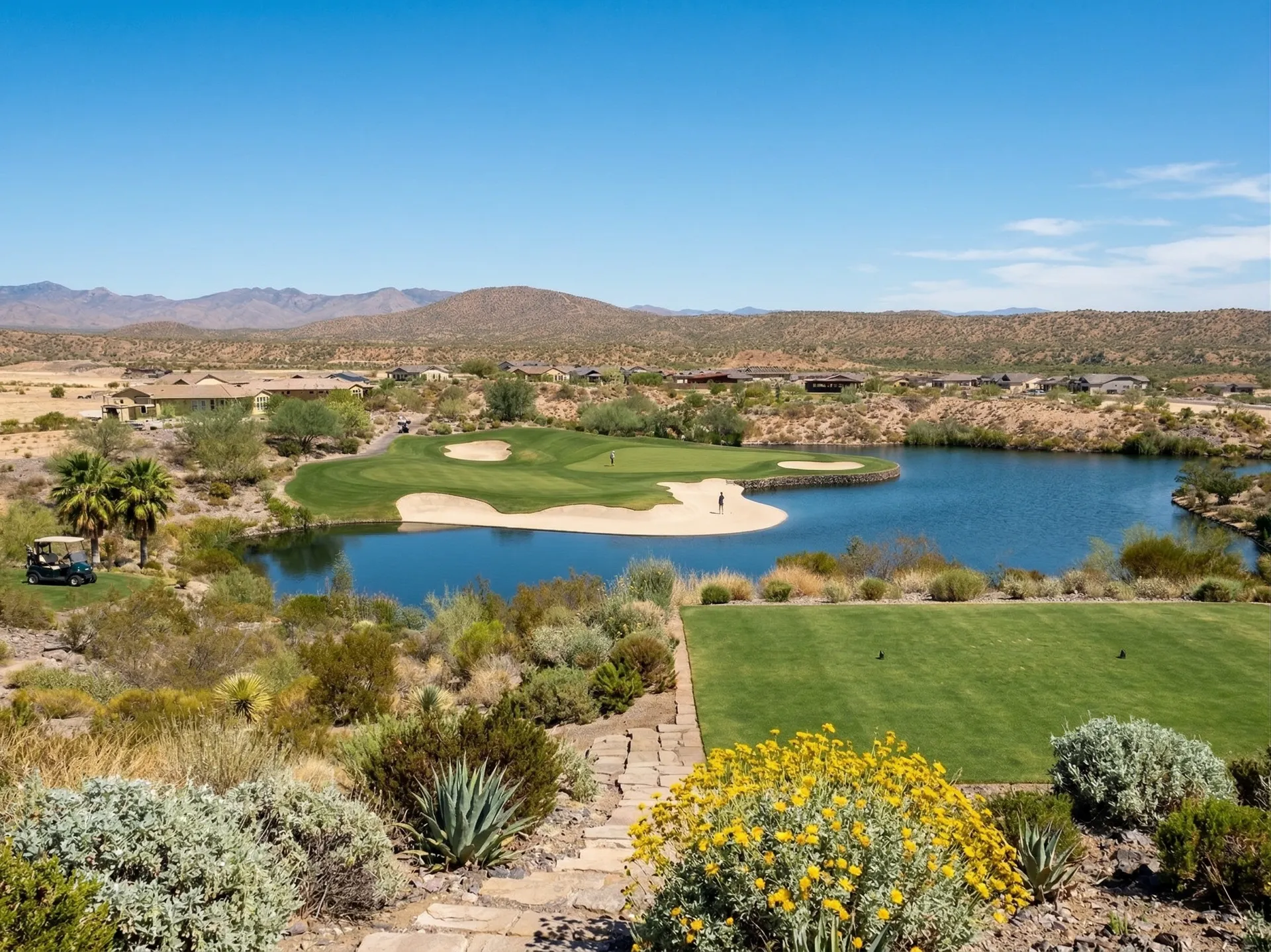
The 13th, “Big Water” (par 3, 246 yards from the Black tees), is postcard and nightmare in a single frame. The tee sits 100 feet above the valley floor. The green juts into a lake. The carry is all water, with a bailout zone short-left for the self-aware. Afternoon crosswinds turn what looks like a 5-iron on paper into something far less certain in the hands. From the White tees (194 yards), the elevation drop makes club selection treacherous; balls hang longer than expected, and the wind does whatever it pleases. Smart play is left-center and two putts. The lake doesn’t care about intent.
The back nine escalates. The 14th, named “Yikes” without a trace of irony, runs 595 yards from the Black tees with water threatening drive, layup, and approach while Vulture Peak fills the skyline. The routing’s five par 5s demand three honest shots through desert terrain where steep fairway sidewalls reject anything offline, and the six par 3s test nerve and club selection across both nines. Wind at 2,400 feet is a persistent factor, particularly in the afternoons, turning every elevated tee shot into a club-selection negotiation.
The drawbacks are real. Bunker sand is coarse, pebbly, and occasionally rocky enough to damage a sole plate. The course’s difficulty and those massive greens stretch rounds toward five hours. The sheer number of tee configurations (up to ten rated options) creates confusion at the markers. Not dealbreakers, but better known before the first tee than discovered on the third.
The facility also operates Li’l Wick, a lighted 9-hole par-3 course where flip-flops replace dress codes and streaming music replaces silence. It takes ninety minutes, requires no tee time, and its final four holes play under stadium lights. Big Wick and Li’l Wick share an address and almost nothing else.
Planning the Trip
What It Costs
| Item | Cost | Notes |
|---|---|---|
| Guest green fee (in-season) | ~$230 | Includes cart and practice facility; contact club for current rates |
| Guest green fee (summer) | Reduced | Extreme heat discount, June through September |
| Club rental | $50 | Callaway Paradym sets available |
| Forecaddie | $30 per person | Plus $20+ tip; book 48 hours in advance |
| Single caddie | $100 per bag | Plus $30+ tip; book 48 hours in advance |
Guest play requires a member invitation. A caddie or forecaddie is worth the investment. Blind shots and complex green reads are frequent enough that local knowledge measurably improves the round.
Booking Strategy
Wickenburg Ranch is now a fully private club. All homeowners in the Trilogy community hold a Social Membership, which includes limited access to Big Wick for a green fee based on availability. Full Golf Membership grants unlimited access. Guest play is available only when accompanied by a member. Wide tee intervals (10 to 12 minutes) preserve the unhurried pace that defines the experience. Contact the club directly for current guest policies and availability.
When to Go
| Window | Why |
|---|---|
| Dec–Jan 🌤️ Good | Cool mornings, possible frost delays; solid snowbird conditions |
| Feb–Apr ☀️ Prime | Ideal temperatures, pristine turf, peak demand |
| May ☀️ Good | Morning tee times only; summer heat building fast |
| Jun–Sep ☀️ Avoid | Extreme heat (100°F+), monsoon humidity; early-June aeration closure |
| Oct 🌤️ Avoid | Three-week overseeding closure, typically early to late month |
| Nov ☀️ Prime | Fresh overseed, perfect fall weather, slightly thinner crowds |
Aeration typically occurs in late May or early June. Overseeding shuts the course for approximately three weeks in October.
Where to Stay
| Property | Rate | Notes |
|---|---|---|
| Trilogy at Wickenburg Ranch | Varies | On-site home rentals; easiest access |
| Rancho de los Caballeros | $$$ | Luxury dude ranch, 15 min; golf packages available |
| Kay El Bar Guest Ranch | $$ | Historic adobe ranch, 15 min |
| Los Viajeros Inn | $ | Budget-friendly, downtown Wickenburg, 10 min |
Getting There
Phoenix Sky Harbor International Airport (PHX) is 60 to 90 minutes southeast and served by all major carriers. A rental car is essential; ride-share coverage in Wickenburg is unreliable. The drive up Highway 74 to US-60 marks a beautiful transition from Phoenix sprawl to open Sonoran Desert.
What Else to Play
Quintero Golf Club, a Rees Jones design 30 minutes southeast on Highway 74, routinely ranks as Arizona’s finest public course and makes a natural pairing. For the full Scottsdale and Phoenix trip framework, including itineraries and budget tiers across a dozen desert courses, see the Scottsdale & Phoenix destination guide.
Why the Window Closed
The recession didn’t design Wickenburg Ranch. But it gave the course something money cannot ordinarily purchase: seven years of uninterrupted maturation, the bentgrass deepening its roots while an unconventional routing settled into terrain that seemed to have been waiting for it. The result is a par-71 that plays with the confidence of a design fifty years older than it is.
The doors have already closed to casual public play. Wickenburg Ranch completed its transition to a fully private club, and access now requires membership or an invitation from someone who holds one. The course that slept for seven years has pulled the covers back over its head. Those who find a way in will understand what the beauty sleep was for.