Most Arizona resort courses share the same visual footnote: a swimming pool glinting behind the 15th green, a terra cotta roof intruding on the 7th tee box. Cholla doesn’t have that problem. It doesn’t have neighbors.
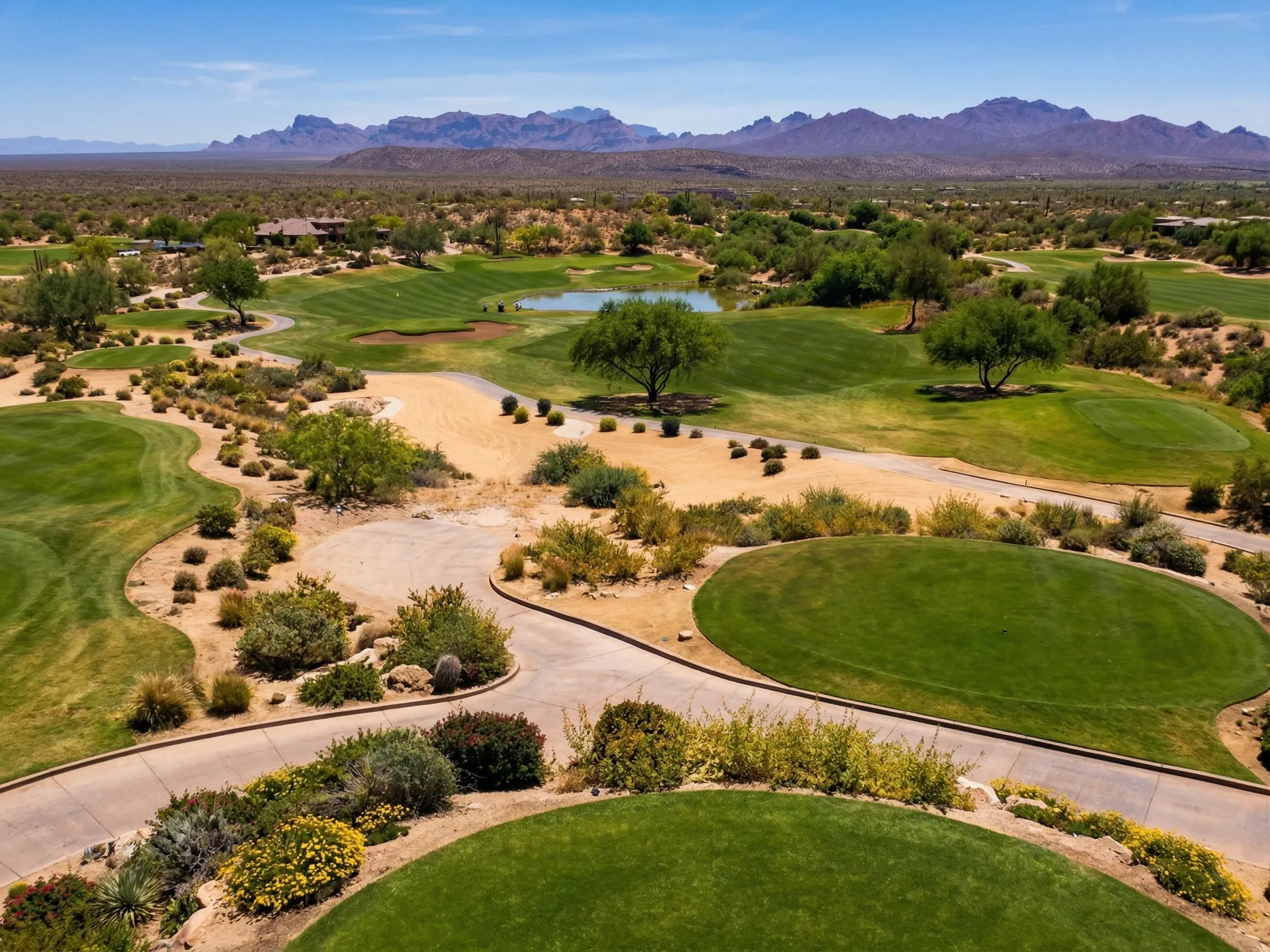
Designed by Scott Miller in 2001 on the Fort McDowell Yavapai Nation’s reservation land, the Cholla Course at We-Ko-Pa Golf Club exists in a kind of isolation that most desert courses advertise but none actually deliver. There are no out-of-bounds stakes on the property. No housing lots. No resort casitas peeking through the mesquite. The only boundaries are ancient arroyos, towering saguaros, and the distant ridgelines of the Superstition Mountains. Everything between the fairway and the horizon is brittle bush, and the brittle bush is not on your side.
Ranked 33rd on Golf Digest’s Best in State list for Arizona, Cholla carries a slope of 138 from the championship tees and plays as pure target golf at full volume: forced carries, split fairways, pushed-up greens that reject anything imprecise. Kim Paez made history here in 2023, becoming the first woman to win the Southwest PGA Championship with a 54-hole total of six under par. The tribe that saved this land from a federal dam project in the 1970s built something that honors the ground: a course where the desert is not decoration but the central strategic hazard.
What the Desert Demands
Miller’s front nine establishes the terms immediately. The routing opens with a gauntlet of forced-carry holes that play over ridges and washes, the fairways appearing as green islands floating in an ocean of scrub. The mood shifts on the back nine with slightly wider corridors and more scoring opportunities, but the psychological pressure of seeing nothing but cactus beyond every fairway edge never fully relents. Cholla rewards aerial precision and exact yardages. The bump-and-run is largely irrelevant here; pushed-up greens and wash-fronted approaches demand that the ball arrive from the sky, land soft, and stay put.
The 7th (par 4, 350 yards from the Cholla tees) presents the round’s most devious decision. A split fairway, divided by a cluster of gnarly trees and desert scrub, forces an immediate commitment. The right side offers a direct angle into the full length of the green but looks perilously narrow from the tee. The left side provides safety, then punishes it: a blind, dramatically uphill wedge over deep bunkers to a shallow putting surface. Most players aim left for comfort and face the harder shot. The hole rewards conviction over caution.
The 8th (par 5, 605 yards from the Cholla tees) carries the number-one handicap designation and earns it completely. A sweeping, downhill-then-turning par 5 with a semi-blind drive, the hole demands constant recalculation. The second shot faces a narrowing fairway. The approach requires a forced carry over desert to a narrow green flanked by a deep bunker left and native scrub right, a rock wall separating the putting surface from a wash below. During the 2016 renovation, Director of Maintenance Ryan Kreizenbeck redesigned this hole with 700 cubic yards of on-site soil, widening the landing area and grassing part of the arroyo to create a more realistic risk/reward approach. His practical fix improved front-nine pace of play by nearly ten minutes per round.
The 18th (par 4, 432 yards from the Cholla tees) delivers the visual shock the rest of the round withholds. A shimmer of blue appears on the right: a water hazard, the first and only on the course, providing a striking contrast against the tan-and-green desert palette that dominated the previous seventeen holes. The drive must stay under 285 yards to avoid running through the fairway into trouble, and the approach from the right side demands a nerve-testing carry over the pond. The hole routinely decides championships. It decided Paez’s in 2023.
Beneath all of it, the MiniVerde bermudagrass greens (installed during a $1.8 million 2016 renovation) run fast and true, their contours deceptively severe beneath surfaces that appear generous. Miller’s signature touch is the “saving bunker,” placed strategically between fairway edges and unplayable desert, offering recovery rather than an automatic lost ball. It is a kindness built into an otherwise uncompromising design.
Planning the Trip
What It Costs
| Item | Cost | Notes |
|---|---|---|
| Green fee (peak, Jan–Apr) | $309 | Includes cart and practice balls |
| Green fee (shoulder, Oct–Dec, May) | $159–$239 | Best value in November |
| Green fee (summer, Jun–Aug) | $109 ($74 AZ resident) | Deeply discounted for heat |
| Forecaddie per person | $30 | Mandatory peak mornings (Thu–Sat, 8–11 AM) |
| Forecaddie gratuity | $20+ | Cash, paid directly to caddie |
Booking Strategy
We-Ko-Pa does not use dynamic pricing or third-party aggregators; the published rate is the rate. Peak season tee times (January through April) should be booked 90 days in advance, particularly around the WM Phoenix Open in early February. The 36-hole package pairing Cholla with its Coore & Crenshaw-designed sibling Saguaro offers discounted rates when both rounds are played within 72 hours. Arizona residents with valid ID receive $40–$90 off within a seven-day booking window. For value seekers willing to brave the heat, the annual or summer We-Ko-Pass program offers preferred green fees as low as $59 from May through October; check wekopa.com for current pass pricing.
When to Go
| Window | Why |
|---|---|
| Jan–Apr ☀️ Prime | Ideal temperatures, peak conditioning, premium pricing |
| May 🌤️ Good | Rising heat; morning tee times essential |
| Jun–Sep ☀️ Avoid | Extreme heat (104°F+), monsoon humidity Jul–Aug; dawn rounds only |
| Oct 🌤️ Avoid | Course closed for overseeding (typically early–mid Oct); cart-path only upon reopening |
| Nov–Dec ☀️ Prime | Fresh ryegrass, brilliant weather, shoulder pricing; the insider’s window |
Overseeding typically closes the course for two to three weeks in October. Cart-path-only rules remain for roughly a month after reopening. Confirm exact dates annually before booking fall travel.
Where to Stay
| Property | Nightly Rate | Distance |
|---|---|---|
| We-Ko-Pa Casino Resort | $250–$400 | On-site; stay-and-play packages, AAA Four Diamond |
| The Boulders Resort & Spa | $400–$600 | 35 min; ultra-luxury desert retreat |
| Hyatt Place Scottsdale/Old Town | $150–$250 | 30 min; central access to Old Town dining |
Getting There
Phoenix Sky Harbor International Airport (PHX) is 30 minutes southwest, served by all major domestic carriers. A rental car is the strongest option; ride-shares to We-Ko-Pa’s Fort McDowell reservation are reliable outbound, but return availability from the relatively isolated location can involve long waits. The Beeline Highway (AZ-87) delivers a stunning, climbing view of the Sonoran Desert on approach.
What Else to Play
The obvious pairing is Saguaro, Cholla’s sister course designed by Coore & Crenshaw in 2006. Where Cholla demands aerial precision and forced carries, Saguaro rewards ground-game creativity through wide corridors and minimalist shaping. Playing them back-to-back offers an unmatched comparative study in desert architecture on the same magnificent piece of land. Troon North Monument (30 minutes) delivers dramatic elevation changes among massive boulders. TPC Scottsdale Stadium (25 minutes) lets visitors play the iconic 16th, golf’s loudest hole. Quintero (50 minutes) provides spectacular isolation and severe elevation changes for those willing to make the drive. For the full trip-planning framework, see the Scottsdale destination guide.
Why the Yavapai Were Right
Scottsdale’s golf corridor is built on convenience: resort courses minutes from Old Town restaurants, tee times bundled with spa packages, cart paths that practically deliver you to the 19th hole. Cholla asks for something different. Thirty minutes into sovereign desert, no houses for company, nothing between the fairway and the mountain skyline but the same ancient landscape the Yavapai fought to preserve.
They had a choice in the 1970s when the federal government wanted to build a dam and flood their reservation. They said no. Decades later, instead of subdivisions, they built two golf courses and let the saguaros keep their ground. Scott Miller honored that decision with a routing that treats the Sonoran Desert as a playing partner, not a backdrop. There is no other course in the Phoenix corridor where the terrain, the isolation, and the challenge feel this deliberately preserved. Cholla doesn’t negotiate with the desert. It belongs to it.