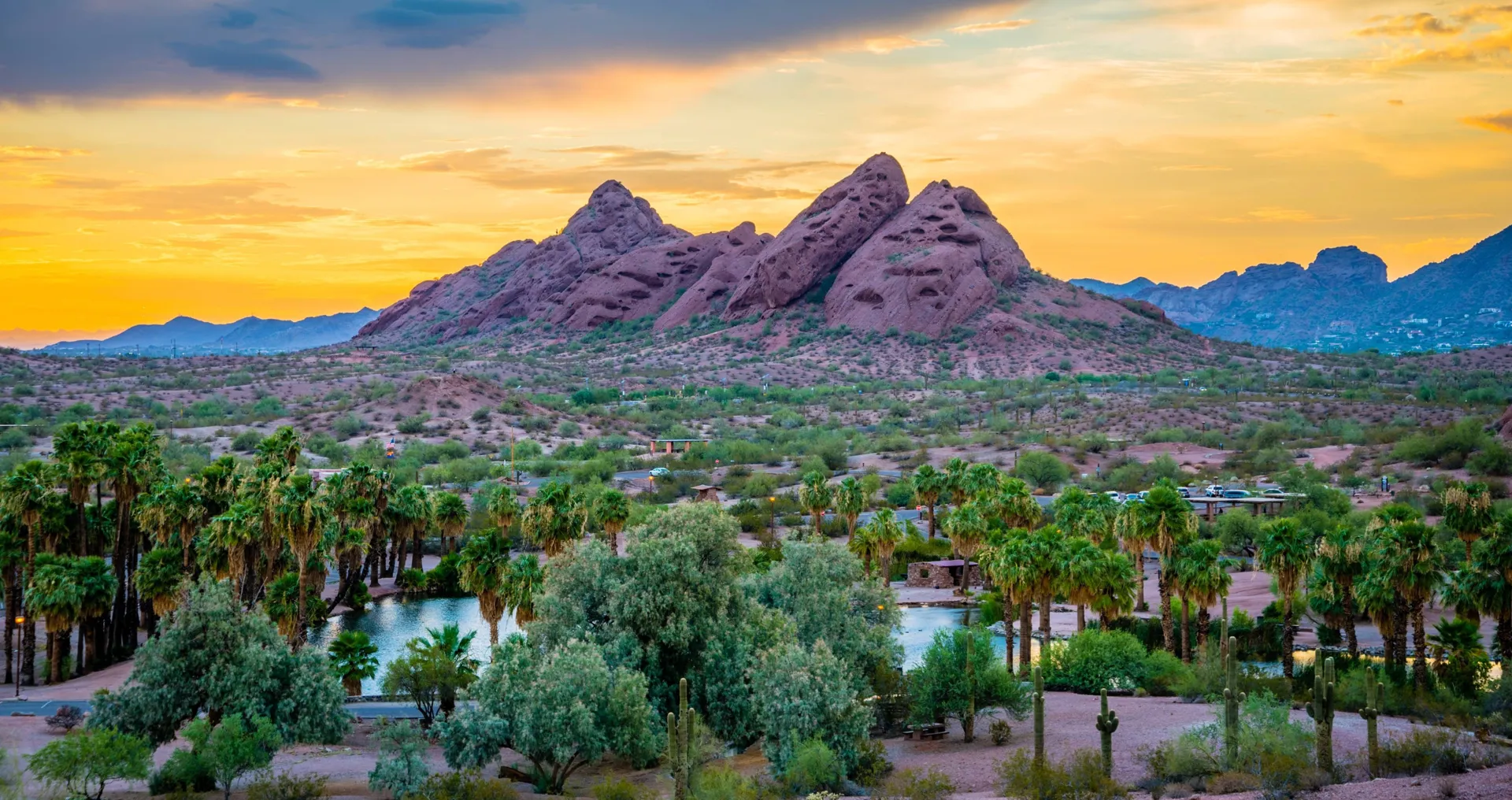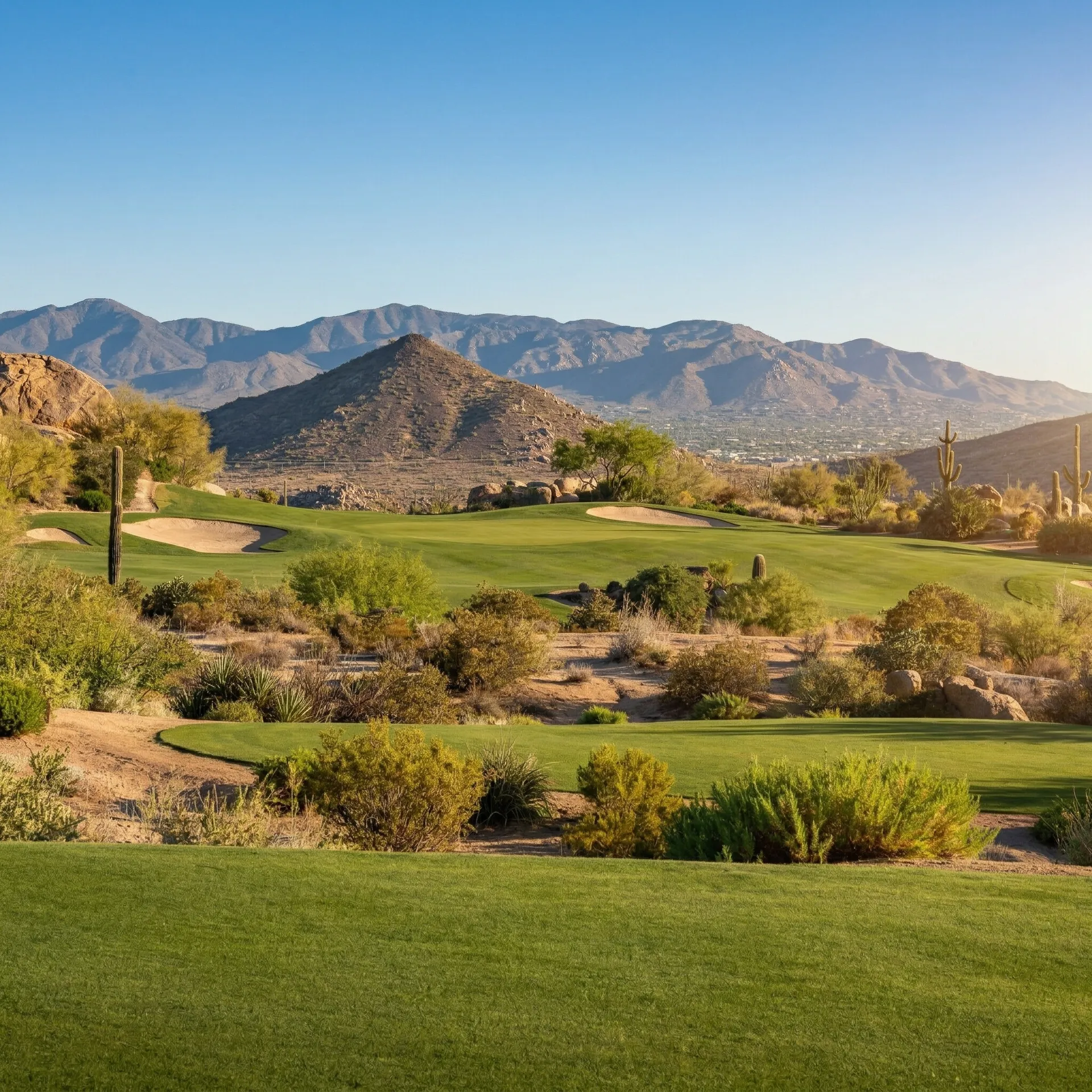
Tom Weiskopf built the Pinnacle course at Troon North in 1995 with a straightforward thesis: the Sonoran Desert does not need to be softened to produce great golf. It needs to be respected, threaded through, and played entirely on its terms.
The thesis proved correct. Weiskopf draped immaculate ribbons of bentgrass and overseeded Bermuda across raw granite canyons in the foothills of Pinnacle Peak, and the result became the blueprint for upscale daily-fee desert golf in America. Ranked among Golf Digest’s “Best in State” for Arizona and a former top-25 selection in Golf Magazine’s “Top 100 You Can Play,” the Pinnacle carries a slope of 147 from the Black tees and a simple warning: the penalty for missing a fairway is not rough. It is rattlesnake country, chest-high saguaro cactus, and granite monoliths the size of delivery trucks that Weiskopf built around rather than blasted through.
In 2007, Weiskopf returned to reconfigure the entire 36-hole facility, swapping nines between the Pinnacle and its sister Monument course to eliminate awkward cart rides and restore the geographic routing he always envisioned. “Both courses can now be played exactly as the land dictates,” he said, “the way Mother Nature intended.” The current Pinnacle layout climbs steadily into the desert foothills before dropping back toward the clubhouse, tighter and more theatrical than Monument, canyon walls closing in where its sibling offers panoramic width.
Boulders, Canyons, and the Art of Committed Golf
The Pinnacle demands commitment on nearly every shot. Fairways are generous enough to find with a well-struck drive, but they are bordered by nothing forgiving: raw Sonoran Desert floor, deep arroyos, and granite outcroppings that function as immovable, unplayable obstacles. Weiskopf did not move these boulders during construction. He routed the course over and around them, making them integral hazards that dictate strategy as firmly as any bunker complex. Arriving at a perfectly struck ball stymied behind a rock formation the size of a city bus is not a fluke at Troon North. It is a rite of passage.
The 8th (par 3, 190 yards from the Black tees) plays over a deep desert ravine to a green ringed by three bunkers, with a massive granite boulder squatting directly in the sight line. The boulder is the kind of visual obstacle that convinces visiting golfers something has gone wrong with the hole design. Nothing has gone wrong. The play is to ignore the rock entirely, trust the yardage, and commit to a mid-iron that carries the canyon. The McDowell Mountains fill the backdrop, and the tight framing of rock and ravine creates the sensation of hitting into a geological amphitheater. Most players bail short into the front bunkers or the collection area. The ones who trust the carry and find the center of the green consider two putts a fine outcome.
The back nine opens with a strategic chess match. The 10th (par 4, 407 yards from the Black tees) bends around a tight dogleg before presenting an approach over what regulars call “bunkerville,” a continuous ribbon of sand cutting directly across the fairway in front of an elevated green. Pinnacle Peak frames the scene behind the putting surface with postcard precision, but the visual compression of those cross-bunkers makes the approach look far more penal than it plays. An extra club clears the sand; fear does not.
The 16th, “The Post Card” (par 3, 140 yards from the Black tees), is Weiskopf’s tribute to Royal Troon’s famous “Postage Stamp,” the site of his sole major championship victory at the 1973 Open. It is a short, downhill plunge to a green guarded by water clinging to the right edge and deep sand left — shallow on the right side, deeper on the left, with undulations that punish inattention. From the elevated tee, the temptation to over-spin a wedge brings the water directly into play. The correct move is a controlled, low-spin short iron aimed dead center, removing the water from the equation entirely. It is the visual centerpiece of the course, the most photographed hole on the property, and the kind of shot that rewards calm hands over raw talent.
Two broader features shape the experience. The greens are massive (some exceeding 900 square yards), running fast on bentgrass with severe multi-tier contours and false fronts that reject anything less than a fully committed approach. And the canyon winds that funnel through the exposed high desert each afternoon transform standard approach shots into crosswind puzzles. A morning tee time is not merely preferable. It is a different golf course.
The routing heavily favors a fade off the tee, with numerous left-to-right doglegs shaping the outward and inward loops. Bump-and-run approaches are rarely viable; elevated greens and forced carries demand aerial target golf from first hole to last. The 14th, a 609-yard par 5 from the Black tees, is a legitimate three-shot hole that punishes anyone attempting heroics on the second shot. Pack at least a dozen balls. The desert does not return what it takes.
Planning the Trip
What It Costs
| Item | Cost | Notes |
|---|---|---|
| Green fee | $300–$400+ | Dynamically priced; peak rates January through April |
| Water surcharge | 5% of green fee | Municipal fee added at check-in, not shown in online booking |
| Cart fee | Included | Cart required; extreme elevation changes prohibit walking |
| Forecaddie | $37 + tax + $30–$40 gratuity | Included peak mornings (Thu–Sat, 8–11 a.m.); optional otherwise |
| Club rental | Contact pro shop | Premium Callaway sets updated annually |
The 5% water surcharge catches visiting groups off guard because it appears only at the counter, not during online checkout. Budget accordingly.
Booking Strategy
Tee times open 90 days in advance through the dynamic pricing portal, and prime morning slots vanish quickly at the mark. Guests at the Four Seasons Resort Scottsdale at Troon North receive priority access, guaranteed tee times, and stay-and-play credits that bypass the public scramble entirely. Singles have the best chance of filling late cancellations. Twilight rates offer savings, but the facility warns explicitly that 18 holes are not guaranteed before dark.
When to Go
| Window | Why |
|---|---|
| Jan–Apr ☀️ Prime | Ideal temperatures, lush overseeded fairways, highest demand and pricing |
| May ☀️ Good | Heat building toward triple digits; early morning tee times essential |
| Jun–Sep ☀️ Avoid | Extreme heat (104–106°F), monsoon storms, aeration closures |
| Late Sep–Early Oct 🌤️ Avoid | Course closed for overseeding; cart-path-only restrictions after reopening |
| Nov–Dec ☀️ Prime | Lush overseed established, crisp weather, fewer crowds than January |
Aeration typically occurs in late May through mid-June. The overseeding closure runs from late September through early October (roughly three weeks), followed by cart-path-only restrictions as the new turf establishes.
Where to Stay
| Property | Nightly Rate | Notes |
|---|---|---|
| Four Seasons Resort Scottsdale at Troon North | $800+ | On-property; shuttle service, golf credits, guaranteed tee times |
| The Boulders Resort & Spa | $500+ | Casitas among rock formations in Carefree; 12 miles |
| The Westin Kierland Resort & Spa | $400+ | Full-service Scottsdale resort with 27-hole golf complex; 15 miles |
Getting There
Phoenix Sky Harbor International Airport (PHX) is roughly 30 miles south, a 35- to 45-minute drive that climbs north through Scottsdale into the high Sonoran foothills. A rental car is essentially mandatory; rideshares to northern Scottsdale for early morning tee times are unreliable at best. The drive north on Pima Road toward Dynamite Boulevard rewards patience with sweeping views of the McDowell Mountains and the gradual transition from suburban grid to open desert.
What Else to Play
The sister Monument course occupies the same property and offers a wider, links-inspired counterpoint to the Pinnacle’s canyon drama. TPC Scottsdale’s Stadium Course ($300+, 20 minutes south) delivers the WM Phoenix Open experience with its iconic enclosed 16th hole. We-Ko-Pa’s Saguaro Course ($250+, 35 minutes east), a Coore & Crenshaw minimalist design entirely free of real estate development, is the philosophical opposite of target desert golf and worth the drive for contrast alone. The Boulders South ($200+, 20 minutes) winds through prehistoric rock formations in Carefree, while Grayhawk’s Raptor ($250+, 15 minutes) delivers aggressive bunkering and tour-tested conditioning. For the full Scottsdale itinerary with budget tiers and day-by-day planning, see the Scottsdale destination guide.
Why the Desert Deserves the Last Word
Scottsdale has no shortage of desert golf courses that smooth the Sonoran landscape into resort-friendly playability, softening edges and adding bailout areas until the desert becomes decoration rather than adversary. Pinnacle refuses that bargain. The boulders stay. The arroyos stay. The cactus stays. Weiskopf understood that the desert’s indifference is not a problem to solve but a character to preserve, and he built a course that asks golfers to meet it on honest terms: commit to the shot, accept the consequences, pack enough ammunition.
The forecaddie will mention the rattlesnake spotted near the 14th fairway last Tuesday. The Dynamite Grille will serve a breakfast burrito that nearly justifies the green fee on its own. And somewhere between the ravine carry at the 8th and the delicate wedge at the 16th, the Pinnacle will extract exactly as many golf balls as the golfer’s courage allows. It has been doing this since 1995. It has never once apologized.