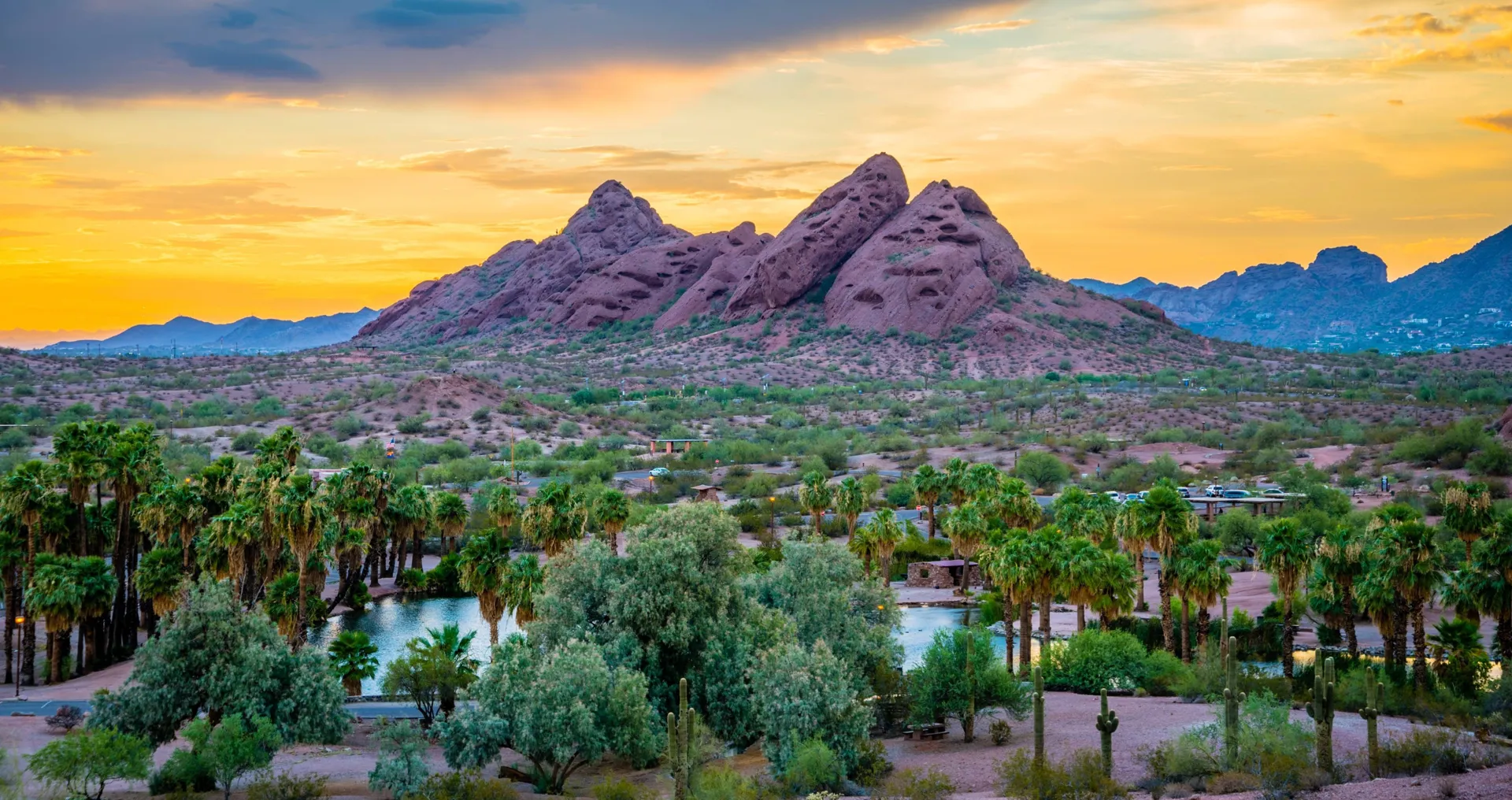
Most desert golf courses in Arizona subscribe to the same doctrine: force the ball over canyons of scrub, punish offline shots with Sonoran purgatory, and call it “target golf.” Tom Weiskopf and Jay Morrish had a different idea. In 1990, they carved the Monument Course through boulder-strewn terrain north of Scottsdale and gave it the soul of a British Open venue: firm fairways, open green fronts, and bump-and-run approaches that reward imagination over brute force. The desert just happened to be there.
The gamble paid beyond anyone’s projections. When Monument opened in what was then the middle of nowhere, tee time demand was so ferocious that Fortune 500 executives begged the pro shop for slots. Troon Golf, now the world’s largest golf management company, was essentially born on this property. A meticulous 2017 restoration used GPS coordinates from Weiskopf’s original design to return every green complex to its 1990 dimensions, resurfaced them with A4 creeping bentgrass, and rebuilt every bunker from the sand up. The conditioning today is tour-level. The course has appeared on Golf Magazine’s Top 100 Courses You Can Play (No. 58 in 2016–17) and carries a slope of 145 from the Black tees (7,039 yards). The scorecard is demanding. The style of play it rewards is refreshingly old-fashioned.
Boulders, Bluffs, and the Back Nine Reckoning
The front nine lulls. Landing areas appear wider than they are, bail-out zones hide behind desert brush, and a few early birdie looks suggest the course might be generous. It is not. Monument is building a case.
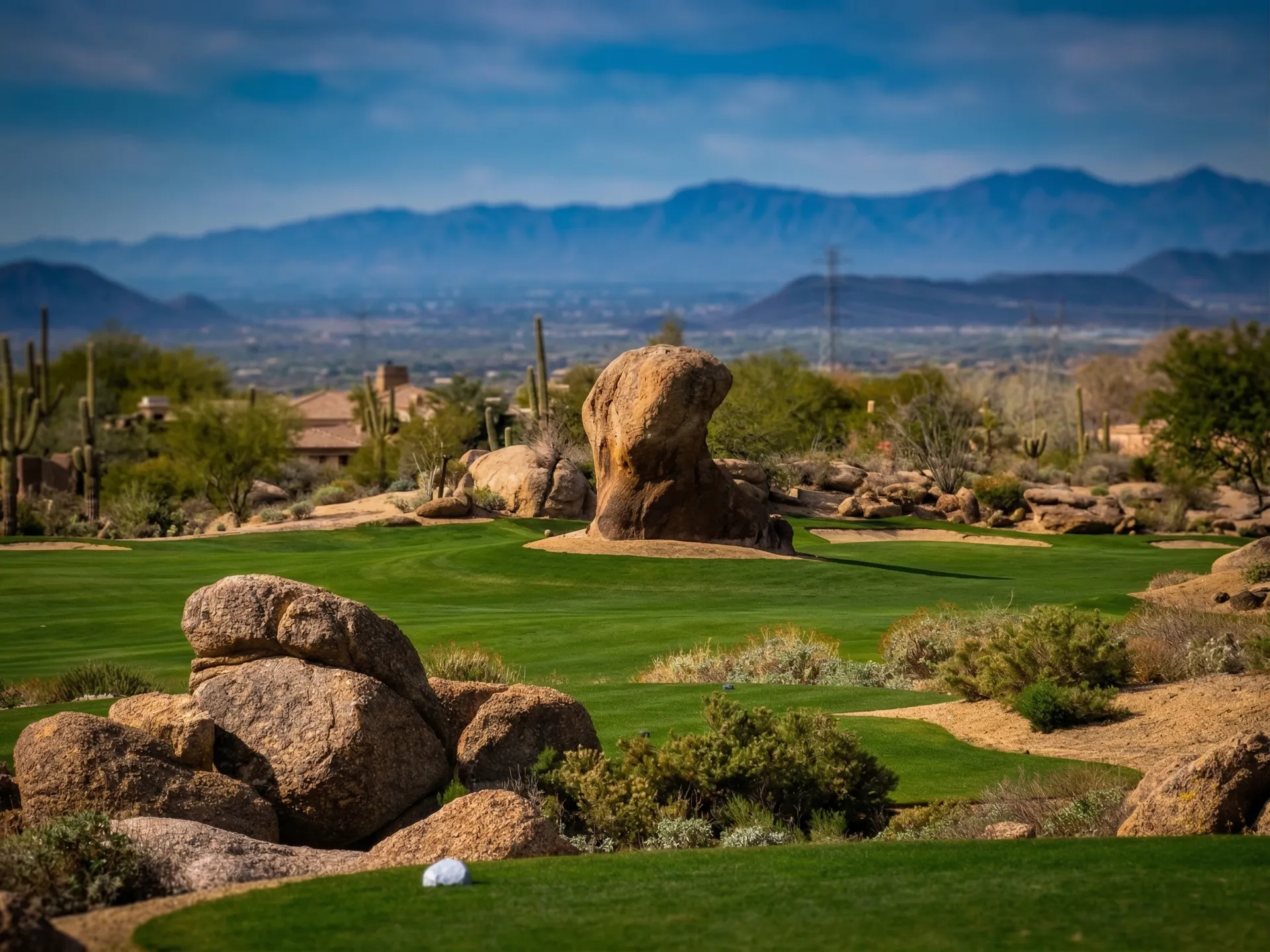
The 3rd, “The Monument” (par 5, 544 yards from the Gold tees), is the course’s thesis statement. A 35-foot granite boulder sits squarely in the center of the fairway, roughly 240 yards from the back tees, forcing an immediate decision: clear it, steer around it, or lay up short. The aggressive line carries high and right over the rock to shorten the dogleg; the sensible line bails left and adds a full club to the approach. Standing on the elevated tee, the desert stretches in every direction, the boulder anchoring the composition like a sculpture placed by a landscape architect with a sense of humor. Most golfers stare at it, then stare at it some more, then hit left into the scrub anyway.
The 6th (par 4, 295 yards from the Gold tees) offers a palate cleanser: a drivable par 4 with a deep central bunker guarding the front of the green. The smart play is a controlled iron off the tee, short of the rock pile, leaving a wedge flip. The bold play is a driver over the bunker to a green that accepts only the precisely struck. Risk and reward distilled to their simplest terms.
The back nine changes everything. Fairways tighten, elevation shifts turn dramatic, and the desert closes in. The 16th, “Lone Mountain” (par 3, 234 yards from the Gold tees), delivers the finest vista on the property and the most disorienting tee shot. The green sits far below the elevated tee box, a verdant island surrounded by boulders and scrub, with panoramic valley views stretching to the horizon. The severe downhill drop plays two to three clubs shorter than the yardage suggests; miss short and left, and a deep collection bunker swallows everything. The instinct is to admire the scenery. The requirement is to pick a club, trust the number, and swing before the view steals all concentration.
What connects these moments is the turf underfoot. The A4 bentgrass greens, rare for the Arizona desert, roll fast, smooth, and true. They are large but heavily tiered, crowned to reject inaccurate approaches into deep collection areas rather than raw desert. Anything above the hole invites three-putt territory. The fairways, overseeded with ryegrass in winter, play firm enough to welcome the bump-and-run. Desert misses carry real consequences: five yards offline often means a lost ball in impenetrable cactus and scrub, which is less a penalty and more a biome reclaiming its territory. Monument rewards positioning, trajectory control, and the restraint not to reach for driver on every tee box. Power without accuracy is just a faster way to lose golf balls.
Planning the Trip
What It Costs
| Item | Cost | Notes |
|---|---|---|
| Green fee (peak season) | $300–$550 | Dynamic pricing; day of week and demand determine rate |
| City water surcharge | 5% of green fee | Added at check-in; rarely shown in aggregator prices |
| Cart fee | Included | Terrain mandates cart use |
| Forecaddie (peak) | $37 + tax per person | Required Thu–Sat mornings, Jan–Apr |
| Forecaddie gratuity | $30–$40 per person | Cash, paid directly to caddie |
| Club rental | $99 + tax | Premium Callaway sets |
The 5% municipal water surcharge is the surprise that catches first-time visitors. Budget for it.
Booking Strategy
Tee times open 90 days in advance for the general public. Set a calendar reminder and call early: prime morning slots vanish within hours of release. Guests booking stay-and-play packages through the Four Seasons Resort Scottsdale at Troon North gain access to guaranteed inventory, which is the clearest advantage during the fiercely competitive February-through-April window. Booking on a Monday or Wednesday can save money over Thursday-through-Saturday dynamic pricing. Twilight rates exist, but the club warns that completing 18 holes is not guaranteed.
When to Go
| Window | Why |
|---|---|
| Jan–Feb ☀️ Prime | Cool, clear, ideal desert golf weather; high demand and peak pricing |
| Mar–Apr ☀️ Prime | Flawless conditions; highest dynamic pricing; book early |
| May 🌤️ Good | Shoulder season begins; afternoon heat becomes a factor |
| Jun–Sep ☀️ Avoid | Extreme heat (105°F+); monsoon storm risk Jul–Aug; summer aeration |
| Oct 🌤️ Good | Overseeding transition; cart-path-only rules for ~30 days post-reopening |
| Nov–Dec ☀️ Prime | Fresh winter ryegrass; excellent weather; slightly lower demand than spring |
Summer aeration typically runs mid-June through August. Fall overseeding (Bermuda to ryegrass) occurs in October, with cart-path-only restrictions for roughly 30 days after reopening.
Where to Stay
| Property | Nightly Rate | Notes |
|---|---|---|
| Four Seasons Resort Scottsdale at Troon North | $600–$1,200 | Exclusive tee time access; 2 minutes to the course |
| Scottsdale Golf Villas at Troon North | $400–$800 | On-site; two to four bedrooms; ideal for golf groups |
| Grand Hyatt Scottsdale Resort | $350–$600 | 30 minutes; pool complex and 27 on-site holes |
| The Westin Kierland Resort | $300–$500 | 25 minutes; good dining and nightlife proximity |
Getting There
Phoenix Sky Harbor International Airport (PHX), a hub for American Airlines and a major base for Southwest, is a 35-to-45-minute drive depending on traffic. A rental car is essential; Scottsdale sprawls, and the courses on any serious Arizona golf itinerary are scattered across the valley. The standard route from the airport takes AZ-202 East to AZ-101 North, exiting at Pima Road. Rideshares work for the outbound trip but availability for return pickups from the secluded Troon North area can be unreliable.
What Else to Play
The Scottsdale corridor packs enough quality public golf to fill a week. We-Ko-Pa Saguaro, a Bill Coore and Ben Crenshaw minimalist design on Fort McDowell Yavapai Nation land, is widely regarded as the best pure public course in Arizona and sits roughly 30 minutes east. TPC Scottsdale’s Stadium Course, home of the WM Phoenix Open and the raucous 16th-hole stadium, is 20 minutes away at a similar price point. Grayhawk’s Raptor Course, a Tom Fazio design hosting the NCAA Championships, offers dramatic McDowell Mountain views 15 minutes down the road. For something entirely different, Ak-Chin Southern Dunes (60 minutes south) channels the Australian Sandbelt rather than the Sonoran Desert. For the full trip-planning framework, including itineraries, budget tiers, and dining recommendations, see the Scottsdale destination guide.
Why the Ground Game Belongs in the Desert
Arizona golf has spent decades building courses that demand the same shot over and over: launch it high, carry the scrub, stick it on the green, repeat. Monument was designed to ask a different question. Can a golfer read the terrain, choose to keep the ball low, and trust the ground to do work that the air usually handles? The firm fairways and open fronts are not a compromise. They are the point.
Weiskopf and Morrish looked at the Sonoran Desert and saw what most architects missed: a landscape that could play firm, roll fast, and reward the same instincts that make links golf endlessly replayable. The 35-foot boulder on the 3rd hole is the perfect emblem. It does not care about swing speed or launch angle. It cares about angle, commitment, and the willingness to make a choice. The rest of the round follows the same logic. Monument will not take the prettiest photographs in Scottsdale, and it will not be the cheapest round in the valley. But it is the rare desert course that plays like a conversation between golfer and terrain rather than a high-altitude bombing run. That distinction is worth the drive, worth the dynamic pricing, and worth every lost ball that the saguaros claim as rent.