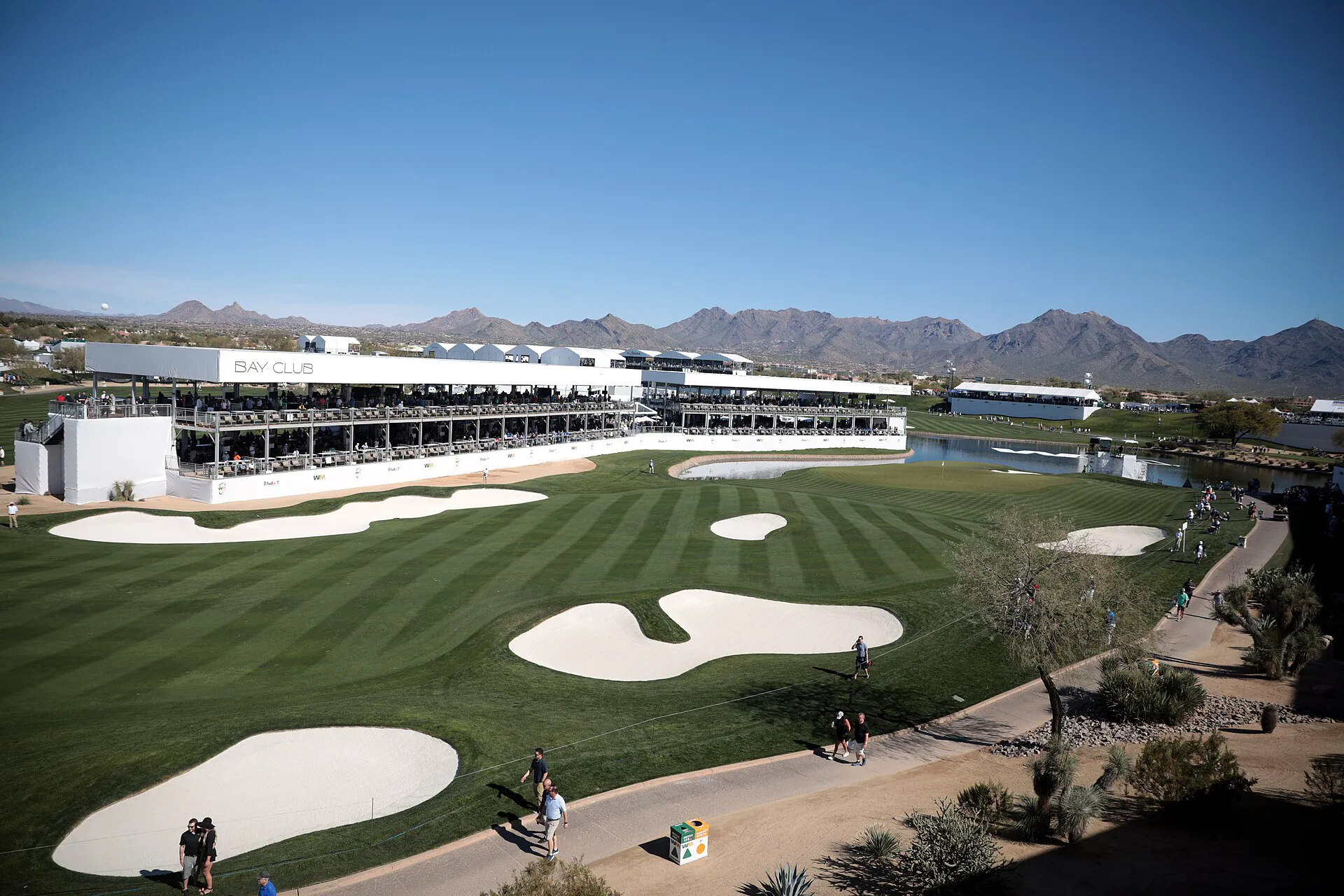
Every February, twenty thousand people pack temporary grandstands around a 163-yard par 3 and scream at a wedge shot. Beer cascades from the sky when something remarkable happens. Tiger Woods’s hole-in-one in 1997 started it. The hole didn’t change. The audience did.
Tom Weiskopf and Jay Morrish designed the Stadium Course in 1986 on a federal flood-retention basin outside Scottsdale, a stretch of decomposed granite that the Bureau of Reclamation never intended for golf. Weiskopf returned in 2014 for a $15 million renovation that resurfaced all eighteen greens, relocated four, and removed 250 trees to sharpen the strategic demands. The result occupies an intersection that should not work: municipal land, PGA Tour operation, daily-fee public access, and the most attended event in professional golf. The WM Phoenix Open regularly draws hundreds of thousands of spectators across tournament week — the last official count, in 2018, topped 700,000. Winners include Mickelson, Koepka, Matsuyama, and Scheffler. From the Championship tees, the course stretches to 7,261 yards with a slope of 142 and a 74.7 rating, delivering turf conditions that rival any venue on Tour.
The 16th hole gets all the attention. The other seventeen do the actual work.
The Finishing Stretch That Built a Reputation
The front nine functions as a solid, well-conditioned desert examination that few people talk about by name. Broad fairways flanked by native Sonoran wash, white-sand bunkers positioned to punish thoughtless tee shots, and TifEagle Bermuda greens overseeded with ryegrass that roll at 11–12 on the Stimpmeter. The 8th, a 475-yard par 4 with a tight landing zone, is the toughest assignment on the outward half. The 11th, rated the number-one handicap hole on the card, demands two precise strikes on a 472-yard corridor where missing the fairway means scrambling from desert scrub for bogey.
The back nine is where the course earns its name. Starting at the 15th, a reachable par 5 with a green complex fronted by water, the routing launches a four-hole crescendo that generates more dramatic swings per yard than any comparable stretch on Tour.
The 16th (par 3, 163 yards from the Championship tees) is the hole that defines the franchise. Architecturally, it asks for a short iron to a small, firm, heavily bunkered green sitting in a desert waste area. That is the entire assignment. During tournament week, it becomes something else: “The Coliseum,” enclosed by grandstands that convert a routine par 3 into a gladiatorial arena. Tiger’s ace in 1997. Sam Ryder acing it in the third round and Carlos Ortiz following suit in the final round in 2022. Emiliano Grillo’s slam-dunk ace in 2025, a pitching wedge from 155 yards that dropped into the cup and spun around the bottom before settling — the delayed reaction from the crowd was deafening. The rest of the year, the grandstands come down because the land is a federal flood basin and permanent structures are prohibited, leaving behind bare concrete footings and retaining walls. The gap between the spectacle and the architecture is the largest in professional golf.
The 17th (par 4, 332 yards from the Championship tees) offers the most consequential decision on the course. Water guards the left side of a green that sits tantalizingly within driver range. Go for it and the reward is eagle territory. Miss left and the ball is wet. In 2001, Andrew Magee’s tee shot bounced off a putter on the green and into the cup for the only par-4 hole-in-one in PGA Tour history. Tour players almost universally attack. Recreational golfers who attempt the hero shot frequently donate their ball to the water hazard.
The 18th closes with a cape-style par 4, 442 yards with water running the entire left side and the fairway tilting toward the lake. “Church pew” bunkers frame the right, punishing the bail-out. Hug the hazard for a shorter approach, or play safe and face a long iron into a green shaped like something a committee couldn’t agree on. The hole summarizes the course: optically intimidating, strategically clear, unforgiving of half-measures.
Two features define playing conditions year-round. The greens average 7,069 square feet (sixth-largest on Tour), but shelves and tiers punish players who miss the correct level, and three-putts arrive fast when pace control lapses. And the Sonoran Desert imposes its own tax: wide misses off the tee vanish into the native scrub, and the time spent searching for them is how rounds stretch past four hours and forty-five minutes during peak season. The infrastructure built to support tournament-week crowds also leaves a permanent fingerprint: engineered spectator mounds, extensive paved cart paths, and an on-site DraftKings Sportsbook across from the 18th green. Golfers seeking isolated desert solitude will find it at We-Ko-Pa, not here.
Planning the Trip
What It Costs
| Item | Cost | Notes |
|---|---|---|
| Peak green fee | $399–$550 | Dynamic pricing; highest rates February–March |
| Summer green fee | $100–$175 | June–September; extreme heat discounts |
| Cart fee | Included | Year-round |
| Forecaddie (per person) | Complimentary | Mandatory Nov 1 – Apr 15; included in green fee |
| Forecaddie gratuity | $20–$50 | Cash; paid directly to the caddie |
| Walking caddie | $130 per bag | Base rate; plus $50+ gratuity |
| Club rental | $95 | Premium TaylorMade and Callaway sets |
Forecaddies are mandatory and complimentary (included in the green fee) from November 1 through April 15. The program operates through Caddiemaster; gratuity of $20–$50 per person is customary and paid directly to the caddie.
Booking Strategy
Non-resort guests can book 30 days in advance. Guests at the Fairmont Scottsdale Princess book up to 90 days out through the resort’s golf concierge, which functionally means they lock up many desirable weekend morning slots during peak season before the public window opens. The surest path to a prime tee time is a stay-and-play package through the Fairmont. For savings without sacrifice, target November or late March when conditions are excellent and dynamic pricing eases. The course closes for 10–14 days surrounding the WM Phoenix Open in late January and early February.
When to Go
| Window | Why |
|---|---|
| Jan–Feb ☀️ Prime | Peak conditions and demand; course closes briefly for the WM Phoenix Open |
| Mar–Apr ☀️ Prime | Flawless weather, peak conditioning; Spring Break crowds in March |
| May 🌤️ Good | Temperatures climbing but manageable; twilight rates offer value |
| Jun–Aug ☀️ Avoid | Extreme heat above 103°F; tee off before 7 a.m. or skip it |
| Sep ☀️ Avoid | Still hot; overseeding closures and cart-path-only restrictions |
| Oct 🌤️ Good | Weather improving; overseeding may restrict play early in the month |
| Nov–Dec ☀️ Prime | Fresh ryegrass, excellent weather, slightly lower rates than midwinter |
Aeration occurs in phases from late May through August. Overseeding requires cart-path-only conditions for approximately 30 days from late September through October.
Where to Stay
| Property | Nightly Rate | Notes |
|---|---|---|
| Fairmont Scottsdale Princess | $450–$800+ | On-site; priority tee times, five-star amenities |
| JW Marriott Camelback Inn | $400–$600+ | Nearby resort; 10 minutes from course |
| Westin Kierland Resort | $450–$650+ | 3 miles; its own 27-hole golf complex |
| Hyatt Place Scottsdale/North | $150–$250 | 2 miles; best budget option |
Getting There
Phoenix Sky Harbor International (PHX) handles all major commercial carriers and sits 30–40 minutes south via the Loop 101. Scottsdale Airport (SCF) serves private aviation 15 minutes from the course. A rental car is essential: the Scottsdale golf corridor spans more than 30 miles, and rideshare to early-morning tee times across multiple courses gets expensive and unreliable.
What Else to Play
The Scottsdale corridor holds enough quality public-access golf to fill a week without repeating a layout. Troon North’s Monument Course, another Weiskopf design 15 minutes north, winds through massive boulder formations and regularly ranks as Arizona’s top public course. We-Ko-Pa’s Saguaro layout, a Coore & Crenshaw minimalist design on tribal land 30 minutes east, strips the desert golf experience to its essence: no houses, no commercial infrastructure, just golf and saguaros. Grayhawk’s Raptor, a Fazio design 10 minutes away, delivers Tour-level conditioning with dramatic bunkering and desert washes. For the full trip-planning framework, including itineraries and budget tiers, see the Scottsdale destination guide.
Why the Real Show Plays 51 Weeks a Year
The Coliseum gets the headlines, the Instagram clips, the SportsCenter segments. It should. Twenty thousand people screaming at a wedge shot is an experience professional golf offers nowhere else. But the Stadium Course doesn’t need the grandstands to justify the trip. The Weiskopf routing, the Tour-caliber conditioning, and a finishing stretch that generates legitimate drama on every hole from the 15th through the 18th don’t get dismantled in February. The scaffolding comes down. The course remains.