The Carefree Highway runs northwest out of Phoenix into nothing. Thirty minutes past the last subdivision, past the point where cell service becomes a suggestion and GPS grows tentative, a single-lane road turns south into the Hieroglyphic Mountains. At the end of that road, behind a gatehouse and surrounded entirely by Bureau of Land Management land that ensures no developer will ever follow, sits Quintero Golf Club.
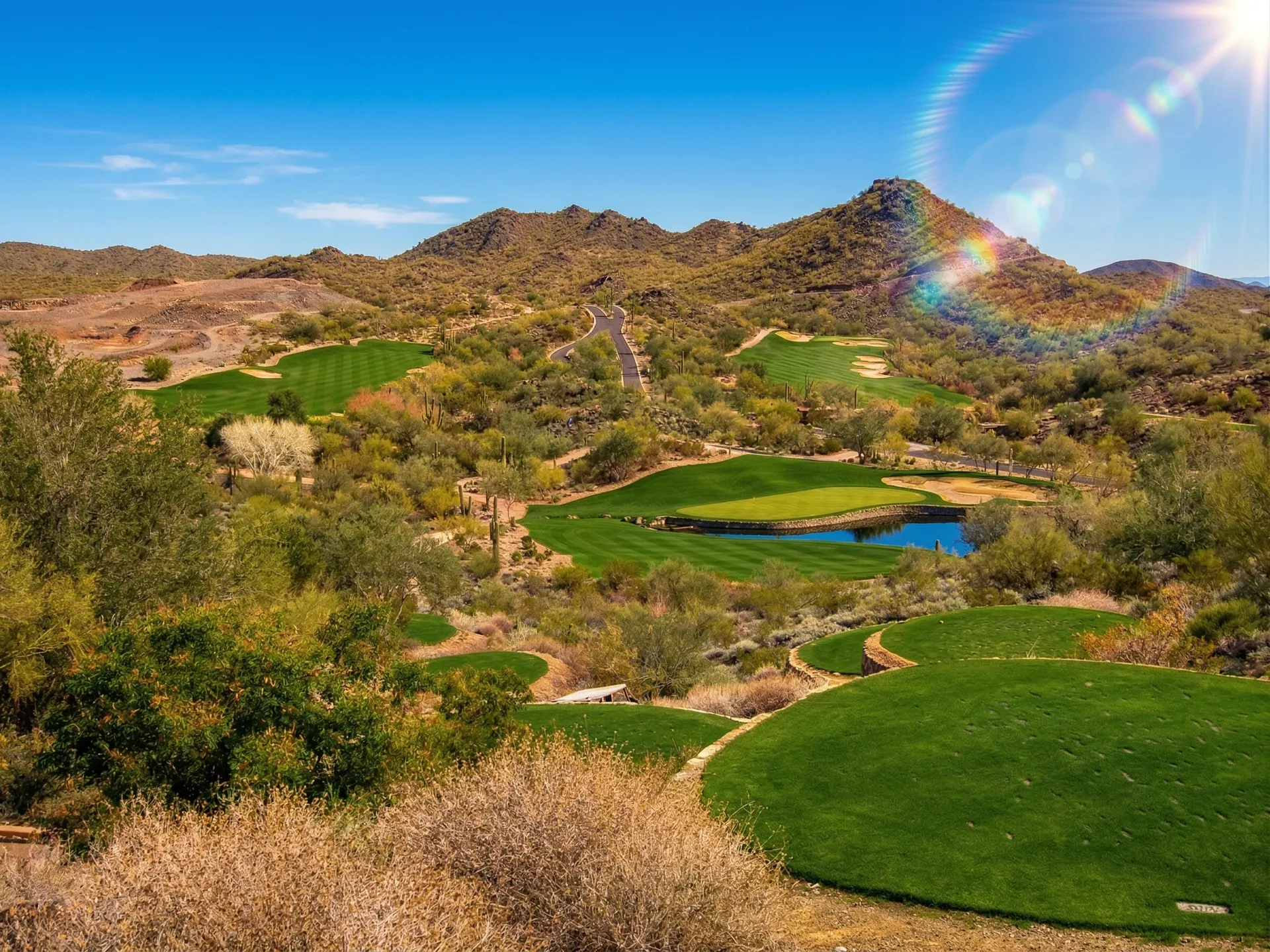
Rees Jones and Steve Weisser built it in 2000 on terrain covering 700 feet of elevation change, threading 18 holes through desert canyons where saguaro cacti serve as the only gallery. No homes interrupt the sightlines. No roads cross the playing corridors. The nearest neighbors are coyotes, and they show no interest in anyone’s handicap. First-time visitors historically navigated the final stretch by watching for a distinctive three-armed “W” shaped saguaro that marked the approach to the turnoff.
Golf Digest ranks Quintero 93rd among America’s 100 Greatest Public Courses. Golfweek names it the second-best public-access course in Arizona. In 2025, Jones returned to oversee a multi-million-dollar renovation that rebuilt every green with drought-tolerant 007XL Bentgrass, replaced all 65 bunkers with Augusta-white sand, and resurfaced every tee box. Twenty-five years of desert wear, corrected in five months. The course that was already worth an hour of empty highway now plays better than it ever has.
The Par 3s That Justify the Pilgrimage
Quintero has fourteen solid holes and four par 3s that border on extraordinary. The routing as a whole plays as demanding target golf: elevated tees, forced carries over rocky desert washes, and greens perched on canyon ridges that reject anything low and punish anything short. But the par 3s are where Jones and Weisser stopped designing and started sculpting.
The 6th (par 3, 169 yards from the Silver tees) drops 110 feet from tee to green. The putting surface sits far below in a desert basin, an emerald circle framed by the brown sweep of the Sonoran. The yardage says pitching wedge. The hang time says otherwise. Balls stay airborne so long that club selection becomes guesswork: the effective distance plays up to 30 yards shorter than the card reads, and first-timers routinely fly the green. The bailout is short and right. Smart players take it. Everyone else learns why the elevation-adjusted yardage matters more than the one printed on the scorecard.
The 9th (par 3, 162 yards from the Silver tees) carries entirely over water to a green perched above a hand-built rock wall, the pond reflecting desert sky. Nine different island tee boxes rotate throughout the season, each one altering the angle and the required trajectory. The yardage is short. The consequences of coming up short are wet. The green forgives long misses and punishes timid ones, transitioning the routing from the mountains back toward the clubhouse with genuine theatrical flair.
The 16th (par 3, 189 yards from the Silver tees) delivers the collection’s closing argument. A downhill shot to a green flanked by a desert wash on the left and a sweep of brilliant white bunkers on the right. There is no safe miss. The visual contrast of the new Augusta-white sand against brown desert and green turf is the renovation’s most striking upgrade: what was always a strong hole now photographs like something Jones designed specifically for the cover of a magazine.
The par 4s and 5s demand a different kind of respect. The 8th (par 5, 502 yards from the Silver tees) earns its reputation as the hardest hole on the course through a deep desert wash crossing, three abstract bunkers carved into the landscape, and a severely elevated green requiring extra clubs on the approach. Most par 5s offer a choice between aggression and conservatism. The 8th offers a choice between conservatism and disaster. The routing’s overall character tilts uphill: the majority of approach shots play to elevated, heavily defended greens, rewarding high-trajectory iron play and punishing anything that comes in low. Bump-and-run golf does not exist at Quintero. This is a course that demands the ball arrive from the sky.
The 2025 renovation addressed aging infrastructure without altering the routing’s identity. The 007XL Bentgrass greens run fast and true, resolving heat-tolerance issues that plagued the original putting surfaces through Arizona summers. The 65 rebuilt bunkers drain properly and hold their edges through monsoon season. A strict “desert rule” governs errant shots: balls hit into the protected native landscape receive a one-stroke penalty drop within two club lengths, preserving both pace of play and the federally managed ecosystem surrounding every hole.
Planning the Trip
What It Costs
| Item | Cost | Notes |
|---|---|---|
| Green fee | $160–$385 | Dynamic pricing; peaks on winter weekend mornings |
| Cart fee | Included | Walking permitted but carts are standard due to extreme elevation changes |
| Practice facilities | Included | Range, practice tee, and putting green |
| Forecaddie | $30–$35 per player | Available November–April; plus $20+ gratuity |
| Walking caddie | $100 per bag | Single bag carry; plus $30+ gratuity |
A forecaddie is worth booking for first-timers navigating blind tee shots and multi-tiered greens. Reserve at least 48 hours in advance through CaddieMaster.
Booking Strategy
Public tee times open 90 days in advance. Arizona residents booking with valid ID receive discounted rates at check-in. For peak-season morning slots, book at exactly 90 days; weekend mornings sell out quickly following the 2025 renovation. Budget-conscious golfers should target weekday afternoons, when dynamic pricing drops toward $200. A valid credit card is required to hold all reservations, and a strict 48-hour cancellation policy applies.
When to Go
| Window | Why |
|---|---|
| Jan–Apr ☀️ Prime | Peak season; temperatures in the 60s–80s, winter ryegrass fully mature |
| May 🌤️ Good | Off-season rates arrive; afternoons hot, mornings still playable |
| Jun–Sep ☀️ Avoid | Extreme heat exceeding 100°F; monsoon storms July–August; zero shade on the routing |
| Oct 🌤️ Good | Course reopens after overseeding; expect cart-path-only conditions |
| Nov–Dec ☀️ Prime | Cool mornings, pleasant afternoons; ryegrass maturing; peak rates apply |
The course closes for overseeding in late September or early October, typically reopening by late October or early November. Expect cart-path-only restrictions for several weeks after reopening to protect the establishing ryegrass.
Where to Stay
| Property | Nightly Rate | Notes |
|---|---|---|
| Quintero Terrace Casitas | Varies (contact club) | On-site luxury units renovated in 2025; ideal for dedicated golf groups |
| Scottsdale resort properties | $250–$500 | 45–60 minutes; best if playing multiple Scottsdale-area courses |
| Castle Hot Springs | $1,000+ | Ultra-luxury wellness resort ~40 minutes away; for the indulgent detour |
Getting There
Phoenix Sky Harbor International Airport (PHX) is a 45- to 60-minute drive via I-17 North and AZ-74, the Carefree Highway. A rental car is non-negotiable. Ride-shares will deliver from the airport, but securing a return trip from the remote clubhouse is unreliable. The final 18 miles of AZ-74 pass through open desert with no services before the turnoff for Quintero Lane and the gatehouse. Treat the drive as prologue, not inconvenience.
What Else to Play
The Scottsdale corridor sits an hour southeast and offers enough variety to fill a week. Troon North Monument ($200+, 45 minutes) routes through massive granite boulders for a different strain of dramatic desert golf. We-Ko-Pa Saguaro ($309, 50 minutes) delivers the inverse experience: a walking-friendly Coore and Crenshaw links course on tribal land with no housing in sight. TPC Scottsdale Stadium ($150–$637, 50 minutes) provides the tour-stop arena, complete with the stadium 16th. For the full trip-planning framework, see the Scottsdale destination guide.
Why the Empty Highway Is the Point
Every elite course in the Scottsdale corridor exists within the gravitational pull of resorts, restaurants, and real estate developments. Quintero exists outside all of it. The 45-minute drive that discourages casual visitors is the same drive that guarantees what those visitors are missing: a course where the desert sets the terms, where the horizon belongs to the Hieroglyphic Mountains rather than a roofline, and where 700 feet of elevation change does what flat, manicured desert courses cannot.
The road to Quintero is long and empty. The road back is the same. In between, for four and a half hours, the Sonoran Desert has something to prove. Rees Jones gave it 18 holes to make the argument.