Most Scottsdale golf courses announce themselves with desert theater: forced carries over saguaros, fairways dissolving into rocky arroyos, rattlesnake warnings posted on the first tee. The Raptor Course at Grayhawk Golf Club skipped that audition entirely.
Tom Fazio and Dennis Wise designed Raptor in 1995 as something the Sonoran Desert hadn’t seen: a parkland course with fairways wide enough to accommodate a generous slice and bent grass greens fast enough to expose a lazy wedge. The combination looks forgiving from the tee. It isn’t. When the NCAA selected Raptor to host the Division I Men’s and Women’s Golf Championships for three consecutive years (2021–2023), the world’s best college players arrived with power and precision. The green complexes answered with deep bunkers, severe contours, and a general indifference to reputations. Phil Mickelson, who has served as Grayhawk’s touring ambassador since his Arizona State days, has his name on the clubhouse restaurant. The course doesn’t care about that either.
The Greens Have Opinions
The front nine settles into a gentle, traditional rhythm. Fairways sweep through mesquite-shaded arroyos, hiding the surrounding homes and creating an insulated, low-slung parkland feeling that belongs in the Piedmont, not the Sonoran. Fazio built the corridors wide and the forced carries minimal, which means the average golfer can find the short grass and feel briefly competent. Then the greens deliver their verdict.
Raptor’s bent grass putting surfaces are massive, heavily contoured, and quick. They feature false fronts, dramatic tiering, and sweeping undulations that reject anything without proper spin into deep collection areas or cavernous bunkers. The defense here isn’t the desert. It’s the putting surface, and it doesn’t negotiate.
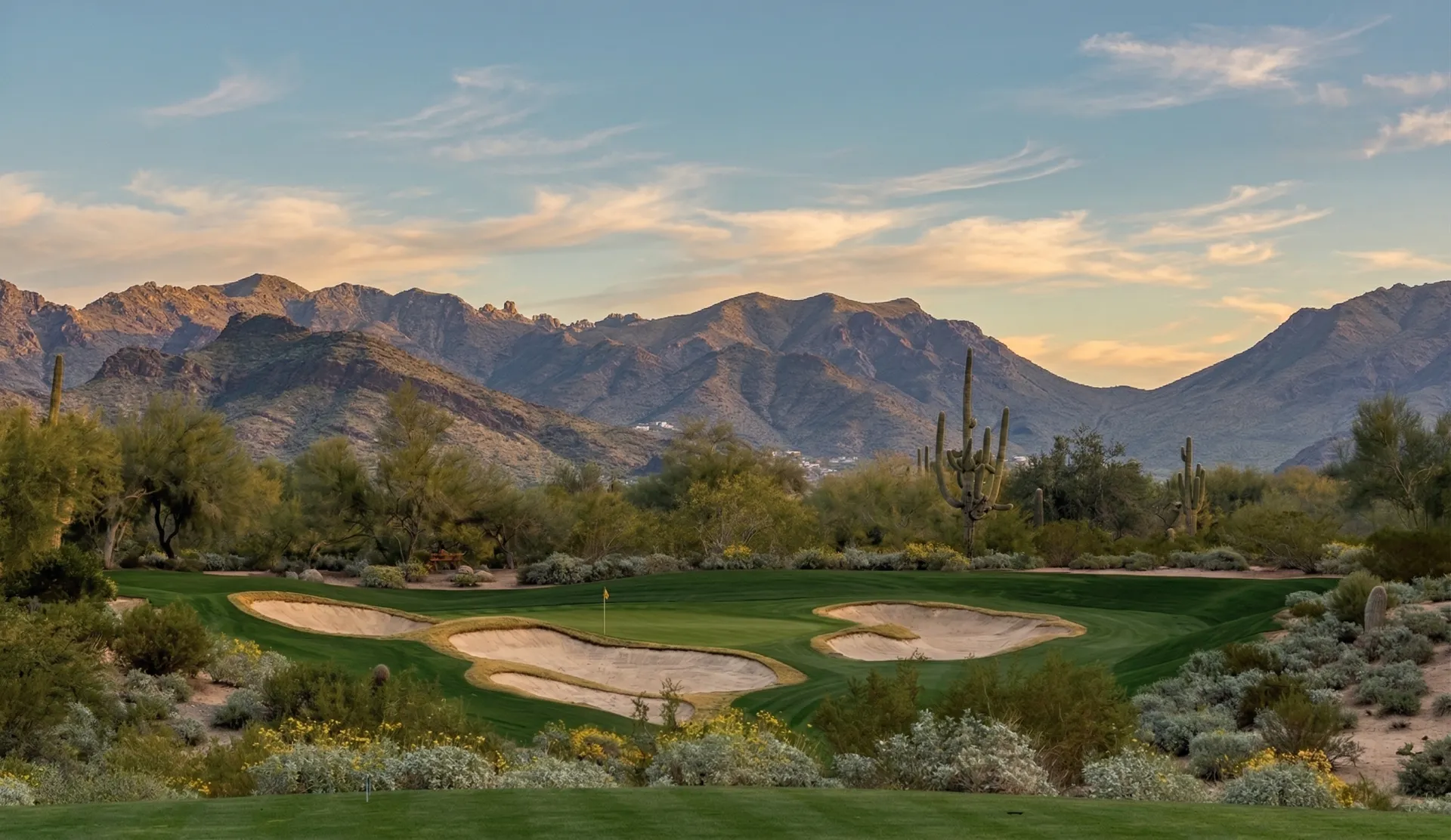
The 8th, “Aces & Eights” (par 3, 156 yards from the Palo Verde tees), plays entirely over desert scrub to a double-tiered green protected by three deep bunkers cut into the front. The McDowell Mountains fill the backdrop, but the view is best appreciated before hitting. Finding the wrong tier means a 40-foot putt across a ridge that treats anything without perfect speed as a suggestion. The play is an extra club to the center of the correct tier, treating a two-putt par as the achievement it is.
The back nine recalibrates. The routing winds through deeper desert washes, introduces creeks and water hazards, and raises the stakes considerably. The 10th, “Quill Creek” (par 4, 359 yards from the Palo Verde tees), looks like a gift on the scorecard. A creek slices across the fairway at 280 yards and trickles down the right side toward an elevated, two-tiered green. The fairway slopes gently right, funneling anything hit with driver toward the water. The intelligent play is a long iron to the flat spot short of the crossing, leaving a controlled wedge to the correct tier. During the NCAA Championships, aggressive drives turned this hole into a scoring disaster with remarkable efficiency.
The 18th, “Big Sky” (par 5, 494 yards from the Palo Verde tees), brings water heavily into play for the final 200 yards down the right side while deep bunkers guard the left. The hole tumbles downhill toward the timber-beam clubhouse and Phil’s Grill, the Phoenix skyline stretched beyond. Reachable in two for long hitters willing to challenge the lake from a downhill, sidehill lie, it rewards discipline over ambition. A layup to flat ground and a wedge approach produces the birdies. The hero shots produce the stories told afterward at Phil’s Grill, often involving the word “almost.”
Fazio returned in 2015 to reroute holes 15, 16, and 17, replacing beloved originals to accommodate adjacent development. The new 16th, a short downhill par 3 with a creek and pond guarding the left, flummoxed elite college players holding wedges during the NCAA Finals. Regulars are divided on whether the new holes match the character of the originals, but the difficulty is not in question. The old stretch had personality. The new stretch has teeth.
Planning the Trip
What It Costs
| Item | Cost | Notes |
|---|---|---|
| Green fee (peak) | $250–$350 | Dynamic pricing; highest rates January–April weekends |
| Green fee (summer) | $75–$130 | Extreme discounts June–August |
| Cart fee | Included | Standard with all green fees |
| Forecaddie | $40–$50 per person (shared) | Plus cash gratuity; request in advance |
Walking is permitted, and the gentle terrain makes it pleasant, though carts are standard. Forecaddies are worth the investment during peak season: Raptor’s blind bunkers and multi-tiered greens benefit from someone who has read the contours a thousand times.
Booking Strategy
Tee times open 90 days in advance online. During peak season (January through April), booking at the 30-day mark is essential for morning slots. Calling the pro shop directly for a 36-hole Raptor-Talon package unlocks scheduling flexibility across five days and slight discounts unavailable online. Twilight rates begin 3.5 hours before sunset and offer the best value for players willing to race the fading light. Summer walk-ons are easy. Winter walk-ons are a fantasy.
When to Go
| Window | Why |
|---|---|
| Jan–Apr ☀️ Prime | Perfect desert weather, lush overseeded ryegrass, peak pricing |
| May ☀️ Good | Shoulder season; heat building but playable, prices dropping |
| Jun–Aug ☀️ Avoid | Daily highs above 100°F; aeration in July, thinning turf |
| Sep ☀️ Good | Heat breaking; course preparing for fall transition |
| Oct 🌤️ Avoid | Raptor typically closed mid-October for overseeding |
| Nov–Dec ☀️ Prime | Fresh ryegrass, crisp mornings, excellent conditions |
Raptor closes for fall overseeding (typically mid-to-late October) and undergoes aeration in July. Confirm dates with the pro shop before booking travel around these windows.
What Else to Play
Grayhawk’s sister course, the Talon (David Graham and Gary Panks), features deeper box canyons and an island green at a comparable daily fee. TPC Scottsdale’s Stadium Course, home of the WM Phoenix Open and its famous 16th-hole coliseum, sits ten minutes south. We-Ko-Pa’s Saguaro Course, 25 minutes east on Fort McDowell Yavapai Nation land, offers the opposite aesthetic: minimalist, housing-free desert links by Coore and Crenshaw. Troon North’s Monument and Pinnacle courses thread through massive granite boulders fifteen minutes north. For the full Scottsdale trip framework, including itineraries and budget tiers, see the Scottsdale destination guide.
Why the Wide Fairways Don’t Help
Raptor’s great trick is generosity that doesn’t translate to scoring. Fazio gave visiting golfers every fairway they could want, then stationed the real examination on the greens. The course doesn’t punish the tee shot. It punishes the approach, the read, the speed, the nerve. Three years of NCAA championship golf proved the formula works at every level. The fairways welcome everyone. The green complexes sort them out.