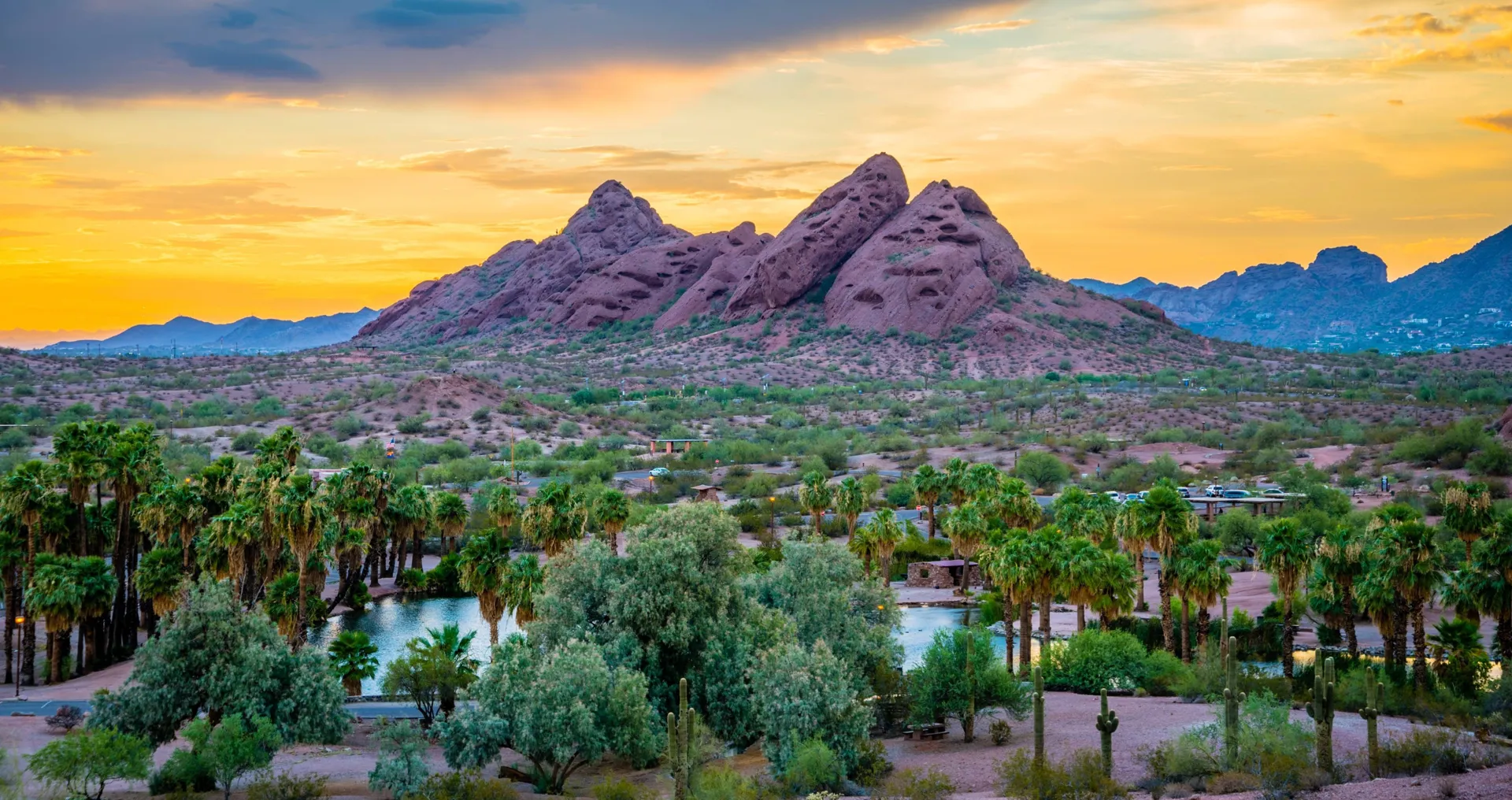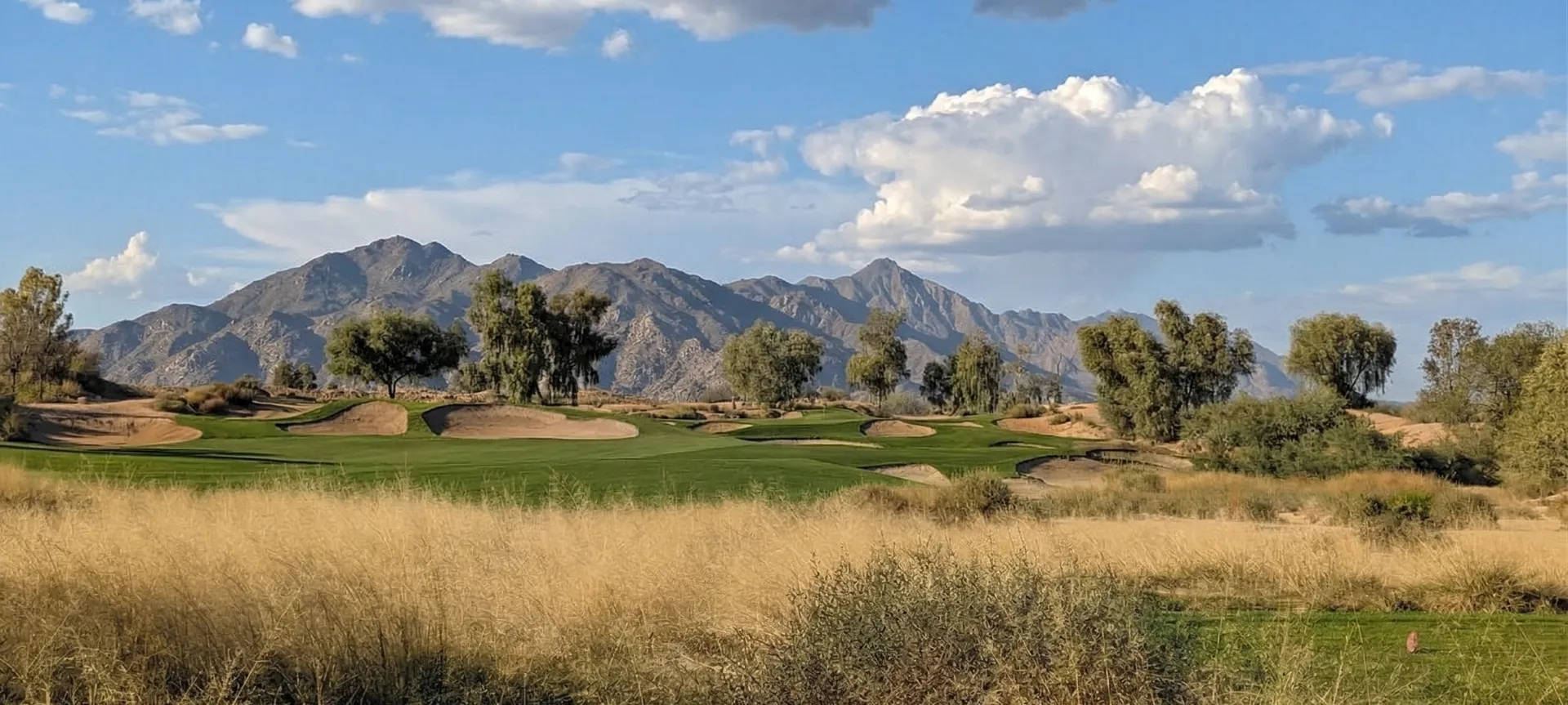
Every course in the Phoenix-Scottsdale corridor sells some version of the same aesthetic: saguaro-studded fairways threading through rocky arroyos, with forced carries over pristine desert. Ak-Chin Southern Dunes wants absolutely nothing to do with any of it.
Brian Curley, Lee Schmidt, and Fred Couples built this course in 2002 not as an homage to the Sonoran Desert but as a transplant from the Australian Sandbelt, dropping 129 bunkers across 320 acres of flat terrain in Maricopa, forty-five minutes south of Scottsdale. No houses. No cacti in the playing corridors. No target-golf theatrics. Just sand, turf, wind, and a ground game that rewards imagination over launch angle. The Ak-Chin Indian Community purchased the property in 2010, reclaiming ancestral land that had been removed from their reservation by executive order in 1912 and transforming what was once a men-only private enclave into a premier daily-fee public course managed by Troon Golf. Golfweek ranks it tied for fifth among public courses in the state.
Sand, Wind, and the Ground Game
Even after a 2014 renovation removed 83,000 square feet of bunkers, Southern Dunes still contains twelve acres of sand spread across 129 hazards. That averages more than seven bunkers per hole. The turf is Bermuda, overseeded in winter for lush conditions, and it runs firm and fast in ways that reward the bump-and-run approach most Arizona courses never demand. The greens are expansive, sweeping, and receptive to low runners; the putter from just off the putting surface is a genuine weapon here, not a survival tactic.
Wind is the second constant. The property sits in a natural valley that funnels and shifts breezes throughout the day, altering effective yardages without warning. A morning 7-iron becomes an afternoon 5-iron on the same hole. The routing favors a fade (most doglegs bend right), but the absence of trees allows any shot shape to thrive if the player reads conditions correctly.
The 14th (par 4, 283 yards from the Blue tees) is the hole that defines the personality. Sixteen bunkers guard a playing area that contains, mathematically, more sand than grass. From the tee, it looks like a chaotic sea of white with thin ribbons of Bermuda woven between the hazards. The decision is binary: lay up to a preferred wedge distance through the cross-bunkers, or commit with the driver and carry the trouble entirely. The timid play, an uncertain iron aimed at the widest gap, is the one most likely to find sand.
The 10th (par 4, 366 yards from the Blue tees) introduces the only significant water on the property, a pond running along the right side of a dogleg right. A massive bunker encroaches from the right and fronts a green surrounded by more sand than putting surface. The conservative bail-out left off the tee avoids the water but leaves a brutally long approach over sand. Challenging the right corner with a precise placement drive rewards the player with a short-iron second.
The back nine carries more variety than the front, adding water features at the 10th and 18th that break the sand-dominant aesthetic. The 13th, a 507-yard par 5 from the Blues, climbs continuously uphill along the western boundary with the largest bunker on the course looming 75 yards short of the green on the left. The front nine establishes the rhythm; the back nine tests whether it holds under pressure. Across all eighteen holes, the 2014 renovation eliminated every blind shot and expanded forward tees to remove forced carries, broadening the course’s appeal without diluting its championship bite. From the tips at 7,546 yards (slope 142, rating 76.5), Southern Dunes hosts NCAA regionals and PGA section championships. From the forward tees, it remains genuinely enjoyable for players who choose the right yardage and accept that bunker shots are part of the deal.
Planning the Trip
What It Costs
| Item | Cost | Notes |
|---|---|---|
| Green fee | $33–$286 | Dynamic pricing by demand and season; shared cart included |
| Single rider cart | $100 | Subject to availability |
| #miniDunes night golf (weekday) | $25 | Unlimited play Wed–Thu afternoons/evenings |
| #miniDunes night golf (Fri–Sun) | $35 | Unlimited play Fri–Sun afternoons/evenings |
Caddies are available by advance request through the pro shop. For first-time visitors navigating twelve acres of bunkers and wind-affected approaches, local knowledge pays for itself.
Booking Strategy
Tee times open 60 days in advance for the general public. The course uses airline-style dynamic pricing: rates adjust in real-time based on demand, and booking early locks in the lowest available rate. Guests at Harrah’s Ak-Chin Casino Resort, ten minutes away, enjoy priority booking windows and stay-and-play packages. Replay rounds are available based on same-day availability at the pro shop.
When to Go
| Window | Why |
|---|---|
| Jan ❄️ Good | Comfortable afternoons; morning frost delays likely |
| Feb–Apr ☀️ Prime | Ideal conditions, overseeded turf, firm and fast; peak pricing applies |
| May 🌤️ Good | Heat rising but mornings still playable; lighter crowds |
| Jun–Aug ☀️ Avoid | Extreme heat (105°F+), monsoon storms, summer aeration |
| Sep 🌤️ Good | Temperatures cooling; turf prepped for overseeding transition |
| Oct 🌤️ Avoid | Course typically closed for overseeding most of the month |
| Nov ☀️ Prime | Freshly overseeded turf; cart-path-only restrictions possible early |
| Dec ❄️ Good | Beautiful afternoons; frost delays can disrupt morning tee sheets |
Overseeding typically closes the course for two to three weeks in October. Cart-path-only restrictions may continue into late November.
Where to Stay
| Property | Nightly Rate | Notes |
|---|---|---|
| Harrah’s Ak-Chin Casino & Resort | $$ | 10 minutes; stay-and-play packages; same tribal ownership |
| Talking Stick Resort | $$$ | 50 minutes; Scottsdale casino resort with golf packages |
| The Westin Kierland Resort & Spa | $$$$ | 55 minutes; luxury Scottsdale option |
Getting There
Phoenix Sky Harbor International Airport (PHX) is roughly 45 minutes north, served by all major domestic and international carriers. A rental car is essential. Maricopa is isolated from the central Scottsdale golf corridor, and rideshare availability for the return trip can be unreliable. From Sky Harbor, take I-10 East to AZ Highway 347 South into Maricopa.
What Else to Play
Southern Dunes sits outside the Scottsdale corridor, but the region offers no shortage of worthy detours. Whirlwind Golf Club (25 minutes) provides 36 holes of Troon-managed desert golf without residential development, an aesthetic companion to Southern Dunes. For the broader Scottsdale trip, We-Ko-Pa’s Saguaro and Cholla courses deliver pure desert spectacle on Fort McDowell Yavapai Nation land, and Quintero offers nearly 700 feet of elevation change through the Hieroglyphic Mountains. The full Scottsdale destination guide maps optimal sequencing for a multi-day trip.
After the Round
The 2014 renovation embedded a six-hole short course called #miniDunes into the practice range, with holes ranging from 60 to 115 yards. In 2024, the facility installed 88 Musco LED light fixtures across 15 poles, creating a fully lit night-golf experience synced to music under the Arizona sky. At $25–$35 for unlimited play, drink holders on every tee box, and the Arroyo Grille’s food truck serving the crowd, it is arguably the best post-round activity in the Phoenix metro.
Why the Drive Is Worth It
The knock on Southern Dunes has always been the location. Forty-five minutes south of Scottsdale, down Highway 347, past the point where the resort corridor gives way to open desert. The former general manager once put it plainly: “We have to continue to fight the idea that we’re out in the middle of nowhere.”
But isolation is inseparable from what makes the course work. No houses means no compromises in the routing. No neighboring developments means uninterrupted sightlines across 320 acres of pure golf terrain. The Ak-Chin Indian Community did not reclaim this land to surround it with condominiums. They reclaimed it because it was theirs, opened the doors to everyone, and built something that rewards anyone willing to make the drive: a Sandbelt championship layout that asks for imagination before power, a ground game before a launch angle, and the willingness to play a kind of golf that most of Arizona does not know exists.