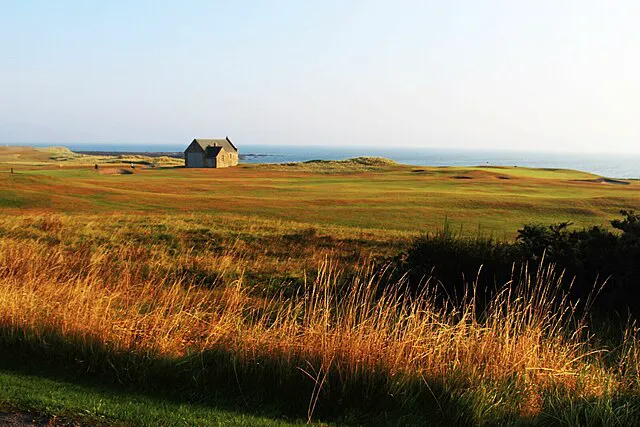
The first time you stand on the 1st tee at the Old Course at St Andrews, you’re standing exactly where every golf legend you’ve ever heard of has stood. Nicklaus stood here. Palmer stood here. Tiger stood here. Old Tom Morris stood here before indoor plumbing was invented. The ghosts outnumber the living by about 600 years to zero.
And the thing that hits you, standing there with your three-wood (because nobody hits driver on this hole unless they hate their golf ball), is this: you can actually play here. You. Not as in “you and your CEO friend who knows a guy.” Not as in “you if you win the member-guest.” You as in regular human you, with your 17 handicap and your swing thought collection that rivals the Library of Congress.
This is the holy ground of golf, and they let anybody walk on it who can scrape together the green fee and wake up at 4 AM to enter the lottery.
That might be the most remarkable thing about the Old Course at St Andrews. It’s not that it’s old, though it is. It’s not that it’s famous, though it is. It’s that it’s public. Augusta National won’t return your calls. Pine Valley wouldn’t let you in even if you owned a small country. But St Andrews? St Andrews will take your money, hand you a tee time, and say “mind the wind.”
A Course That Shouldn’t Work, But Does
Here’s what nobody tells you about the Old Course: on paper, it makes no sense. None. Zero. If someone showed you the blueprint today and asked for funding, you’d check them for head trauma.
The course was created by sheep. And rabbits. And Scotsmen who apparently thought “fairway” meant “anywhere between the town and the beach.” There are seven double greens—SEVEN—meaning you could be on the same putting surface as someone playing a completely different hole. The 5th and 13th share a green. So do the 6th and 12th. Imagine being on the 5th green with a 40-footer when someone lands a 5-iron next to you from the 13th fairway. It’s like cosmic collision avoidance without the cosmos.
The fairways are wider than Montana. The rough is whatever happens to be growing there at the time, maintained by weather patterns rather than mowers. There are bunkers with names like Hell and Coffin and Devil’s Asshole (okay, I made that last one up, but would you be surprised?). The green complexes look like someone took a topographical map and decided to make it three-dimensional just to mess with people.
And the whole thing runs out and back, like someone couldn’t decide on a routing so they just went straight away from town and then straight back. Nine holes out, turn around, nine holes in. The outward holes play into the prevailing wind. The inward holes play with it. Unless the wind changes, which it does, often, mid-round, just to keep you honest.
By modern standards, it’s ridiculous. By golf history standards, it’s perfect.
The Holes That Haunt Your Dreams
The Road Hole. The 17th. Four hundred and ninety-five yards of “what were they thinking?” The tee shot has to clear the Old Course Hotel—not figuratively, literally. You aim at the corner of a building and hope. The second shot has to navigate the deepest pot bunker in golf, a sandy crater that’s claimed more championship hopes than bad putting.
And then there’s the road. An actual road. Made of actual stones. Hard up against the green. Miss right and you’re playing off asphalt with a hotel building behind you and a stone wall for comfort. Thomas Bjorn found that bunker in the 2003 Open Championship with a three-shot lead and left it three shots later. David Duval did something similar. The Road Hole doesn’t care about your credentials.
The 1st hole shares a fairway with the 18th. Stand on the 1st tee and to your right is the 18th fairway. To your left is the 18th fairway. Straight ahead is also the 18th fairway. The 1st fairway is somewhere in there too, theoretically. It’s 376 yards of “try not to hit anyone coming in” which is the kind of safety protocol that makes OSHA inspectors weep.
The 11th hole, High In, has a green that’s shared with the 7th. It also has Eden, a bunker so perfectly placed that it’s like the golf course architect studied geometry and decided to fail the course on purpose. Short is dead. Left is deader. Right is actually okay but nobody believes it.
And then there’s the Valley of Sin fronting the 18th green. It’s a swale. A depression. A place where golf balls go to die just short of glory. It looks harmless. It plays like quick sand. You can be six feet from the hole and need three putts. You can be in the Valley and need an excavation team.
The Town That Golf Built
St Andrews the town is basically a golf course with some buildings attached. The Old Course Hotel overlooks the 17th. The R&A clubhouse overlooks the 18th like a stone judge watching your finish. The town’s main street runs parallel to the Old Course, close enough that you can smell the fish and chips while you’re missing putts.
There’s a cemetery behind the 13th green. Actual graves. The deceased have a better view of the Old Course than most people alive. It’s morbid or romantic depending on your disposition.
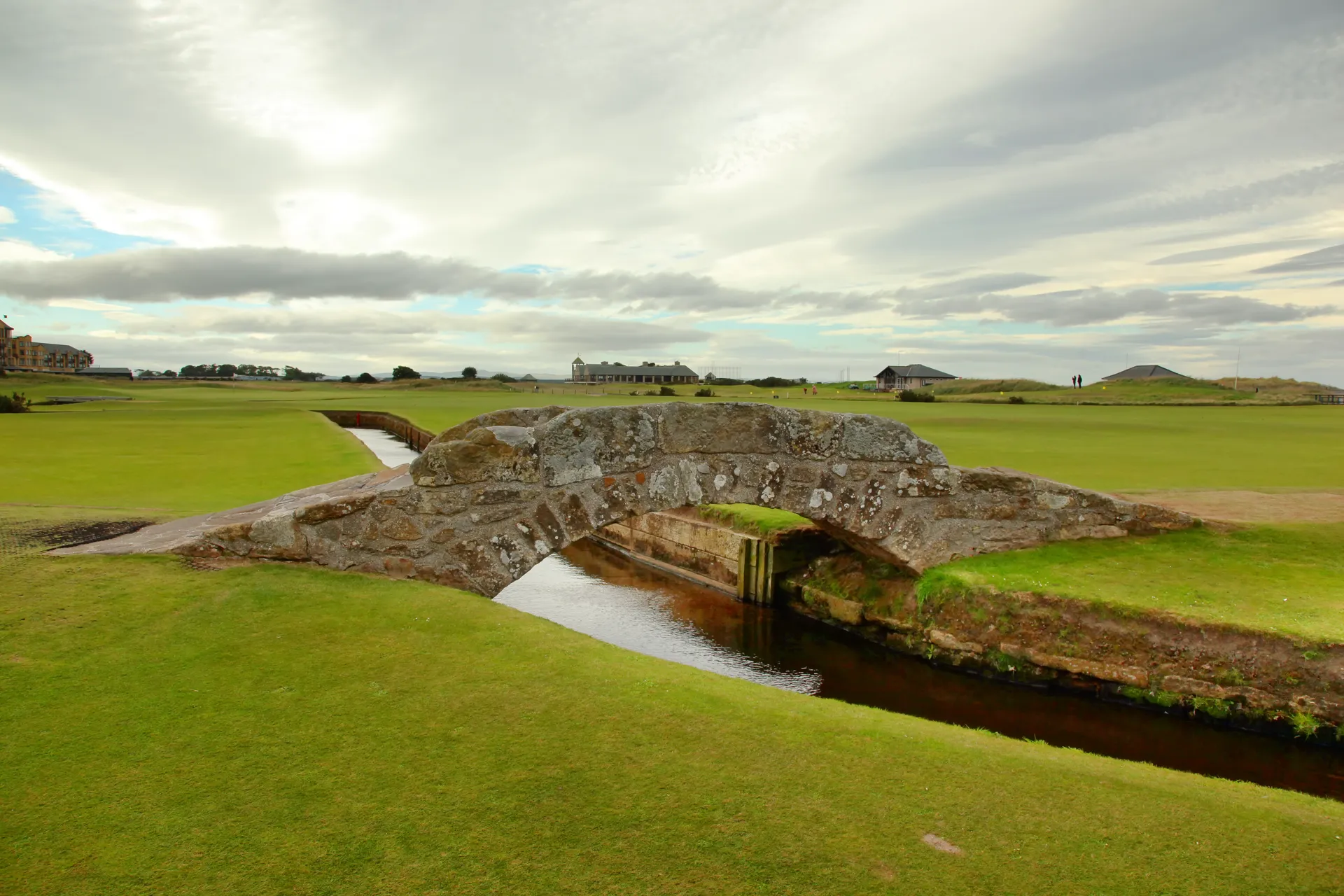
The Swilcan Bridge crosses the burn on the 1st and 18th holes. It’s 700 years old, give or take a century. Every Open Champion has walked across it. You will walk across it. Jack Nicklaus cried walking across it during his final British Open in 2005. The bridge doesn’t care. It’s outlasted everybody.
The town has 18,000 people and approximately 147 golf courses. The University of St Andrews is there, being all academic and prestigious. Prince William met Kate Middleton there, probably because she was impressed by his mashie niblick collection.
But really, St Andrews is a golf town that happens to have a university, not a university town that happens to have golf courses. The difference matters.
The Lottery That Might Break Your Heart
Here’s how you play the Old Course: you don’t just book a tee time. This isn’t Myrtle Beach. You enter the daily lottery. The previous day, between 2-4 PM local time, you show up (or register online if you’re fancy and coordinated across time zones) and throw your name in.
If your name gets drawn, congratulations. You’ve won the golf lottery, which is better than the regular lottery because you get to spend money immediately.
If your name doesn’t get drawn, you can try the standby list. Show up early. Real early. Like “I haven’t been to bed yet” early. Wait with the other desperate souls who also didn’t win the lottery but refuse to admit defeat. Sometimes spots open up. Sometimes they don’t. Sometimes it rains sideways and you question your life choices.
Or you can book months in advance through the ballot system, which is like the lottery but with more planning and less immediate gratification. You submit your request. You wait. You hope. You receive an email that either makes your year or ruins your week.
The green fee is currently around £300 in peak season. That’s roughly $380 US, which sounds expensive until you remember you’re playing the same course where Young Tom Morris won four straight Opens before turning 21. Then it seems like a bargain.
Playing Where History Lives
The thing about the Old Course is you’re not just playing golf. You’re playing archaeology. Every bunker has a story. Every ridge has history. The Hell Bunker on 14 is about 10 feet deep and requires a ladder to exit if you’re really unlucky. Principal’s Nose on the 16th is a bunker complex that looks like exactly what it’s named after.
Old Tom Morris was born in 1821 and died in 1908. He won the Open Championship four times. He designed and redesigned the Old Course. He was the keeper of the green for nearly 40 years. His son, Young Tom Morris, won the Open four consecutive times starting at age 17. Young Tom died at 24, and Old Tom never quite recovered. They’re both buried in the cathedral graveyard, a short walk from the course.
Bobby Jones said the Old Course was the one course he would play if he could only play one course for the rest of his life. This from a man who won the Grand Slam and basically had his pick of courses.
Jack Nicklaus won his first Open Championship here in 1970. He won his second in 1978. The man called it the course he’d most like to play if he could only play one more round.
Tiger Woods won here in 2000 and 2005, the latter by five shots and without finding a single bunker in four rounds. The bunkers were devastated by the snub.
The Wind That Writes the Score
The North Sea is right there. Just past the town, across the beach, bringing weather systems that have no business affecting golf but do anyway. The wind at St Andrews doesn’t blow—it attacks.
On calm days (which exist in theory), the Old Course plays like a gentle walk through golf history. On windy days (which exist in practice), it plays like a hostage negotiation with Mother Nature.
The inward nine plays easier because you’re generally downwind. Unless you’re not, in which case you’re upwind on holes designed to play downwind, which is like trying to eat soup with chopsticks.
I played the Old Course in September. The wind started at 15 mph at breakfast. By the turn, it was 30. By the 16th hole, it was 40, and I watched a woman’s drive from the forward tees travel backwards. Not hook backwards. Not slice backwards. Straight back towards her, like the ball had decided to reconsider the entire venture.
That’s St Andrews. That’s links golf. That’s playing golf the way it was meant to be played before someone invented irrigation systems and grooming standards.
Why It Matters More Than It Should
The Old Course at St Andrews shouldn’t be one of the best courses in the world. By modern standards, it’s weird. The fairways are too wide. The greens are too wild. The routing makes no sense. Half the bunkers are invisible from the tee.
But it is one of the best courses in the world. Maybe the best, depending on who you ask and how romantic they’re feeling.
Because the Old Course isn’t about perfection. It’s about golf in its purest form—navigating land, managing wind, making decisions, accepting consequences. It’s about history layered so thick you can feel it in the turf. It’s about democracy in a sport that often forgets democracy exists.
You can play where Bobby Jones played. Where Jack played. Where Tiger played. You can stand on the Swilcan Bridge and take the same photo everyone takes because everyone should take that photo. You can miss the same putts in the Valley of Sin that professional golfers miss on Sunday afternoon with Open Championships on the line.
And when you finish—whether you shot 76 or 106, whether you found Hell Bunker or avoided it, whether the wind blessed you or destroyed you—you walk off the 18th green in front of the R&A clubhouse and you think: I played the Old Course at St Andrews.
That’s not nothing. That’s everything.
The Details (For When You’re Ready)
Location: St Andrews, Fife, Scotland
Architect: Sheep, rabbits, time, Old Tom Morris (modifications)
Year Opened: Approximately 1400-something (exact date lost to history)
Par: 72
Yardage: 7,305 yards (Championship tees)
Green Fee: £300 in peak season (April-October)
Access: Daily lottery (48 hours in advance), advance ballot, or standby list
Signature Holes: 17th (Road Hole), 18th (Valley of Sin)
Best Time to Play: May through September (if you like daylight and marginally better weather)
What to Bring: Windproof everything, low expectations, high hopes
Caddies: Recommended. They’ve seen things. They know things. Listen to them.
The Lottery System:
- Enter the daily draw 48 hours in advance (2-4 PM local time)
- Can enter online or in person at the Old Course Starter’s Hut
- Singles have better odds than groups
- Winter months (November-March) are easier to book
- Locals and handicap holders get priority (but tourists still have chances)
- Standby list is first-come, first-served starting at 6 AM
Pro Tips:
- Play twice if you can—once to see it, once to understand it
- The caddies know which bunkers are in play; trust them
- The double greens are exactly as confusing as they sound
- Aim for the big greens; you’ll still miss them half the time
- The town has more golf shops than churches (and both have devout followers)
- Book accommodations early; St Andrews is popular for some reason
The Old Course at St Andrews is golf’s home address. It’s where the sport learned to walk before it learned to run. It’s proof that the best courses aren’t always designed—sometimes they just evolve, one sheep path at a time, until greatness emerges.
And the best part? They’ll let you play it. All you need is a lottery win, a tolerance for wind, and the willingness to walk where legends walked.
See you at the Swilcan Bridge.