Western Gailes doesn’t have a marketing department. It doesn’t need one.
Tucked onto a narrow strip of Ayrshire linksland between the Firth of Clyde and an active railway line, Western Gailes has spent nearly 130 years doing nothing in particular to draw attention to itself. F. Morris (no relation to Old Tom) laid out the original routing in 1897 for four Glaswegians who wanted year-round links golf without the frost-prone parkland back home. They leased the land from the Duke of Portland, hired a greenkeeper, and let the dunes do most of the design work.
The dunes obliged magnificently.
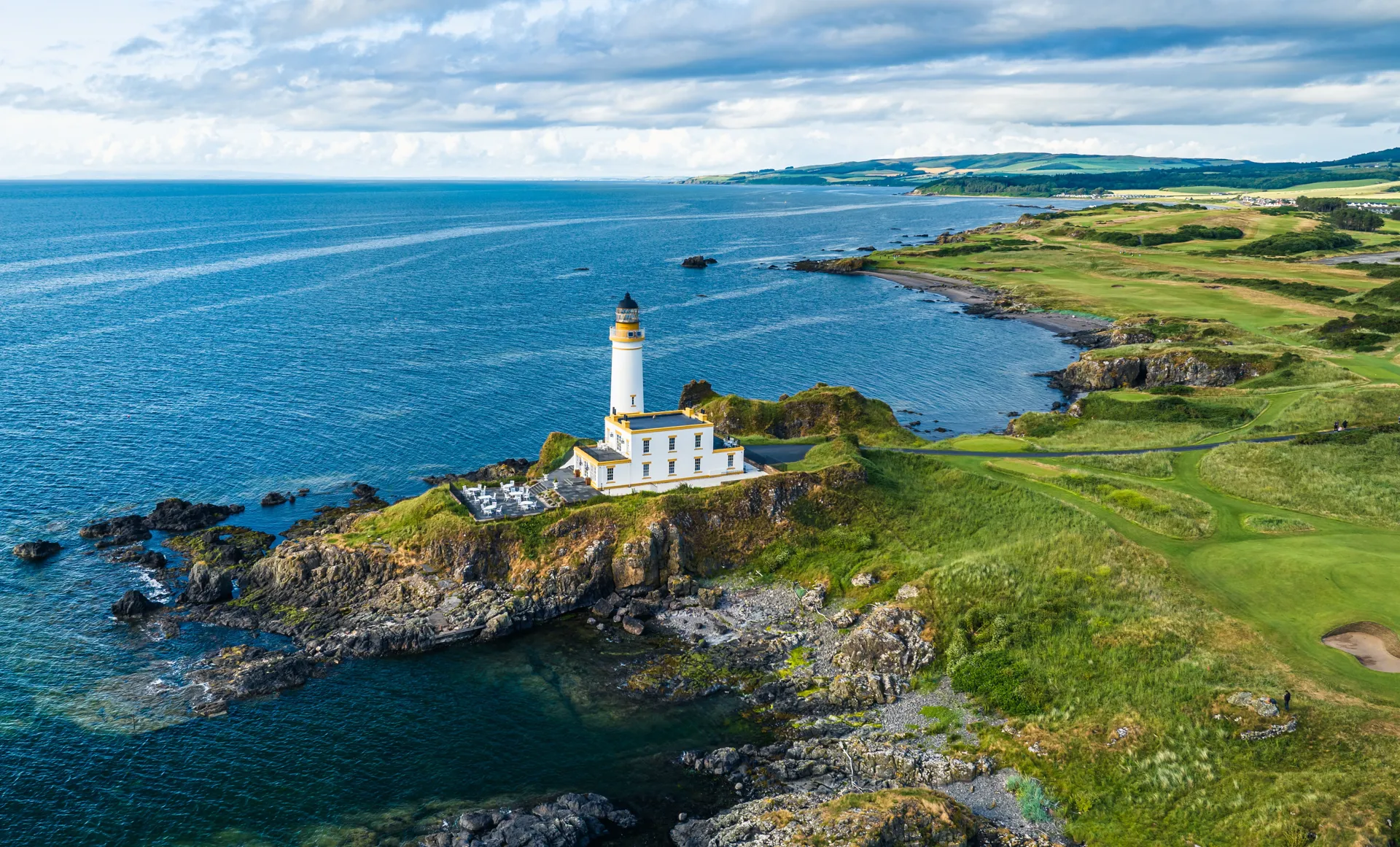
The course ranks among the top 50 in Britain and Ireland on most serious ranking lists and serves as a regular Final Qualifying venue for The Open Championship. Geoff Ogilvy, a U.S. Open champion, played it and called it “high on my list of must-play courses” before immediately planning his return. And yet Western Gailes exists in relative anonymity compared to its Ayrshire neighbors: Royal Troon has the Postage Stamp and the television cameras, Turnberry has the lighthouse and the luxury hotel, Prestwick has the origin story of The Open itself.
Western Gailes has none of those things. What it has is golf. Stripped down, wind-blasted, deceptively strategic links golf on land that hasn’t been softened for commercial consumption. The 1972 Curtis Cup was played here, the kind of event that proves a venue’s championship mettle without turning it into a brand. A teenage Rory McIlroy and Shane Lowry competed in the 2007 European Amateur Team Championship on these fairways before anyone knew their names. Western Gailes doesn’t produce celebrities. It produces golfers who understand what the game is supposed to feel like.
Where the Wind Changes Its Mind
The routing is what sets Western Gailes apart from every other course in Ayrshire, and most courses anywhere. The clubhouse sits in the center of the property, and the course unfolds in a loose figure-eight: four holes march north along the railway, nine holes sweep south along the coastline, and five holes turn north again to finish. Three directional changes mean three entirely different wind experiences. Club selection from the previous hole is immediately irrelevant.
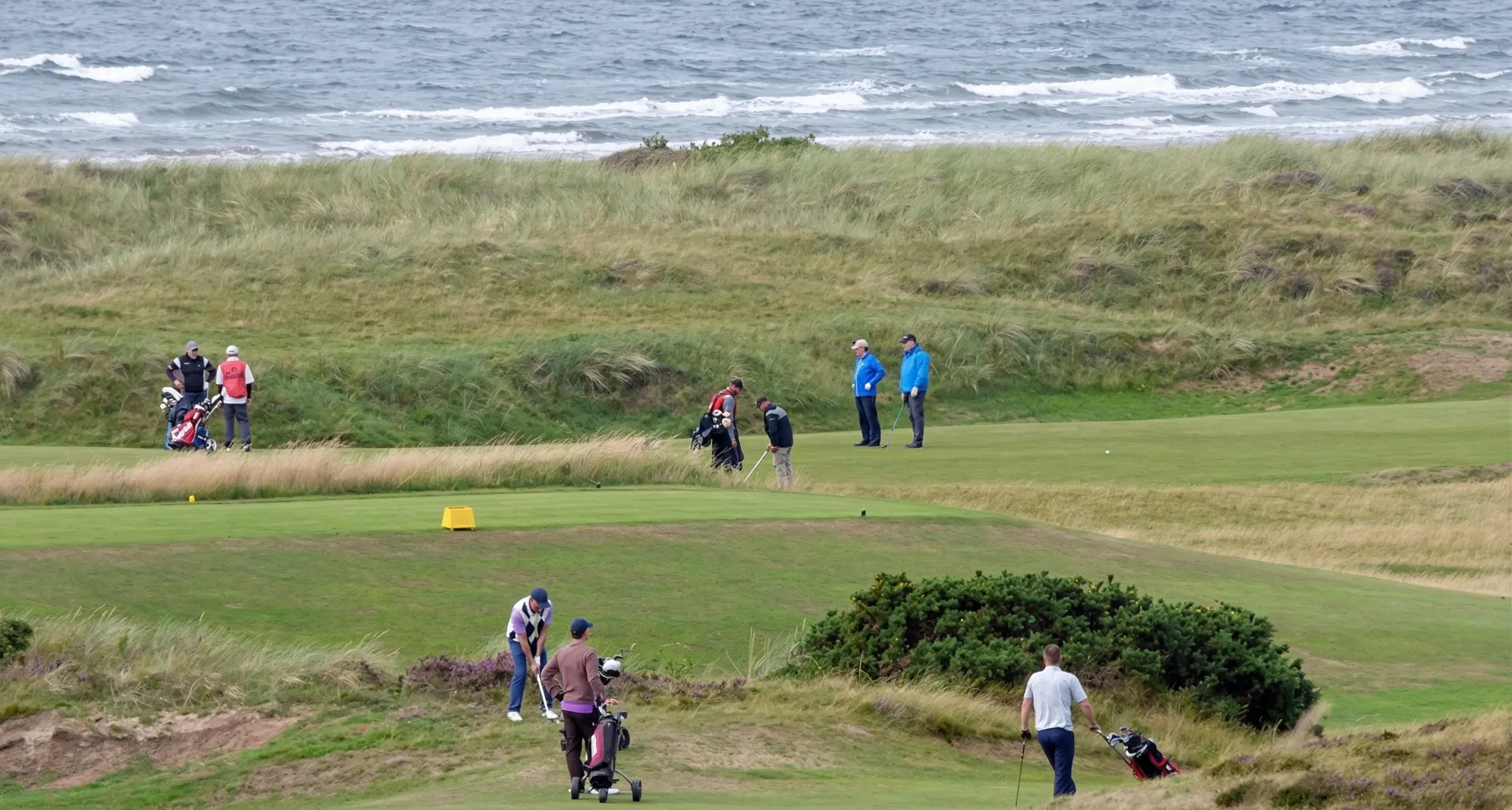
The opening stretch plays tight and claustrophobic, with the railway looming hard on the right as an immediate out-of-bounds. At the 5th, the course breaks free onto the coastline, and the mood shifts entirely. Massive dunes frame everything. The Firth of Clyde crashes along one side. Arran and Ailsa Craig rise on the horizon. The wind, a mild nuisance moments ago, is suddenly hostile and personal.
The 6th, “Lappock” (par 5, 470 yards from the Medal tees), announces the coastal stretch’s intentions. Usually playing downwind, it tempts longer hitters to reach in two. The temptation is a trap. The approach is entirely blind, fired through a narrow cartgate opening in the dunes, and the ball simply disappears. The green reveals itself only upon arrival: a natural punchbowl amphitheater, hidden and gathering. The smart play is a low, running long iron, well short and right, trusting the firm turf and the contours to funnel the ball into the bowl. The brave play is the same shot, just with more club.
The 7th, “Sea” (par 3, 171 yards from the Medal tees), is the most photographed hole on the property and the one that punishes camera-phone confidence. Played from an elevated tee atop a sand dune, it delivers a brief panorama of the Firth and the Isle of Arran before demanding absolute precision. The green sits in a nook surrounded by pot bunkers, bumps, and hollows, and the crosswind off the sea makes club selection a genuine ordeal. Average players miss the green entirely and end up plugged in sand or lost in marram grass. Good players drill a low stinger beneath the breeze and let the firm turf do the work. Great players make par and feel like they’ve stolen something.
Nearly half of Western Gailes’ greens sit in natural saucers or punchbowls that gather approach shots generously, then punish them with subtle, neutralizing slopes. The other half perch on plateaus, rejecting anything less than precise. The turf is firm, fast fescue. The rough is gorse, heather, and regret. The course rewards the ground game above all else: low trajectories, bump-and-run approaches, the willingness to shape the ball both ways to hold a crosswind. High-spin target golf is a recipe for lost balls and mounting frustration.
The railway returns on the final stretch, holes 14 through 18, where the route turns north again. The 17th (par 4, 443 yards from the Medal tees) is widely regarded as the hardest hole on the property. The tee shot must be aimed at the left edge of the distant clubhouse; anything that drifts right is permanently gone on the active tracks. Members accept the difficulty and play conservatively down the left side, relying on a strong short game to salvage par. Visitors tend to discover, too late, that the railway keeps score.
Planning the Trip
| Item | Cost |
|---|---|
| Green fee (spring/fall weekday) | £190 |
| Green fee (summer weekday, May–Oct) | £310 |
| Green fee (summer Saturday) | £335 |
| Green fee (summer Sunday) | £310 |
| Green fee (winter) | £95 |
| Caddie (per bag) | £70 |
| Forecaddie (per group) | £100 |
| Cart | Medical certificate only |
Summer weekday green fees include a soup-and-sandwiches lunch in the clubhouse dining room, a tradition that remains genuinely charming. Caddie fees are paid in cash directly to the caddie, and a generous gratuity is expected on top. Book caddies at the time of tee-time reservation; first-time visitors will benefit enormously from local knowledge on the blind approaches and the wind.
Western Gailes welcomes visitors on its own terms. Monday, Wednesday, and Friday offer the widest availability (09:00–12:00 and 14:00–16:30). Tuesday and Thursday tee times are restricted to a narrow afternoon window (14:00–15:00, April through September only). Saturday availability runs 15:00–16:30 from May through September. Sundays open from 14:30–16:00. A handicap limit of 24 for men and 28 for women is enforced, and the club may ask for certification on arrival. Book several months in advance. A 50% non-refundable deposit secures the reservation. Walk-ons are not an option, and groups of fewer than four may be paired.
Where to Stay
| Property | Rate (per night) | Notes |
|---|---|---|
| The Gailes Hotel & Spa | £180+ | Three minutes from the course; spa and tailored golf packages |
| South Beach Hotel | £140+ | In Troon; family-run, popular with golf groups, ocean views |
| Marine Troon | £250+ | Overlooks Royal Troon; spa, pool, fine dining |
| Lochgreen House Hotel | £220+ | Country house luxury in Troon; award-winning restaurant |
When to Go
| Window | Why |
|---|---|
| Jan–Mar 🌧️❄️ Avoid | Coastal storms, minimal daylight, saturated turf; winter rules in effect |
| Apr 🌤️ Good | Turf beginning to firm; brisk but playable; fewer visitors competing for tee times |
| May–Jul ☀️ Prime | Driest months, longest daylight, firm fescue; 36-hole days possible |
| Aug 🌤️ Prime | Warm with returning showers; deep fescue rough at peak thickness |
| Sep–Oct 🌬️ Good | Excellent autumn conditions; shoulder pricing; weather increasingly variable |
| Nov–Dec 🌧️ Avoid | Wettest months; soft turf, fading daylight, limited enjoyment |
If the trip coincides with Open Championship weeks at Royal Troon or Turnberry, expect the course in championship-qualifying condition: narrowed fairways, deepened rough, and severely penal pins.
Getting There
Glasgow Prestwick Airport (PIK) is ten minutes by car, serving budget carriers from European cities. Glasgow International Airport (GLA), the primary hub for transatlantic flights, is thirty minutes via the M77. Edinburgh Airport (EDI) offers extensive international connections but adds roughly ninety minutes of driving. A rental car is the most practical option for navigating between Ayrshire courses, though dedicated golf transfer services operate throughout the region.
What Else to Play
Western Gailes sits in what may be the densest corridor of championship links in Scotland. Dundonald Links, a Kyle Phillips design, is two minutes away. Glasgow Gailes, owned by the ninth-oldest golf club in the world, is three minutes. Prestwick, the birthplace of The Open, is a fifteen-minute drive. Royal Troon is fifteen minutes. Turnberry, forty-five. An Ayrshire golf trip built around Western Gailes has world-class options in every direction, and a week is barely enough to play them all.
Why the Quiet Ones Are Worth the Drive
The Ayrshire coast has courses that command attention through history, spectacle, and sheer force of personality. Western Gailes doesn’t compete on those terms. It doesn’t need to.
What it offers is something rarer: a links experience that hasn’t been edited for public consumption. The same fescue F. Morris walked in 1897 still grows underfoot. The same wind that shaped the dunes still shapes every shot. The railway still runs, and the out-of-bounds stakes still stand exactly where they’ve always stood.
Mackenzie & Ebert refined the bunkering in 2020. The course absorbed the improvements the way it absorbs everything: quietly, without fuss, without a press release. Western Gailes is the course that golfers recommend to golfers they actually respect. That’s not marketing. That’s reputation, earned one round at a time, between the tracks and the tide.