Most courses earn their mythology from a single era. Turnberry keeps earning its from catastrophe. The Ailsa Course has been flattened into a military airfield, rebuilt from the rubble, and reimagined for a new century, each incarnation more dramatic than the last. Ranked among the top 10 courses in the world by Golf Digest and host to four Open Championships, it currently occupies a position without precedent: universally acclaimed, architecturally ascendant, and absent from the Open rota for the foreseeable future.
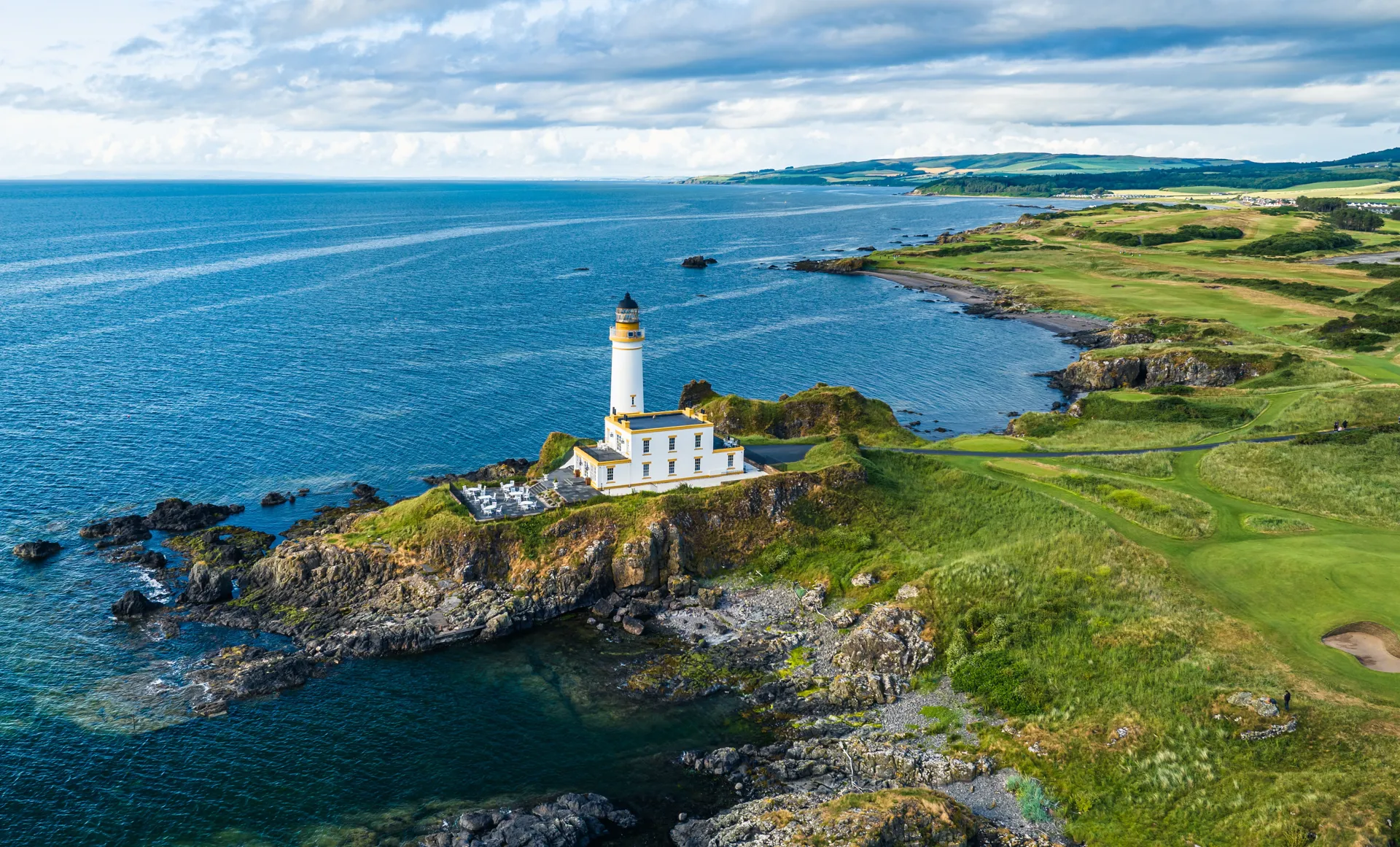
None of that matters standing on the 9th tee with the Firth of Clyde churning below, the volcanic silhouette of Ailsa Craig on the horizon, and the ruins of Robert the Bruce’s castle between the player and the green.
Willie Fernie routed the original links along the Ayrshire coast in 1901. Philip Mackenzie Ross rebuilt it from the wreckage of RAF Turnberry in 1951, shattering concrete runways to reshape dunes from scarred earth. Martin Ebert pushed the course to the cliff edge in a 2016 redesign that added five new holes, four of them along the coast, cementing the Ailsa’s claim to the most spectacular continuous oceanside routing in the British Isles.
The defining moment came in July 1977, when Tom Watson and Jack Nicklaus separated from the field and went at each other for 36 holes in uncharacteristic Scottish sunshine, matching shot for shot until Watson prevailed by one stroke on the 72nd hole. They called it the Duel in the Sun. The 18th still carries the name.
Where the Cliffs Take Over
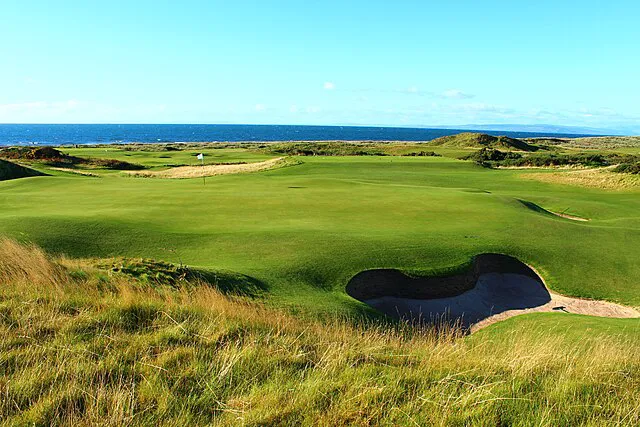
The first three holes offer no warning. They wind through gorse-lined corridors inland, quietly demanding but visually restrained, the kind of opening that could belong to any competent links. Then the 4th tee delivers the reveal. The routing drops to the coastline and stays there for eight consecutive holes, threading along cliff edges, across rocky bays, and past the remains of a medieval castle. Ailsa Craig, the volcanic plug that gave the course its name, appears and disappears through the marine haze like a geological hallucination 10 miles offshore. Every fairway along this stretch sits atop the buried concrete of wartime runways, a fact that adds a quiet improbability to the whole enterprise. Ebert’s redesign deliberately amplifies the drama: tees pushed to cliff edges, fairways lowered to reveal the ocean, greens positioned where the land barely holds.
The 7th, “Roon the Ben” (par 5, 511 yards from the White tees), arrived in its current form in 2025 after Ebert relocated the green 50 yards to the absolute edge of the cliff. The tee shot demands a pronounced draw to split three fairway bunkers. Then comes the approach: a horizon green perched directly above the beach, the ocean filling the entire sightline, daring the player to trust a club selection that every instinct rejects. Ebert lowered the fairway specifically to heighten this confrontation between golfer and geology. The scratch player uses ground contours to run the ball onto the surface. Everyone else meets the revetted bunkers.
The 9th, “Bruce’s Castle” (par 3, 187 yards from the White tees), is the hole that sells plane tickets. Ebert converted it from a hogs-back par-4 into a heroic par-3, demanding a forced carry across the crags and churning water of Castle Port Bay. The castle ruins occupy the immediate foreground. The Turnberry Lighthouse looms beside the green. Crosswinds can move a well-struck iron 30 yards in either direction, making club selection an exercise in faith rather than arithmetic. Gary Player called Turnberry “an absolute paradise of links golf” and ranked it second only to Pine Valley among all courses on the planet. Standing on this tee, the assessment feels conservative.
Between the 9th and 10th, the lighthouse operates as the most famous halfway house in golf, serving Scottish meat pies and single malts with panoramic views of Ailsa Craig. The building also houses a two-bedroom luxury suite. Purists have objected to the opulence. Nobody has been observed refusing the pie.
The 11th, “Maidens” (par 3, 178 yards from the White tees), delivers the climax of the coastal sequence. Created entirely by Ebert in 2016 to replace an inland par-3, it plays across small bays and rock outcroppings with the coastline consuming the entire left flank. Anything short or left is gone. The resemblance to Cypress Point’s iconic short holes is fair, and unlike Cypress Point, a resort booking is the only membership required.
The transition inland after the 11th shifts the register without softening the test. Holes 12 through 18 thread through dramatic dunes where the wind becomes less predictable and the premium shifts to precise iron play from every angle. The 16th features Wilson’s Burn crossing in front of the green, a stream with an unfailing instinct for approach shots that land three yards short of safety. The 18th, forever named “Duel in the Sun,” plays into the prevailing wind with gorse pinching the landing area, a closer that earns its history.
The turf is firm, fast-running Scottish fescue throughout, rewarding the ground game and amplifying the roll. Greens are large and subtly contoured, with internal rumples and false fronts that reject weak approaches down steep banks. The prevailing southwesterly wind typically assists on the outward nine and fights on the return, intensifying through the afternoon. From the Black tees, the course stretches to 7,489 yards with a 139 slope, but the real difficulty is atmospheric: coastal exposure amplifies every flaw in the swing, and the forced carries over native terrain demand the kind of commitment that sheltered inland courses never develop. The Ailsa rewards a piercing ball flight, mastery of the bump-and-run, and the discipline to commit to a number when the wind says otherwise.
Planning the Trip
The Ailsa charges the highest published green fee in the British Isles.
| Item | Cost |
|---|---|
| Green fee (non-resident, peak, before 1pm) | £1,000 |
| Green fee (non-resident, peak, after 1pm) | £545 |
| Green fee (hotel resident, peak) | £425 |
| Green fee (non-resident, off-peak) | £315 |
| Caddie fee | £75 |
| Caddie gratuity (expected) | £20+ |
The pricing tells the story. Turnberry enacted the £1,000 morning rate to protect tee times for hotel guests and members, making the stay-and-play package at Trump Turnberry the most cost-effective path to the Ailsa. Hotel residents pay less than half the visitor rate for morning times. Day visitors booking after 1pm cut the fee nearly in half. Either way, the caddie is worth every pound: blind shots, wind-adjusted club selections, and green contours that punish guesswork make local knowledge the most valuable thing in the bag.
When to Go
| Window | Why |
|---|---|
| Jan–Feb ❄️🌬️ Avoid | Cold marine winds, frost risk, winter mats |
| Mar–Apr 🌤️ Good | Turf drying out, spring winds demand low ball flight; gorse begins to bloom |
| May–Jun ☀️ Prime | Firm fairways, vibrant gorse, long daylight for twilight rounds |
| Jul–Aug ☀️ Prime | Peak summer; ideal temperatures, fastest and firmest turf |
| Sep 🌤️ Prime | Crowds thin, conditions remain excellent, classic Scottish light |
| Oct 🌧️ Good | Rain returns but course stays playable; off-peak rates apply |
| Nov–Dec 🌧️🌬️ Avoid | Damp, extremely windy, severely reduced daylight |
The Ayrshire coast is fully exposed to Atlantic weather. Even in peak season, pack waterproofs; conditions can shift from sunshine to sideways rain within a single round.
Where to Stay
| Property | Rate (approx.) | Notes |
|---|---|---|
| Trump Turnberry Hotel | £400+/night | On-site; priority tee times and lowest green fees |
| Marine Troon | £200+/night | Overlooks Royal Troon; strong base for playing both courses |
| Lochgreen House Hotel | £180+/night | Troon; traditional elegance, award-winning dining |
Getting There
Glasgow Prestwick Airport (PIK) is the closest option, roughly 30 to 40 minutes south along the coast. Glasgow International (GLA) is roughly 75 minutes. Edinburgh (EDI) is about two hours by car. A rental car opens the full Ayrshire Coast on non-Turnberry days; the resort arranges private transfers for those who prefer not to drive.
What Else to Play
The Ayrshire Coast packs more championship pedigree into 50 miles of coastline than anywhere in Scotland outside Fife. Royal Troon (45 minutes north) is the essential pairing, a rigorous Open venue anchored by the Postage Stamp. Prestwick (40 minutes) is where the Open was born in 1860: eccentric, blind, unforgettable. Western Gailes (50 minutes) is the cult favorite, a narrow strip of pure links between the railway and the sea that architecture devotees rank among Scotland’s finest. Shiskine, a 12-hole gem on the Isle of Arran accessible by ferry from Ardrossan, offers one of the most charming rounds in the country for the price of lunch. King Robert the Bruce, Turnberry’s on-site sister course ranked among the world’s top 100, provides a worthy second day without leaving the property.
Why the Cliffs Always Win
The Ailsa has been requisitioned by the military, paved into an airfield, rebuilt from rubble, redesigned for a new century, priced at a level without equal, and removed from the Open rota. Through all of it, the Firth of Clyde has kept crashing against the same rocks, Ailsa Craig has kept vigil on the same horizon, and the lighthouse has kept its watch beside the 9th green. Watson and Nicklaus understood this in 1977: their duel endures not because of the trophy, but because of the theater the land provided. Courses derive stature from championships, from architects, from the names on the deed. The Ailsa derives its stature from geology. That geology is patient. It was here before the first tee was pegged, and it will be here long after the arguments about ownership and access have exhausted themselves. All it asks is whether the golfer has the nerve to hit toward the edge.