The club’s motto is Tam arte quam marte: as much by skill as by strength. What Royal Troon neglects to mention is that it tests both, in sequence, and keeps the harder half for last.
Laid out by George Strath and Willie Fernie in 1888 along the Ayrshire coastline, then fundamentally strengthened by James Braid before Troon’s first Open Championship in 1923, the Old Course follows the oldest routing principle in links golf: straight out along the shore, straight back into the prevailing wind. Ten Open Championships have been contested here since Arthur Havers won the first in 1923, most recently Xander Schauffele in 2024, and the pattern is always the same. Players feast on the front nine. The back nine feasts on them.
The opening six holes run downwind across flat coastal terrain, inviting birdies that feel almost too easy. Then the course turns. The inward nine marches directly into the northwesterly gale, fairways narrowing, the railway line pressing close, every yard earned through low, grinding ball-striking. Between those bookends sit the most famous short hole in championship golf and one of the most feared par fours in the world.
This is the course that produced Henrik Stenson’s final-round 63 in 2016, edging Phil Mickelson’s 65 in one of the greatest head-to-head battles in Open history. It is also the course where Jack Nicklaus carded a 10 on the 11th hole during his 1962 Open debut. Ranked 28th in the world by Golf Digest, Royal Troon does not flatter anyone. It reveals who they are.
A Round in Three Acts
Royal Troon’s out-and-back routing creates a psychological drama unlike any other Open venue. The rhythm of the round splits into three movements, and understanding them is the difference between posting a score and simply surviving.
The opening six holes run southwest with the wind at the player’s back, across relatively flat terrain where the fescue fairways roll generous and wide. The 1st, 2nd, and 3rd offer genuine birdie chances to anyone who can keep the ball on the short grass, building momentum toward the two longest holes on the card. The 4th (par 5, 522 yards from the White tees) is reachable in two downwind, and the stretch builds toward the final act of generosity.
The 6th, “Turnberry” (par 5, 544 yards from the White tees), represents the last downwind hole before the routing turns savage. Extended to 623 yards for the 2024 Open (making it the longest hole in Open Championship history), it plays as the quintessential risk-reward moment with the wind behind. A committed drive leaves a fairway wood approach that can chase onto the green across firm turf. A pot bunker added short-right of the green by Martin Ebert ahead of the 2024 championship devours running approaches that miss by inches. This is the hole to play aggressively. The wind will not be this kind again.
The middle stretch (7th through 9th) descends into the duneland, where the terrain rises sharply and the compass begins its cruel pivot. Blind tee shots appear on the 9th, marking the transition from comfort to confrontation. But before the routing completes its turn, one hole demands a full stop.
The 8th, “Postage Stamp” (par 3, 123 yards from the White tees), is the most celebrated short hole in golf, and it earns the reputation through sheer treachery. The green measures roughly 2,600 square feet, perched on the side of a sandhill with the silhouette of Ailsa Craig floating in the Firth of Clyde behind it. The Coffin Bunker guards the left, its vertical sod-stacked face guaranteeing a sideways escape at best. Wind swirls through the dune hollow and transforms club selection into guesswork with a short iron. Gene Sarazen aced it with a 5-iron in 1973, at age 71. The following day, he holed from a bunker on the same hole for birdie, playing it in three strokes across two rounds. Phil Mickelson called the Postage Stamp a perfect example of how precision challenges the best players without requiring length. Colin Montgomerie, who grew up at the club (his father was club secretary), ranks it alongside Augusta’s 12th and Pebble Beach’s 7th among the great short holes in the world. The green does not care about résumés. It cares about the quality of the strike, and nothing else.
From the 10th tee forward, the round changes character entirely. The wind is now fully in the face, the terrain still rolling through the dunes, and the routing delivers nine holes of relentless attrition.
The 11th, “The Railway” (par 4, 421 yards from the White tees), is statistically one of the hardest holes in major championship golf and Troon’s number-one handicap hole. The tee shot is blind, fired over a sea of dense, vibrant yellow gorse toward a narrow ribbon of fairway. An active railway line and its stone wall run the entire right side as out of bounds, close enough to hear the trains. Nicklaus made his 10 here during the 1962 Open. The instinct is to bail left, which finds gorse so thick it swallows golf balls without trace. The correct play requires commitment: a left-to-right fade that rides the wind toward the railway, trusting geometry over fear. The approach is long and must hold a small green that falls away severely. There is no easy way through this hole. There is only the disciplined way.
The closing stretch from the 12th through the 18th is a grinding march into the wind that separates course management from stubbornness. The 12th (par 4, 427 yards from the White tees) requires two perfectly struck, wind-cheating shots through crosswinds. The 15th (par 4, 436 yards) demands a powerful, low drive through a narrow corridor, its tee moved left in 2016 to restore the historic line of play. The 17th (par 3, 210 yards) is a late-round par three that often requires a fairway wood to reach the green into a headwind, a club most golfers do not associate with the shortest holes. And the 18th funnels toward a green fortressed by the 13 bunkers Braid added in 1923, as if worried the preceding 17 holes might have been too welcoming.
Two design features define what Royal Troon feels like underfoot and in the hands. The firm fescue turf, traditional and fast-running, demands a ground game that becomes a survival skill when the wind rises on the inward half. Approach shots must land well short and trundle onto the putting surfaces; the aerial game that works downwind on the front nine gets eaten alive coming home. And the 98 pot bunkers, most of them revetted with stacked sod and deep enough to hide in, punish any approach that drifts even slightly offline. These are not sand traps from which a competent wedge player recovers easily. They are penalties, sometimes requiring a sideways or backward exit.
The honest drawbacks are worth naming. The linear out-and-back routing lacks the varied compass directions of a links like Muirfield, and when the wind is truly howling, the closing holes can feel more like an endurance test than a strategic puzzle. The 11th runs alongside an active railway, and Glasgow Prestwick Airport sits close enough that low-flying aircraft occasionally puncture the atmosphere. Rounds regularly stretch beyond four hours for visitor groups, thanks to the gorse, the bunkers, and the wind.
Planning the Trip
Royal Troon operates as a private members’ club with restricted visitor access. Unaccompanied visitors may play on Mondays, Tuesdays, and Thursdays only, and tee times during the high season (mid-April through October) should be booked roughly 12 months in advance through the club’s website or by phone.
Costs
| Item | Cost | Notes |
|---|---|---|
| Green Fee (Old Course) | £395 | Visitor rate, mid-April through October |
| Day Ticket (Old + Portland) | £460 | One round on each course |
| Caddie (single bag) | £70 | Per bag before gratuity; request when booking |
| Forecaddie (2–4 golfers) | £100–£140 | Per round before gratuity; varies by group size |
| Buggy/Cart | £20 | Medical certificate required; caddie must drive |
Handicap certificates are enforced: men must hold a 20.0 index or lower, women 30.0 or lower. The dress code is traditional (tailored trousers, collared shirts), and the Smoke Room requires jacket and tie for gentlemen. Cancellations within 90 days forfeit 100% of the green fee.
A caddie is not required but is strongly recommended. The blind tee shots on the 9th, 10th, and 11th, combined with the deep pot bunkers throughout, make local knowledge genuinely valuable rather than merely atmospheric. Standard gratuity runs £20–£40 per bag.
When to Go
| Window | Why |
|---|---|
| Jan–Mar ❄️ Avoid | Cold, heavy rainfall, limited daylight; course at its worst |
| Apr 🌤️ Good | Course firming up but weather unpredictable; fewer visitors |
| May–Aug ☀️ Prime | Driest months, longest daylight, firm fescue, peak conditions |
| Sep 🌤️ Good | Solid late-season play before autumn rains fully arrive |
| Oct 🌧️ Good | Visitor season closes; pack serious rain gear |
| Nov–Dec 🌧️🌬️ Avoid | Brutal winds, dormant turf, minimal daylight |
May is historically the driest month and offers extended daylight for evening rounds.
What Else to Play
The Ayrshire coast concentrates more championship links within a 40-minute drive than nearly any comparable stretch in Scotland. Prestwick Golf Club, the birthplace of the Open Championship, sits 10 minutes south and delivers quirky, dramatic links golf built on instinct rather than modern design theory. Western Gailes, 15 minutes north, offers a brilliantly routed narrow strip of classic links between the railway and the sea at roughly £335 per round. Trump Turnberry’s Ailsa Course commands arguably the most spectacular coastal views in Scottish golf, 40 minutes south, though the green fee (roughly £1,000) reflects its resort positioning. For something entirely different, the 12-hole Shiskine Golf Club on the Isle of Arran, a short ferry ride from the Ayrshire coast, serves as the perfect antidote to championship-caliber intensity.
Back at the club, the Portland Course (redesigned by Alister MacKenzie in 1921) plays shorter and more sheltered, available as a day ticket with the Old Course for £460. The 9-hole Craigend Course, designed by Martin Ebert, features a miniature replica of the Postage Stamp for warm-ups or second chances.
Where to Stay
| Property | Rate (approx.) | Distance | Notes |
|---|---|---|---|
| Marine Troon | $350+/night | 0.2 miles | 5-star, overlooking the course; spa and pool |
| Lochgreen House Hotel | $300+/night | 1.5 miles | Elegant dining with locally sourced Scottish cuisine |
| Piersland House | $200+/night | 0.5 miles | Historic estate across from the club; excellent restaurant |
| South Beach Hotel | $150+/night | 0.5 miles | Welcoming 3-star, walkable to the clubhouse |
Getting There
Glasgow Prestwick Airport (PIK) sits 10 minutes from the club and serves primarily budget European carriers via Ryanair. Glasgow International Airport (GLA), 45 minutes by car, handles most transatlantic routes and is the practical entry point for North American travelers. Edinburgh Airport (EDI) is 90 minutes across the country but offers the widest international connections. A rental car is the most efficient option for playing multiple Ayrshire courses. Alternatively, Troon’s railway station provides direct service to Glasgow Central and sits minutes from the club.
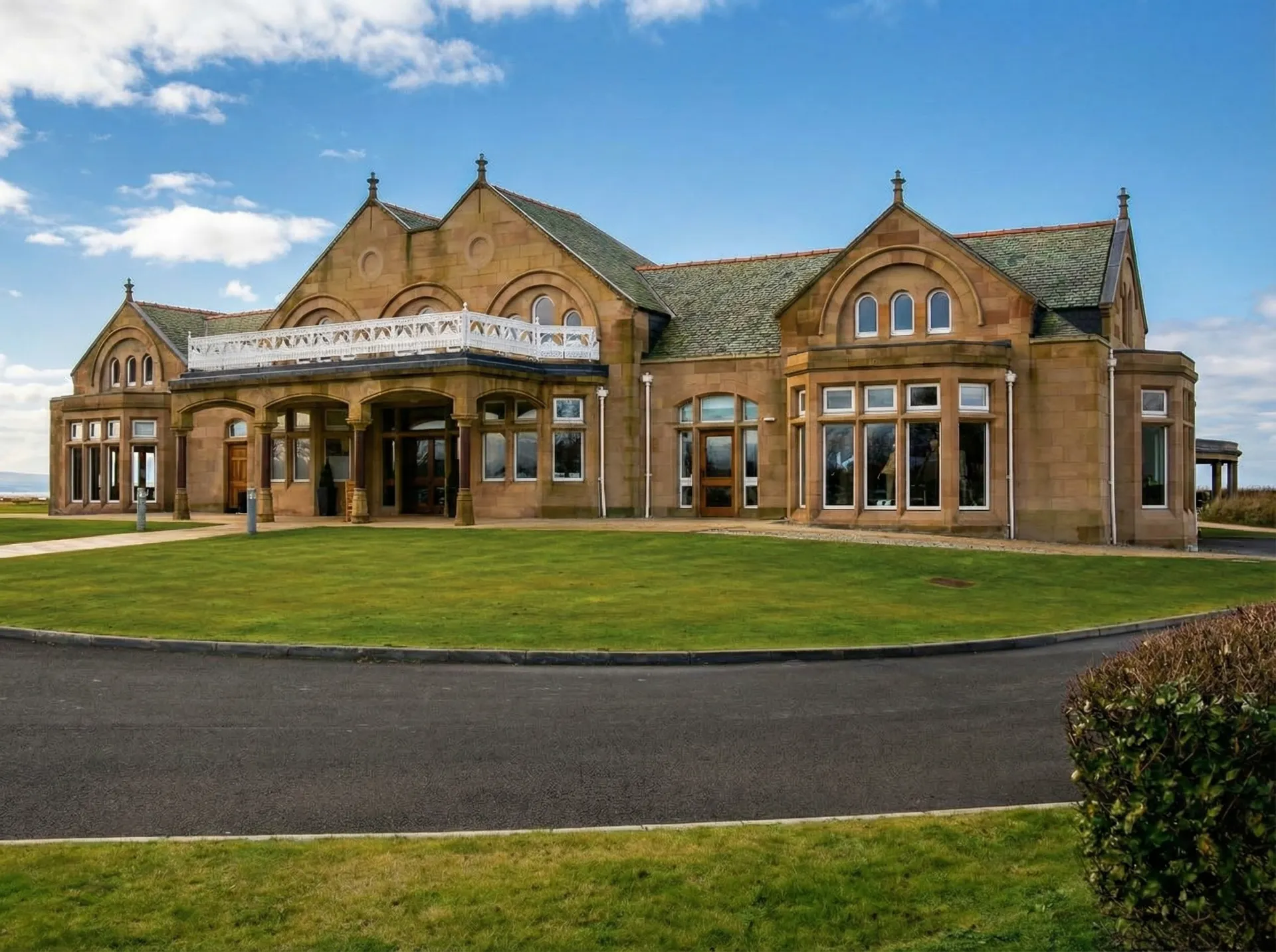
Arrive early enough to visit the clubhouse lobby, which displays replicas of what are believed to be the oldest known set of golf clubs in the world, donated to the club in 1915. The Rabbit and The Seal bars offer excellent post-round views over the course, while the Ailsa Room handles more formal lunch. Off-site, Piersland House Restaurant across the road serves elegant British dining, and Lochgreen House features locally sourced Scottish seafood and beef.
Why the Walk Back Is Worth the Trip
Royal Troon’s motto promises skill and strength in equal measure. The course delivers something sharper: honesty.
The front nine is generous enough to let any competent golfer believe they belong. Six holes downwind, firm turf, reachable par fives, the quiet accumulation of confidence. Then the routing turns, and the walk back begins. Into the wind. Into the bunkers. Into the railway and the gorse and the 98 reasons Braid ensured no score at Troon is ever safe.
Every Open Championship here follows this arc. Leaders emerge on the outward half. The leaderboard reshuffles after the turn. What survives is not the player with the longest drive but the one with the deepest reserves. Stenson’s 63 in 2016 was not a fluke of low scoring. It was a masterclass of ball-striking into the wind that no one else in the field could sustain.
Three-time major champion Padraig Harrington once called Troon “one of the fairest courses on the Open roster.” He was right, in the most Scottish sense of the word. The course does not ambush anyone. It shows its hand on the 1st tee, lays out the terms with six generous holes, and then waits for the walk back to settle the matter. Most courses test what players can do. Royal Troon reveals what they cannot hide.