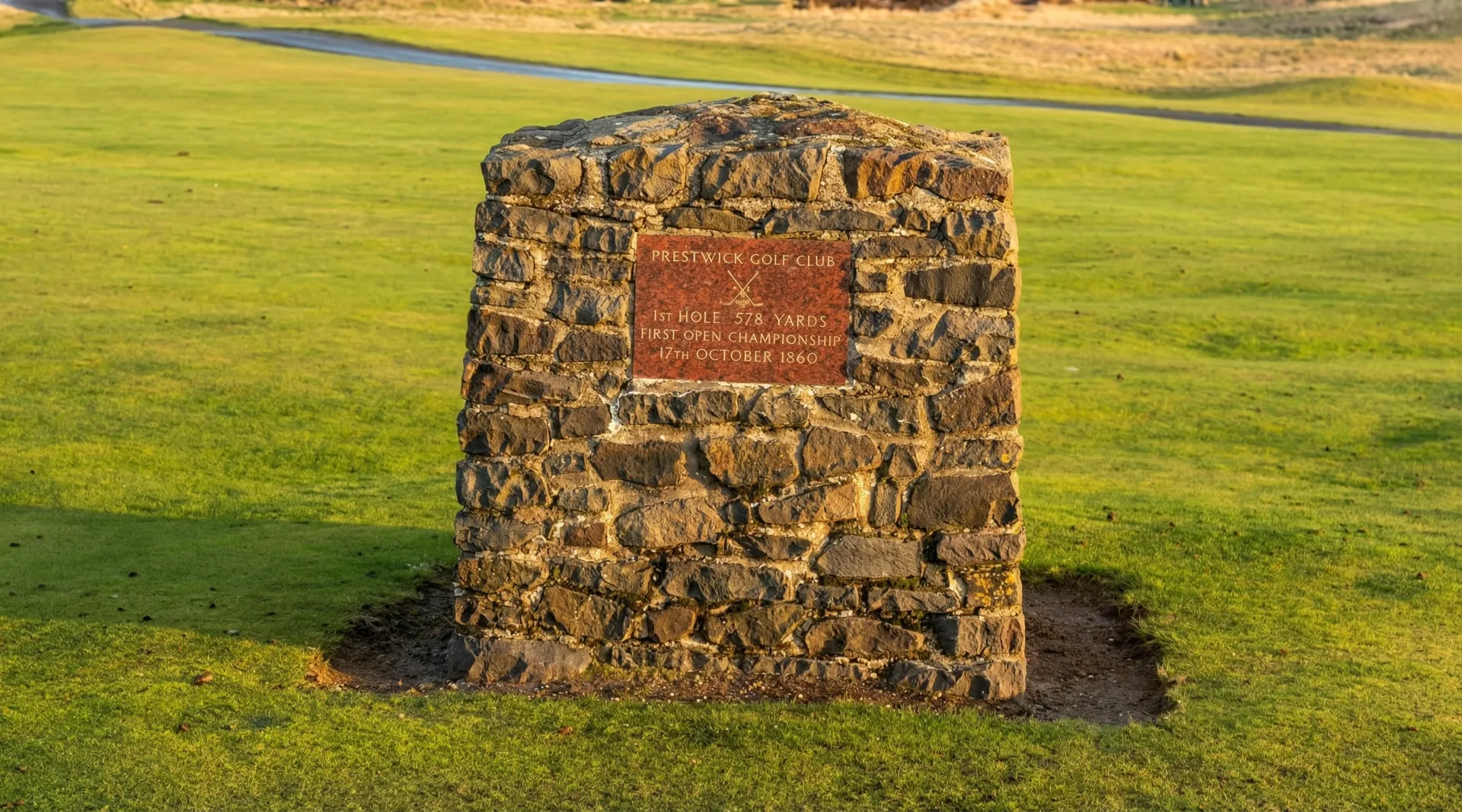
On October 17, 1860, eight professionals gathered at a compact links course in coastal Ayrshire and played three rounds of twelve holes in a single day. Willie Park Sr. won. Old Tom Morris, the man who had designed the course nine years earlier, lost by two strokes. Nobody present could have understood what they had just set in motion. That day was the first Open Championship.
Prestwick Golf Club hosted twenty-four Opens between 1860 and 1925, an extraordinary concentration matched in frequency only by St Andrews. It stopped hosting not because the course lost its challenge, but because its tight footprint could no longer accommodate the spectator crowds that championship golf now demanded. The R&A moved on to larger stages. Prestwick stayed exactly where it was.
What survives is something rarer than a former championship venue: a working architectural time capsule of mid-nineteenth-century links design. Blind tee shots fired over towering dunes. Cavernous bunkers reinforced with wooden railway sleepers. Greens hidden behind hills that require ringing a bell to alert the following group. Frank Pennink, the golf writer and architect, described the terrain as “a golf course architect’s idea of heaven.” Modern course design has spent the better part of two centuries trying to eliminate exactly these features. Prestwick has spent the same period refusing to cooperate.
Ranked 66th among courses outside the United States by Golf Digest, Prestwick doesn’t compete on conditioning or visual spectacle. It competes on conviction. And conviction, at Prestwick, has never been in short supply.
Where the Game Plays by Different Rules
Playing Prestwick requires a recalibration. Target golf, aerial approaches to visible pins, the modern assumption that a golfer should be able to see where the ball is going: none of it applies here. At Prestwick, the shot disappears over a hill, behind a dune, or into a punchbowl green that reveals itself only after the ball has arrived.
The tone is set immediately. The 1st hole, “Railway,” measures just 345 yards, but the fairway narrows violently the further the ball travels, pinching toward an active railway line and a low stone wall marking out of bounds along its entire right side. The clubhouse looms uncomfortably close to the backswing. It is a hole that announces Prestwick’s philosophy before the round has properly begun: precision over power, always.
From there, the routing transitions sharply. The front nine presses tight against the town, the railway, and the Pow Burn. The middle stretch, known as the Elysian Fields, opens into gentler rolling terrain and the course’s most conventional holes, where fairways widen and targets become visible. It feels like a reprieve. It is a reprieve. Then the back nine plunges into some of the most rumpled, hummock-filled landscape on the Ayrshire coast, where imagination replaces technique as the dominant skill and every fairway seems to funnel toward a different hidden hazard.
Firm bentgrass fairways and fast fescue greens define the playing surface, and both reward the same thing: restraint. The bump-and-run is the essential shot. Aerial approaches bounce through greens so firm and contoured that a well-struck iron can finish thirty yards past the flag. The greens themselves slope aggressively, many running back to front, rejecting any ball that arrives without the right trajectory and pace. The prevailing wind from the Firth of Clyde pushes right to left across the front nine, funneling shots toward exactly the hazards the player is trying to avoid. Length matters less here than creativity, and creativity matters less than trusting a caddie who points at a distant church steeple and says “aim there.”
The 3rd, “Cardinal” (par 5, 477 yards from the Medal tees), is the hole that reshaped modern American golf architecture. The fairway doglegs sharply right around the Pow Burn, with a massive bunker (the Cardinal) bisecting the landing zone, its face braced with towering wooden railway sleepers that give it the appearance of a fortress wall. Pete Dye visited Prestwick in 1963, saw those timber-faced hazards, and imported the concept to Harbour Town and TPC Sawgrass. “Those railroad ties we know so well,” Dye later said, “were inspired by a trip to Prestwick.” Every railroad-tie bunker in American golf traces its lineage to this spot. The strategic play is a tee shot to 230 yards, short of the bunker, followed by a blind mid-iron over it. The heroic play demands a 300-yard carry over the top. The Pow Burn collects most heroes.
The 5th, “Himalayas” (par 3, 206 yards from the Medal tees), is the most gloriously absurd hole in links golf. The golfer stands on the tee and sees nothing but a towering wall of sand and fescue. The green sits in a hidden punchbowl on the other side, guarded by five bunkers and entirely invisible. Colored aiming discs mounted on a fence provide the only directional guidance. Pick a club, aim at the disc, and commit to the swing without visual confirmation of the target. After holing out (or making peace with the result), ring the bell behind the green to alert the group following. By any modern architectural standard, this hole is preposterous. By any experiential standard, it is unforgettable.
The 17th, “Alps” (par 4, 394 yards from the Medal tees), may be the most nerve-wracking approach shot in Scottish golf. A precise drive down a narrow fairway sets up a completely blind second shot over a literal hilltop, guided only by a small stone marker at its crest, to a green defended immediately in front by the sprawling Sahara bunker. Bernard Darwin called it “the most spectacular blind hole in all the world.” The prudent move is one extra club to guarantee clearing both the hill and the sand. Most visitors, lacking either prudence or local knowledge, find the Sahara instead.
The honest caveats deserve mention. Blind shots and thick fescue rough cause regular ball-searching delays, and some rounds stretch past four and a half hours on a course measuring barely 6,500 yards from the visitor tees (6,551 from the Medal tees, 6,908 from the championship blacks). The footprint is so tight in places that adjacent fairways create genuine safety concerns. Modern architectural purists will find several holes excessively arbitrary, conceding that none of them would be permitted in a contemporary routing. These are legitimate criticisms. They are also beside the point. Prestwick was built before the modern critique existed, and it has shown no interest in conforming to it.
Planning the Trip
Prestwick runs a dedicated visitor program called the Prestwick Experience, which bundles 18 holes with a formal three-course lunch served at the club’s historic long table in the Members’ Dining Room. The walls display Open Championship memorabilia dating to 1860. It is the primary and most reliable way for visitors to access the course.
| Item | Cost | Notes |
|---|---|---|
| The Prestwick Experience | £390 | 18 holes and formal 3-course lunch (Wednesdays) |
| Bag caddie | £65 | Per bag, before gratuity (cash) |
| Forecaddie | £100 | Per group, before gratuity |
| Club hire | £65 | Titleist clubs and 3 balls |
| Pull trolley | £10 | From the Pro Shop |
The Prestwick Experience is available on Wednesdays only, with tee times at 08:00–08:30 or 14:30–15:00. Book well in advance for summer dates. Between November and March, visitor play and full catering are severely restricted.
A caddie is not technically required, but at a course defined by blind shots, hidden pot bunkers, and approaches aimed at objects on the far horizon, playing without one is a recipe for lost balls and slow play. Book through the club at least a week in advance, and budget £65 per bag before gratuity, paid in cash.
The club takes its dining traditions seriously. Gentlemen must wear a jacket, collared shirt, and tie to eat in the Members’ Dining Room; ladies must change out of golf attire. The clubhouse is undergoing renovation work that may temporarily relax these requirements, so confirm the current dress code when booking.
When to Go
| Window | Why |
|---|---|
| Jan–Mar ❄️ Avoid | Cold, wet, minimal daylight; visitor play heavily restricted |
| Apr 🌤️ Good | Spring daylight returns but weather remains unpredictable |
| May–Aug ☀️ Prime | Driest months, firm turf, maximum daylight for the full links experience |
| Sep–Oct 🌤️ Good | Cooler temperatures, excellent turf, classic autumn links golf |
| Nov–Dec 🌧️ Avoid | Wet and dark; winter visitor restrictions resume |
Where to Stay
| Property | Rate (approx.) | Notes |
|---|---|---|
| Number 17 (Dormy House) | £125–£210/night | On-site; 8 rooms overlooking the 1st tee, breakfast included |
| Carlton Hotel | £155/night | Central Prestwick; 5-minute taxi to the course |
| Lochgreen House Hotel | £200+/night | 4.5-star property in Troon; ideal for multi-course Ayrshire trips |
| Adamton Country House | £58–£80/night | Budget-friendly country hotel near the airport |
Number 17, the club’s own dormy house, deserves the first call. Eight rooms overlooking the opening tee, breakfast included, and a commute measured in footsteps.
Getting There
Glasgow Prestwick Airport (PIK) sits less than two miles from the course, making arrivals from European hubs absurdly convenient. For long-haul flights, Glasgow International (GLA) is approximately 45 minutes via the M77. Prestwick Town has its own rail station with direct service to Glasgow Central, so a rental car is useful but not essential for visitors staying local.
What Else to Play
Prestwick sits at the center of Scotland’s densest concentration of championship links. Royal Troon’s Old Course borders Prestwick to the north, a ten-minute drive. Western Gailes, a superb links test routed through the Irvine Bay dunes, is fifteen minutes further up the coast. For something utterly different, the twelve-hole course at Shiskine on the Isle of Arran, reached by ferry from Ardrossan, delivers one of the most purely joyful rounds in Scottish golf.
Off the Course
The Red Lion pub in central Prestwick is more than a post-round stop. This is where the club’s fifty-seven founding members gathered in 1851, and where the idea for the first Open Championship took shape. It still serves proper pub fare and pre-flight pints. For modern dining, The Vine offers Asian-inspired dishes and cocktails, while Taj Bar & Kitchen provides excellent Indian cuisine on Main Street.
Before leaving the grounds, find the stone cairn west of the clubhouse. It marks the exact location of the original 1st tee from the 1851 twelve-hole layout, and the spot where the first shot in Open Championship history was struck.
Why the Birthplace Still Matters
Every sport has an origin story. Golf’s isn’t mythology.
In 1851, fifty-seven members led by the Earl of Eglinton hired Old Tom Morris away from St Andrews and laid out twelve holes along the Firth of Clyde. Nine years later, they organized a competition to crown the best professional golfer in Scotland, offering a red Morocco leather Challenge Belt as the prize. Young Tom Morris, Old Tom’s son, won the Open in 1868, 1869, and 1870 with such dominance that he earned the right to keep the Belt permanently. With no trophy to play for, the Open was cancelled in 1871. The following year, Prestwick, St Andrews, and the Honourable Company of Edinburgh Golfers pooled thirty pounds to commission a replacement. That replacement was the Claret Jug.
Prestwick didn’t just host the first Open Championship. It created the conditions that produced the most iconic trophy in golf.
The course has been outgrown by spectator demands, bypassed by the modern championship circuit, and questioned by architects who find its blind shots indefensible by contemporary standards. None of that registers when standing on the 5th tee, staring at a wall of dune grass, aiming at a colored disc, and swinging into the void. That is golf stripped to its original proposition: hit the ball, walk after it, figure it out.
Prestwick is not the best course in Scotland. It might be the most important one.