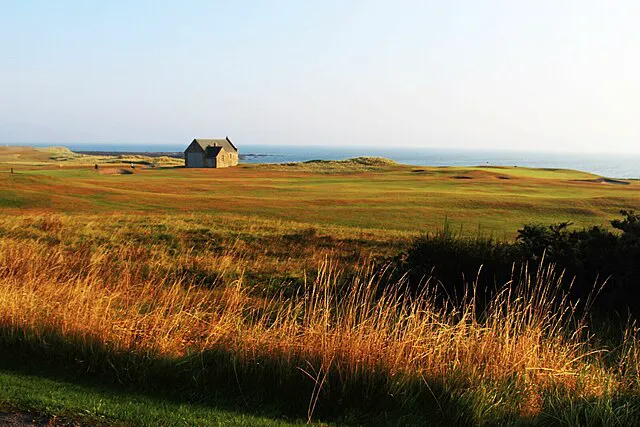
Jean Van de Velde stood on the 72nd tee of the 1999 Open Championship with a three-shot lead. He needed only a double-bogey six to win. Ten minutes later, he was in a playoff he’d eventually lose to Paul Lawrie. What happened in those ten minutes—a drive into rough, a recovery that found the Barry Burn, a third shot that splashed into water again, shoes and socks off wading to assess options—became the defining image of Carnoustie’s brutality.
Van de Velde didn’t lose that Open because he choked. He lost because Carnoustie punishes poor decisions with severity that other championship courses can’t match. The finishing holes—particularly 17 and 18—create pressure that exposes weakness ruthlessly. You can play solid golf for 71 holes and still watch everything collapse over the final seven.
They call it Car-Nasty. Not affectionately. The nickname acknowledges what everyone who’s played Carnoustie understands: this is Scotland’s most brutal championship examination. Not the most scenic—that’s Turnberry or Royal Dornoch. Not the most strategic—Muirfield claims that title. The most brutal. Carnoustie tests length, accuracy, mental toughness, and nerve under conditions that eliminate anyone lacking complete command of all four.
The course has hosted eight Open Championships since 1931. Winning scores: +5, +4, +9, +6, +6, +6, +6, -6. That last number—Padraig Harrington’s -6 in 2007—is the outlier, achieved in perfect weather on a soft course. The other seven championships saw conditions Carnoustie normally provides: wind, firm turf, Barry Burn waiting to swallow shots, and finishing holes that demand perfection when exhaustion and pressure peak.
Ben Hogan won here in 1953, his only Open Championship appearance, shooting 282 (+2) and calling it one of the toughest tests he’d faced. Tom Watson won in 1975 at +9 (279), battling Jack Newton in an 18-hole playoff. Gary Player won in 1968. Padraig Harrington won twice—2007 and again at the 2018 Open at Carnoustie would be won by Francesco Molinari. Each championship confirmed Carnoustie’s reputation: only complete players with exceptional mental strength survive.
The Design That Demands Everything
Allan Robertson and Old Tom Morris laid out Carnoustie in the 1850s. James Braid made significant revisions in the 1920s, lengthening it and adding strategic complexity. The course now measures 7,402 yards for Open Championship play—one of the longest in championship golf. But length alone doesn’t explain Carnoustie’s difficulty.
The routing follows classic links out-and-back design, playing away from the clubhouse for nine holes before returning. This creates prevailing wind patterns that golfers must navigate constantly—downwind early, into wind late, crosswind throughout. The wind changes strategy hole by hole, sometimes minute by minute.
The Barry Burn—a small stream that winds through the property—creates most of Carnoustie’s dramatic moments. It crosses the 18th fairway twice, sitting exactly where drives land and where approaches to the green must carry. It fronts the 17th green, punishing approaches that come up short. Van de Velde found it twice on the 72nd hole. Countless other players have watched Open Championship dreams disappear into its shallow water.
The opening stretch eases players in gently. The 1st through 6th holes are difficult but fair—links golf that rewards good shots and punishes poor ones without resorting to brutality. The 6th hole, “Hogan’s Alley,” was named after Ben Hogan’s strategic play during his 1953 victory. At 578 yards, it’s a genuine three-shot par-5 that demands precision on every shot.
Then Carnoustie turns mean. The 7th through 11th stretch—“The Corner”—plays into prevailing wind and tests length, accuracy, and patience. The 14th—“Spectacles”—features twin bunkers fronting the green that gave the hole its name and have gathered countless approach shots. The 15th and 16th demand precision with mid-irons to greens that reject anything poorly struck.
But everyone knows Carnoustie’s reputation is built on the finishing holes. The 17th and 18th create pressure unlike any other closing stretch in championship golf.
The Closing Holes That End Dreams
The 17th plays 499 yards into prevailing wind with the Barry Burn fronting a narrow green. The hole demands a perfect drive to have any chance of reaching in regulation. The approach must carry the burn with precision—come up short and you’re wet, hit long and you’re off the back in thick rough. The green is small, angled, and rejects anything not perfectly struck.
This is where Open Championships are won or lost. A birdie here creates momentum. A bogey creates doubt. And a double-bogey—which happens regularly even to tour professionals—can end championship dreams in seconds. The 17th doesn’t offer bail-out areas or conservative options. You either execute or you pay.
The 18th might be the most demanding finishing hole in golf. At 499 yards, it’s the longest closing par-4 in Open Championship golf (though it plays as a par-4 only during Opens—otherwise it’s a par-5). The Barry Burn crosses the fairway twice—once at drive distance, once fronting the green. Every shot matters. Every decision carries consequences.
The drive must carry the burn—roughly 250 yards—and find a narrow fairway. Miss left and you’re blocked by the burn from reaching the green. Miss right and deep rough makes approach impossible. The second shot must carry the burn again—100+ yards of carry to a green that slopes severely and is protected by bunkers and thick rough.
Van de Velde’s collapse happened here. But he’s not alone. Countless players have stood on the 18th tee with leads and watched them evaporate. The hole doesn’t care about your position or your history. It demands execution when pressure peaks and legs are tired and minds are exhausted. Most golfers—including world-class professionals—can’t deliver.
The 17th and 18th combination creates what golf course architects call “ampitheatre finish”—holes that gather spectators and create drama. At Carnoustie, the drama often involves catastrophe. Players who’ve hit good shots for 70 holes suddenly can’t find fairways or greens. The pressure compounds. The Barry Burn waits. And championship dreams die within sight of the clubhouse.
What Makes Carnoustie Different
Scotland has multiple championship links courses. St Andrews is the home of golf. Muirfield is the fairest test. Royal Troon and Royal Birkdale host excellent Opens. But Carnoustie stands apart for its sheer brutality. The course doesn’t offer relief. It doesn’t provide breather holes. It tests every element of golf from first tee to final putt and punishes any weakness severely.
Length matters here. At 7,402 yards, Carnoustie is longer than almost any other championship links. Players need distance off the tee to have reasonable approaches. But length without accuracy is worse than useless—missing fairways here means trouble that can’t be escaped easily.
Wind affects every shot. Carnoustie sits exposed on Scotland’s east coast, subject to winds off the North Sea. The routing means golfers play into, across, and with wind constantly. Club selection changes. Strategy adapts. What worked on hole 3 won’t work on hole 13 because wind direction has shifted.
The Barry Burn creates fear. Most championship hazards are bunkers or rough—painful but recoverable. The Barry Burn ends holes. Find it and you’re probably making double-bogey or worse. This psychological pressure affects decision-making throughout the round, particularly on finishing holes where the burn is most prominent.
Firm conditions demand ground game. Carnoustie plays firm and fast, particularly during Open Championships. Approach shots must account for bounce and roll. High, spinning shots that work on soft American courses don’t work here. Players need bump-and-run shots, low punches, and creativity around greens.
The closing stretch breaks players mentally. Other courses have difficult finishing holes. Carnoustie’s 17th and 18th create pressure that’s mentally exhausting. Players arrive at these holes tired, knowing one mistake can erase four days of solid golf. The mental toughness required to execute under those conditions separates champions from everyone else.
Tom Watson, who won here in 1975, said Carnoustie was the toughest Open Championship course he’d played. Ben Hogan, who won in his only Open appearance, called it a monster. Tiger Woods, who finished T24 in 1999 and missed the cut in 2007, struggled to solve it. These aren’t players who shy from difficulty. Carnoustie simply demands more than most courses ask.
The Opens That Built The Legend
Eight Open Championships at Carnoustie have produced memorable golf and occasional heartbreak.
The 1953 Open saw Ben Hogan make his only Open Championship appearance, winning at +2 (282) in weather that turned nasty on Sunday. Hogan’s precision ball-striking and strategic intelligence carried him through conditions that destroyed other players. His victory at Carnoustie, following his Masters and U.S. Open wins earlier that year, completed golf’s first triple crown in the modern era.
The 1968 Open featured Gary Player winning at +9 (289), two shots ahead of Jack Nicklaus and Bob Charles. The scoring revealed Carnoustie’s difficulty—the world’s best players struggled to break 290. Player’s victory demonstrated the complete game Carnoustie demands.
The 1975 Open produced an 18-hole playoff between Tom Watson and Jack Newton, with Watson prevailing by one stroke. The championship showcased two complete players battling Carnoustie’s difficulty and each other. Watson’s victory launched his Hall of Fame career and confirmed Carnoustie’s status as ultimate championship test.
The 1999 Open gave the world Jean Van de Velde’s collapse, Paul Lawrie’s unlikely victory, and lasting images of Carnoustie’s brutal nature. Van de Velde’s three-shot lead evaporating on the 72nd hole remains cautionary tale about what Carnoustie does to players under pressure. Lawrie, ten shots back entering Sunday, won by shooting 67 while others crumbled.
The 2007 Open saw Padraig Harrington win at -6 (277), the only winning score under par in Carnoustie history. But even that victory required survival—Harrington found the Barry Burn on 18 in regulation, made bogey, then won in a playoff. Carnoustie demands respect even in perfect conditions.
Each Open at Carnoustie has confirmed the course’s fundamental nature: it’s brutally difficult, mentally exhausting, and capable of destroying anyone regardless of their skill or preparation. Champions must possess complete games, exceptional mental toughness, and ability to execute under pressure that would break most golfers.
If You’re Determined
Unlike Pine Valley or Augusta National, Carnoustie welcomes daily-fee play. The course is publicly accessible, though expensive—green fees approach £300 during peak season. Tee times fill months in advance for summer play. But if you want to test yourself on Open Championship terrain, Carnoustie will take your money and your dignity.
Prepare appropriately. This isn’t a bucket-list round where you photograph holes and enjoy the scenery. This is four to five hours of golf that will expose every weakness in your game.
Play from appropriate tees. Championship tees measure 7,402 yards and are absurd for anyone not playing professional golf. Member tees at 6,700-6,900 yards are still brutally difficult. Don’t let ego dictate tee selection.
Accept that wind will dominate. Scotland’s east coast produces consistent wind. Some days it’s manageable. Some days it’s overwhelming. Strategy must adapt constantly. What worked on the front nine won’t work coming home.
Respect the Barry Burn. The water looks innocuous—it’s shallow, narrow, barely qualifies as hazard by American standards. But it’s positioned exactly where shots land. Play away from it. Accept layups. Don’t let it ruin your round trying to be heroic.
Understand the closing stretch. The 17th and 18th will test you. They’re designed to create pressure even during casual rounds. Don’t try to match Open Championship strategies. Play smart, aim for greens, accept bogeys.
Appreciate what you’re playing. Carnoustie has hosted eight Opens. Hogan, Player, Watson, and Harrington won championships here. The Barry Burn has ended countless dreams. The finishing holes have separated champions from pretenders. This is golf history, and you’re walking through it.
Most golfers leave Carnoustie humbled. Scores are higher than expected. Pars feel like victories. The Barry Burn claims multiple balls. The finishing holes create pressure that’s hard to explain to people who haven’t experienced it. This is normal. This is Carnoustie being what it’s been for 170 years: brutally difficult, unforgiving, and honest about what golf demands.
What Car-Nasty Knows
Golf should test complete games. Length, accuracy, mental toughness, strategic thinking, execution under pressure—champions need all of these, and Carnoustie tests all of these simultaneously. The course doesn’t apologize for difficulty. It doesn’t soften for modern equipment or accommodate players who lack complete games. It remains what it’s been since Allan Robertson and Old Tom Morris laid it out: Scotland’s most demanding championship examination.
The nickname Car-Nasty isn’t insult—it’s acknowledgment. Players who survive Carnoustie have earned respect. Open Champions crowned here have proven themselves against test that eliminates anyone with weaknesses. The Barry Burn keeps swallowing balls. The finishing holes keep breaking dreams. And par keeps being achievement rather than expectation.
Jean Van de Velde’s collapse wasn’t failure of nerve—it was Carnoustie being Carnoustie. The course punishes poor decisions and imperfect execution with severity that softer tests can’t match. Standing on the 72nd tee with three-shot lead means nothing if you can’t execute two more shots perfectly. Van de Velde couldn’t. The Barry Burn doesn’t forget. And Carnoustie’s reputation as championship golf’s most brutal examination was confirmed one more time.
That’s Car-Nasty. Not the most beautiful Scottish course. Not the most historic. But the most demanding, most brutal, most comprehensive test championship links golf provides. Eight Opens have proven it. Countless players have learned it. And anyone who plays Carnoustie discovers it: this course doesn’t care who you are or what you’ve accomplished. It asks if you can execute under pressure when everything matters. Most golfers answer no. The few who answer yes become Open Champions. The difference between those two outcomes is usually measured in inches—and decided by water that’s barely deep enough to cover your golf ball.