Tom Watson has played every significant golf course in the world. He’s won Opens at Carnoustie, Turnberry, Royal Troon, Royal Birkdale, and Muirfield. He’s competed at Augusta National, Pine Valley, Cypress Point. He’s traveled to Australia, Japan, South Africa. He knows golf at its most refined, most demanding, most celebrated.
He keeps returning to Ballybunion.
Not once as tribute or nostalgia tour. Annually. Sometimes multiple times per year. He brings friends, family, anyone willing to make the journey to the southwest corner of Ireland where the Atlantic meets the Shannon Estuary and creates links golf that doesn’t apologize for being raw, wild, and occasionally terrifying.
Watson calls Ballybunion Old Course the best links he’s ever played. Not the hardest—that might be Carnoustie. Not the most strategic—Muirfield claims that title. The best. When pressed to explain, Watson talks about naturalness, about holes that feel discovered rather than designed, about golf that connects directly to the land and ocean in ways that more famous courses have lost.
This isn’t marketing copy. Watson doesn’t get paid for these endorsements. He just keeps returning to a place that golf’s broader world barely notices—Ballybunion has never hosted an Open Championship, rarely appears on television, operates without the fanfare that follows St Andrews or Royal County Down. The course simply exists on the Kerry coast, asking questions that apparently Watson never stops wanting to answer.
What The Atlantic Reveals
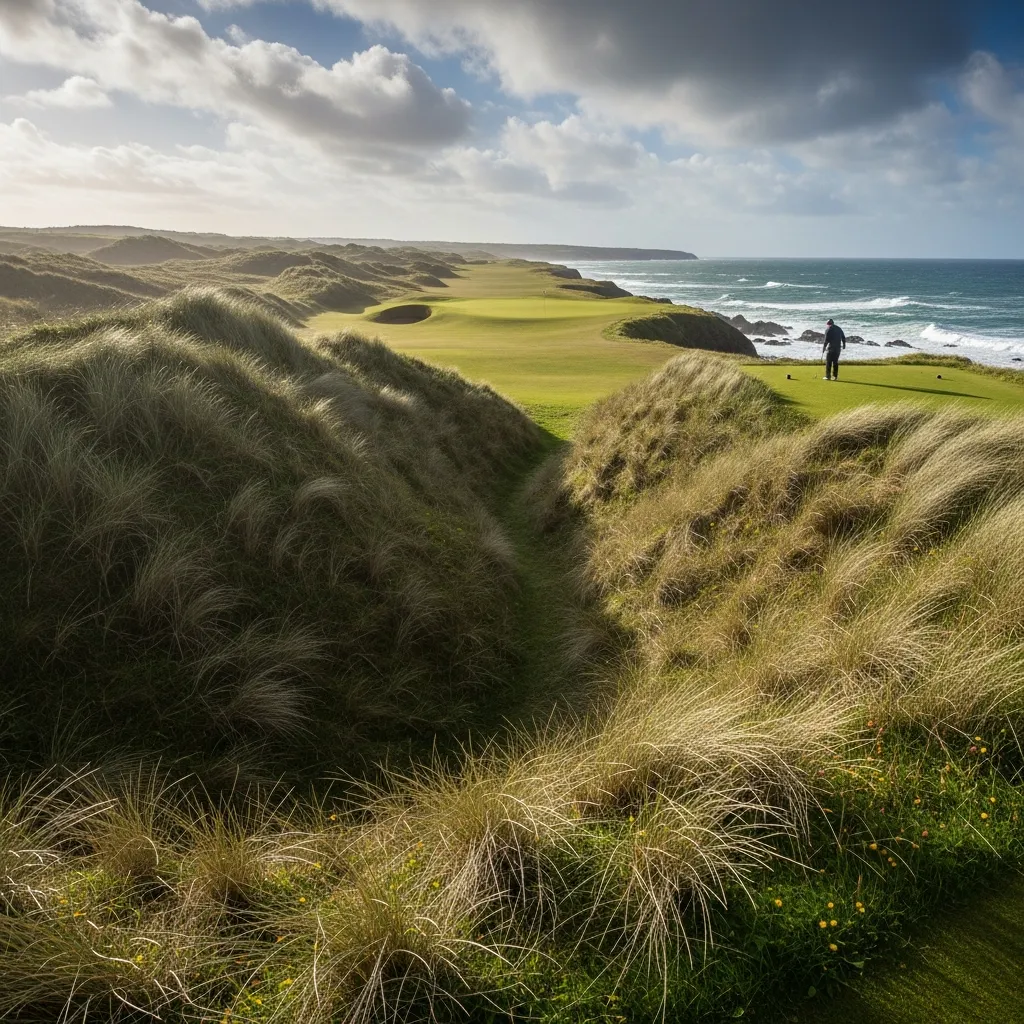
Ballybunion sits on massive sand dunes that rise directly from the beach. The course runs along clifftops for several holes, with the ocean immediately adjacent and visible from nearly every tee. This is links golf stripped to essentials—no trees, no manufactured drama, just wind, dunes, and the constant presence of the Atlantic dictating every strategic decision.
The opening stretch eases players in gently. The first three holes play through dunes without ocean views, establishing the course’s rhythm and demands. Then the 4th arrives—a par-4 that turns sharply along the cliff edge, with the ocean on the right and massive dunes on the left. Miss right and the ball might disappear into the Atlantic. Miss left and you’re facing a blind recovery over dunes to a green you can’t see.
This is Ballybunion declaring its character. The course doesn’t ease you toward difficulty—it presents it and asks what you plan to do about it.
The 7th hole plays from an elevated tee to a fairway below, with the entire hole framed by ocean and sky. It’s 423 yards of links perfection—strategic from the tee, demanding on approach, and breathtaking regardless of how you score. The 8th continues along the cliffs, playing back toward the clubhouse with the ocean threatening every shot.
Then comes the 11th—Ballybunion’s signature hole and one of the world’s great par-4s. The tee shot plays from the highest point on the course, with the ocean extending to the horizon on the right. The fairway sits below, angled along the cliff edge. The approach plays slightly uphill to a green perched on a plateau. Miss right on either shot and you’re looking for a new ball. Miss left and recovery is difficult but possible. The hole creates the kind of pressure that reveals whether golfers trust their swings or just hope for the best.
The stretch from the 11th through the 15th might be the finest five-hole sequence in Irish golf. Each hole demands precision, strategy, and nerve. Each offers ocean views that would be distracting if the golf wasn’t so demanding. The 15th—a downhill par-3 to a green surrounded by dunes and scrub—requires perfect distance control and proper trajectory. Watson has called it one of the best par-3s he’s ever played.
The Design That Nature Built
Nobody knows who designed Ballybunion. Local members laid out the course in 1893, following the natural contours of the dunes. Various designers made refinements over the years, including Tom Simpson in the 1930s. But Ballybunion doesn’t feel designed in any modern sense. It feels discovered—like someone walked through massive dunes, found eighteen great golf holes waiting, and simply cleared fairways to connect them.
This naturalness matters. Modern championship courses get shaped, sculpted, engineered to specific standards. Bunkers are placed strategically. Contours are built deliberately. Everything serves a design philosophy that can be explained and defended.
Ballybunion exists because the land allowed it. The routing follows the coast, working with dunes rather than imposing order on them. Holes play uphill, downhill, along ridges, through valleys. Some greens sit in natural bowls. Others perch on plateaus. The course embraces irregularity and quirk rather than fighting for consistency.
The result is links golf that feels like it’s been there forever. The 16th hole—a par-4 called “O’B”—plays along a narrow fairway with out-of-bounds left and heavy rough right. The green sits in a natural amphitheater surrounded by dunes. It’s simultaneously simple and terrifying. The 17th plays back up the hill, demanding length and accuracy. The 18th finishes near the ocean, bringing the round full circle.
Modern architects study Ballybunion to understand how minimalist intervention creates maximum interest. They photograph the natural contours, the random bunker placements, the greens that fit seamlessly into existing terrain. They try to replicate Ballybunion’s effortlessness in their own designs—and usually fail because true naturalness can’t be engineered.
Why Watson Keeps Coming Back
Watson could play anywhere. He has access to every great course, invitations to the most exclusive clubs, friendships with people who can open any door in golf. He chooses to spend time on the Kerry coast, walking through dunes with Atlantic wind in his face, playing golf that hasn’t changed significantly since Simpson’s refinements ninety years ago.
The reason isn’t about difficulty—Watson has proven himself on harder courses. It’s not about prestige—Ballybunion offers none of the cachet that follows Augusta National or Pine Valley. And it’s not about convenience—getting to Ballybunion requires flying to Shannon, driving an hour and a half through rural Ireland, and arriving in a town that golf hasn’t transformed into destination resort.
Watson returns for something harder to quantify. He talks about Ballybunion revealing golf in its purest form—player against terrain, strategy dictated by wind and ground rather than yardage and data, success measured by executing shots that feel right rather than following formulas. He describes the course as honest in ways that more famous venues aren’t.
This honesty might be Ballybunion’s greatest quality. The course doesn’t pretend to be something it’s not. It’s not refined like Muirfield. It’s not historically significant like St Andrews. It’s not exclusive like Pine Valley. Ballybunion is simply a links course on the Irish coast, offering golf that’s as raw and beautiful as the landscape surrounding it.
Watson found something at Ballybunion that apparently remains worth finding repeatedly. Maybe it’s the reminder that golf doesn’t need infrastructure, polish, or pedigree to be great. Maybe it’s the connection to links golf at its most natural. Maybe it’s just the experience of playing holes that still surprise him, still teach him, still make him think about golf in ways that eighty-plus other courses can’t quite replicate.
Whatever Watson keeps finding at Ballybunion, he’s not alone in seeking it. Serious golfers who make the journey to southwest Ireland understand immediately. This is links golf stripped of everything except what matters: great holes, firm turf, constant wind, and the ocean reminding you that golf is small but beautiful.
The Practical Reality
Unlike Muirfield or Pine Valley, Ballybunion welcomes visitors. The course is semi-private, accepting daily-fee play with advance booking. Green fees run around €250 during peak season—expensive but not prohibitive for a bucket-list experience. Summer tee times fill months in advance. Shoulder seasons offer better availability and often better conditions.
The town of Ballybunion itself is small, functional, built around golf without becoming Disneyfied destination resort. Accommodations range from basic B&Bs to comfortable hotels. Restaurants serve traditional Irish food without pretense. The setting feels authentic in ways that carefully curated golf destinations rarely achieve.
Weather matters significantly. The Atlantic controls conditions—wind, rain, sun, often all three in a single round. Pack for Irish weather, which means preparing for everything. The course plays dramatically different depending on wind direction and intensity. A benign morning round might become brutal by afternoon.
Most golfers combine Ballybunion with other courses in the region. Lahinch sits ninety minutes north. Tralee, Waterville, and Dooks are within reasonable driving distance. The area offers enough quality golf to justify a week-long trip focused entirely on southwest Ireland links.
What Ballybunion Offers
Tom Watson isn’t chasing sentiment when he returns to Ballybunion. He’s chasing something he found there and keeps needing to remember: the feeling that golf can still surprise you, still teach you, still connect you to something beyond scores and statistics.
Ballybunion offers that connection through holes that follow clifftops and dunes, through wind that changes strategy hourly, through natural terrain that creates golf without needing architects to force it. The course is wild, honest, occasionally terrifying, and consistently beautiful.
It’s not for everyone. Golfers seeking manicured perfection should look elsewhere. Those wanting easy access to amenities won’t find them here. But golfers seeking links golf at its most natural—the kind Watson keeps returning to experience—will find Ballybunion worth every mile of the journey.
The Atlantic keeps crashing against the cliffs. The wind keeps blowing across the dunes. And somewhere, Tom Watson is probably planning his next trip back. That might be the only endorsement Ballybunion needs.