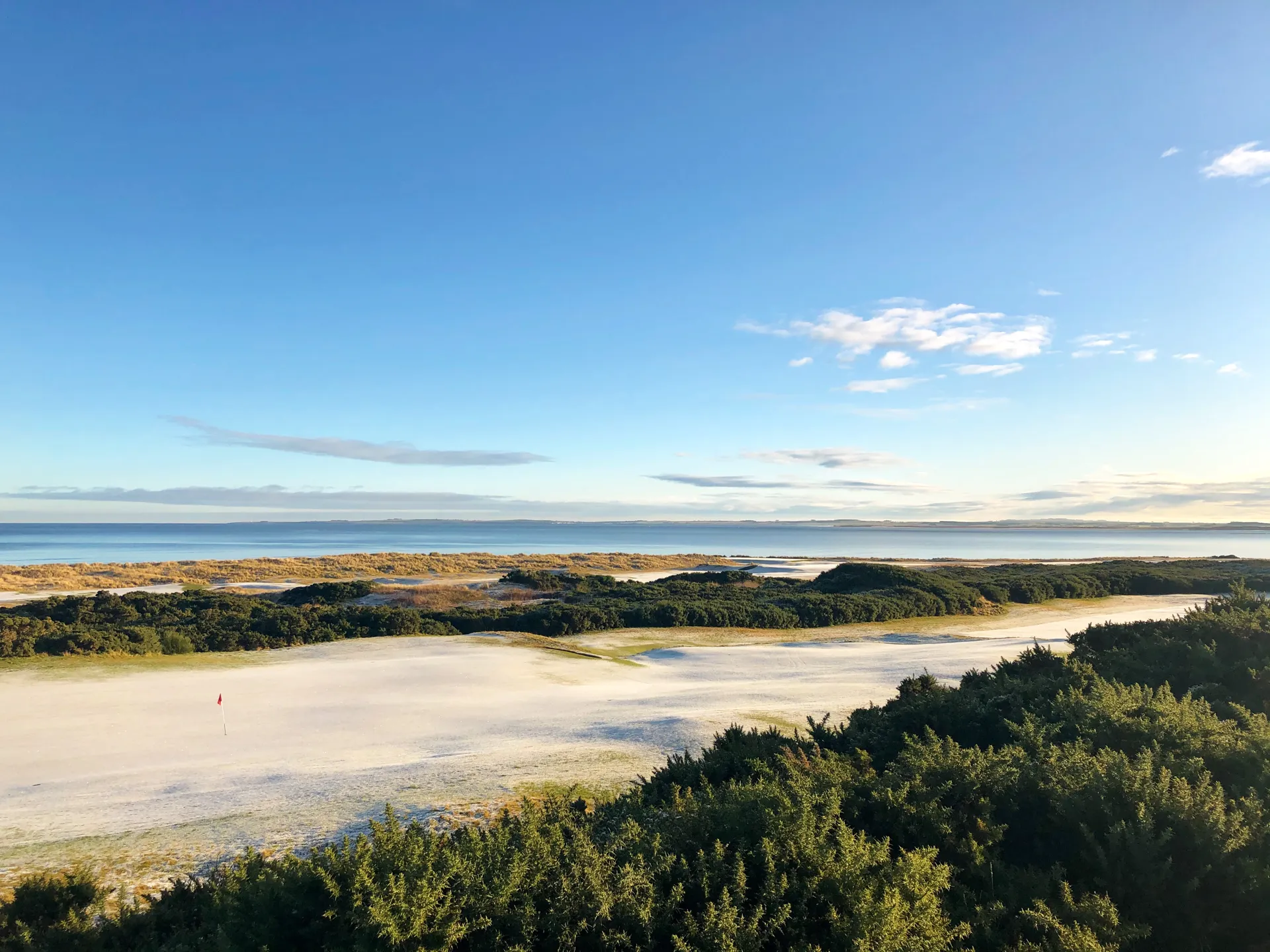
The Mountains of Mourne sweep down to the sea in Northern Ireland, and somewhere along that sweep, someone decided to build the most beautiful golf course on Earth. Not “one of the most beautiful.” The most beautiful. Period. End of discussion. Argument over.
Royal County Down Golf Club sits in Newcastle, County Down, about 30 miles south of Belfast, with the Irish Sea on one side and the Mountains of Mourne on the other. It’s the kind of place where you pull up, see the first tee, and think: “Oh, this is going to hurt.”
And it does. But beautifully.
I played Royal County Down on a Tuesday in July. The sun was shining, which apparently only happens 6 days per year in Northern Ireland. The wind was manageable, meaning it was only 20 mph instead of 40. The gorse was in full bloom, which meant everything off the fairway was bright yellow and wanted me dead.
I shot 91. I lost eight balls. I’ve never been happier.
The Course That Hides Things
Here’s what they don’t tell you about Royal County Down: you can’t see most of the holes. Not because of trees or fog or reality distortion. Because the course was designed by people who apparently thought “visibility” was for cowards.
Old Tom Morris laid out the original course in 1889, supposedly in one afternoon. He walked the land, stuck some stakes in the ground, and basically said “golf holes go here.” The club paid him four gold sovereigns for this service, which was either a bargain or highway robbery depending on your perspective.
But here’s the thing: Old Tom didn’t care if you could see the greens from the tees. He didn’t care if your second shot was blind. He didn’t care if you had to aim at a church steeple in town to know where to hit your drive. The land told him where the holes should go, and visibility was somebody else’s problem.
The result is a golf course where approximately 60% of your shots are aimed at hope and landscape features. The 3rd hole? Aim at the mountain. The 9th hole? Aim left of the stone wall. The 13th? God help you, just hit it and pray.
Modern golf architects would have a panic attack. Royal County Down doesn’t care. Royal County Down has been breaking hearts and confounding players since 1889, and it sees no reason to change now.
The Opening Statement
The 1st hole at Royal County Down is 538 yards of “welcome to links golf, now suffer.” It plays along the beach with gorse on both sides, mountains ahead, and absolutely no indication of where you’re supposed to hit your tee shot.
There’s a stone marker about 275 yards out. That’s your target. Hit it there and you have a long iron into a green you can’t see. Miss it and you’re in the gorse, which is like regular rough except it has thorns and holds grudges.
I hit driver, found the fairway by accident, then hit 4-iron to somewhere near the green. Two putts later, I had par and felt like I’d conquered Everest. This feeling lasted exactly until the 2nd tee.
The 2nd hole is a 443-yard par 4 that plays slightly uphill to a green you also can’t see. But this time, there’s a bunker in the middle of the fairway. Not to the side. In the middle. Just sitting there like “surprise, I’m a hazard in a place where hazards shouldn’t be.”
Hit your drive too far right to avoid the bunker, and you’re in gorse. Too far left, more gorse. Short of the bunker and you have 230 yards in. Over the bunker and you might have 180 yards in. Unless the wind shifts, in which case all bets are off and you should just throw your ball toward the green and hope for the best.
This is Royal County Down. This is what we came for.
The Stretch That Breaks Your Spirit
The 4th through 9th holes at Royal County Down are the kind of golf that makes you question why you love this game. Then you look at the Mountains of Mourne rising behind the greens, watch the Irish Sea crashing against the beach, see the gorse blooming bright yellow, and remember: oh right, this is why.
The 4th hole is a 213-yard par 3 called “Annesley.” It’s named after a person, which is nice because it means when you make triple bogey you can curse someone specific. The tee shot plays over a valley to an elevated green protected by bunkers that look like they were dug by medieval monks with anger issues.
The wind swirls. The distance is never what the yardage says. The green is smaller than it looks and faster than you think. I hit 4-iron that landed three feet past the pin, then watched it roll 40 feet off the back. Welcome to County Down.
The 9th hole is “perhaps the greatest par 5 in golf,” according to people who have played a lot of par 5s and really mean it. It’s 486 yards and every single one of them is earned. The tee shot is blind over a hill. The second shot is blind to a fairway you’re pretty sure exists. The third shot is to an elevated green protected by bunkers, gorse, and the ghosts of golfers who thought they could reach it in two.
I played it three times. Made par once, bogey once, and stopped counting on the third attempt.
The Back Nine That Saves Your Soul
If the front nine is beautiful torture, the back nine is beautiful redemption. The holes move inland, away from the beach, into the dunes and toward the mountains. The views somehow get better, which shouldn’t be possible but is.
The 11th hole is a 438-yard par 4 that curves right around dunes that look like ocean waves frozen in sand. The fairway is rumpled and rippled. The green is perched on a plateau. The Mountains of Mourne fill the entire backdrop like God’s own desktop wallpaper.
I stood on the 11th tee for five minutes just looking. My playing partner, a local member named Seamus who’d seen this view approximately 1,000 times, stood with me and said: “Aye, it never gets old.”
He was right.
The 13th hole is where Royal County Down flexes. It’s 443 yards through a valley with mountains ahead and dunes on both sides. The drive is blind. The approach is blind. Everything is blind. You’re basically playing golf in a landscape painting while wearing a blindfold.
But somehow it works. Somehow, this blind madness creates golf holes that feel right even when they make no sense. The ball finds the fairway or doesn’t. The approach finds the green or doesn’t. You make par and feel like a genius or make bogey and feel like that’s exactly what you deserved.
This is links golf at its purest: nature first, golf second, your scorecard last.
The Gorse That Never Sleeps
Let’s talk about gorse. Gorse is a spiny evergreen shrub native to Western Europe that apparently has a personal vendetta against golfers. It grows everywhere at Royal County Down—lining fairways, surrounding greens, hiding in places you didn’t know existed.
When gorse blooms (April through June), it turns bright yellow and smells like coconut. This is nature’s way of saying “look how pretty I am before I destroy your round.”
Gorse is impenetrable. Not “difficult to get through” impenetrable. Actually impenetrable, as in “you could hide a Volkswagen in there and never find it” impenetrable. Hit your ball in the gorse and it’s gone. Not lost—gone. Departed. Entered another dimension where golf balls go to reflect on their life choices.
I lost three balls in the gorse. Never saw them again. Didn’t even try. When a local member tells you “that’s in the gorse, better take a drop,” you take the drop. They know. They’ve lost approximately 10,000 balls to the gorse. They’re not here to watch you lose your fourth one looking for your third one.
The gorse at Royal County Down isn’t just a hazard. It’s the course’s defensive coordinator, linebacker corps, and entire secondary rolled into one thorny, yellow, coconut-smelling package.
The Clubhouse and The History
The clubhouse at Royal County Down is a Victorian-era building that looks exactly like what you’d expect from a golf club founded in 1889. Stone, dignified, slightly stern, like it’s judging your swing before you even get to the first tee.
Inside, the walls are covered with old photographs, scorecards from ancient championships, and the general accumulation of 135 years of golf history. The bar serves Guinness and local whiskey. The locker rooms have showers that work and a sense of permanence that makes modern country clubs look like temporary housing.
Royal County Down has hosted the British Amateur, the Walker Cup, the Irish Open, and approximately one million rounds by golfers who came, played, suffered beautifully, and went home to tell everyone about it.
The club went “Royal” in 1908 when King Edward VII granted the title. This was apparently a big deal, though it didn’t make the course any easier or the gorse any more forgiving.
The course record is 63, set by Rory McIlroy in 2005 when he was a 16-year-old amateur who was clearly cheating (or possibly the greatest ball striker Northern Ireland has ever produced; both theories have merit).
The Access You Actually Have
Here’s the beautiful thing about Royal County Down: you can play it. Not easily, not cheaply, but actually play it.
The club accepts visitors on certain days (Monday, Tuesday, Friday, Sunday typically—call ahead). The green fee is around £275 ($350 US), which is expensive but reasonable considering you’re playing one of the top five courses in the world.
You can book online. You can show up and request a tee time (good luck). You can stay at one of the local hotels and they’ll help arrange it. The Slieve Donard Hotel is right there, overlooking the course, which is convenient when you want to drink away the memory of your 95.
The club has caddies available. Take one. Seriously. The caddies know which hills hide what, where to aim, which bunkers are in play, and most importantly, which balls are findable and which balls have entered the gorse dimension.
My caddie was named Patrick. He was 67 years old and had been caddying at Royal County Down for 42 years. He knew every break on every green. He knew which way the wind would shift before it shifted. He knew where my ball was going before I hit it, which was depressing but useful.
When I shanked my approach on 14 into what looked like certain death, Patrick said: “That might be okay.” It was okay. The ball had somehow avoided three separate patches of gorse, one bunker, and a stone wall. Patrick knew. Patrick always knows.
Why It Matters
Royal County Down Golf Club could rest on its beauty and be fine. The views alone justify the trip—the Irish Sea, the Mountains of Mourne, the gorse in bloom, the dunes, the whole magnificent landscape that makes you understand why people write poems about Northern Ireland.
But Royal County Down doesn’t just rely on beauty. It’s also one of the best tests of golf in the world. It’s fair but firm, challenging but not tricked up, demanding but not ridiculous. You can play your way around it. You’ll make bogeys, sure. Maybe a lot of bogeys. But they’ll be honest bogeys earned through golf shots, not gimmicks.
The blind shots force you to trust your distances. The gorse forces you to hit fairways. The wind forces you to think. The greens force you to actually putt well. Put it all together and you get golf the way it was meant to be played: figure out the land, make good decisions, accept the consequences.
Modern courses try to eliminate blind shots. Royal County Down doubles down on them. Modern courses try to give you perfect sightlines. Royal County Down gives you a mountain range and says “aim at that.” Modern courses apologize for difficulty. Royal County Down doesn’t apologize for anything.
And somehow, this approach works. The course has been ranked number one in the world by Golf Digest. It’s been in the top 5 of virtually every ranking that matters. Players come back year after year, not despite the blind shots and gorse and difficulty, but because of them.
The Round You’ll Remember
I’ve played Royal County Down three times. The first time I shot 93 and thought I’d conquered it. The second time I shot 89 and realized I’d learned nothing. The third time I shot 91 and understood: this course doesn’t get conquered. It gets experienced, survived, maybe occasionally managed. But never conquered.
Each time, I walked off the 18th green thinking the same thing: “I need to play this again.” Not because I played poorly. Not because I wanted revenge. Because Royal County Down is the kind of course that gets in your soul.
The beauty is almost overwhelming. The challenge is perfect. The history is palpable. The whole experience is like playing golf on a postcard painted by someone who really understood both postcards and golf.
When people ask me “what’s the best golf course you’ve ever played?” I usually say Royal County Down. Not because it’s the hardest. Not because it’s the most famous. Because it’s the most complete—beautiful, challenging, historical, accessible, honest. It’s what golf courses would all be if golf course architects had better land and fewer committee meetings.
If you only play one course in Ireland, make it Royal County Down. If you only play one links course ever, make it Royal County Down. If you only play one course that combines stunning beauty with legitimate championship challenge, make it Royal County Down.
Just bring extra balls. The gorse gets hungry.
The Details (Book Your Flight)
Location: Newcastle, County Down, Northern Ireland (30 miles south of Belfast)
Architect: Old Tom Morris (1889), modified by Seymour Dunn and others
Year Opened: 1889
Par: 71
Yardage: 7,186 yards (Championship tees)
Green Fee: £275 ($350 US) - varies by season
Access: Visitors welcome Mon/Tue/Fri/Sun (call ahead to confirm)
Signature Holes: 4th (213-yard par 3), 9th (486-yard par 5), 13th (blind everything)
Best Time to Play: May through September (gorse blooms April-June)
What to Bring: Extra balls (so many extra balls), windproof clothing, camera, humility
Caddies: Absolutely recommended. They know things you don’t know.
Getting There:
- Fly into Belfast International Airport (30 miles)
- Drive or take bus to Newcastle (45 minutes)
- Stay at Slieve Donard Hotel (right next to course)
- Or stay in Newcastle town (5-minute drive)
Playing Tips:
- Book tee times well in advance (3-6 months recommended)
- Visitor days fill up quickly in summer
- Consider playing afternoon when winds typically calm down
- The front nine plays harder than the back nine
- Trust your caddie on every blind shot
- Accept that you’ll lose balls in the gorse
- Take photos on 4th, 9th, and 13th tees
- Stay for lunch/drinks in clubhouse after
Course Quirks:
- Many blind shots—aim at markers, mountains, or church steeples
- Gorse is everywhere and unplayable (take penalty drops)
- Wind direction changes constantly
- Greens are firm and fast
- Bunkers are penal (they’re supposed to be)
- Stone walls are in play on several holes
- Sheep occasionally wander onto course
Nearby Golf:
- Royal Belfast Golf Club (20 minutes north)
- Ardglass Golf Club (15 minutes south)
- Kirkistown Castle Golf Club (45 minutes south)
- Portrush and Portstewart (90 minutes north—worth the trip)
Royal County Down Golf Club is what happens when you take perfect land, hire Old Tom Morris for an afternoon, and trust nature to do most of the work. It’s beautiful beyond reason, challenging beyond expectation, and accessible beyond what a top-five course in the world has any right to be.
You’ll lose balls. You’ll make bogeys. You’ll question your club selection, your aim point, and your decision to take up golf in the first place.
And you’ll love every minute of it.
See you in Newcastle. Bring gorse-proof pants.