
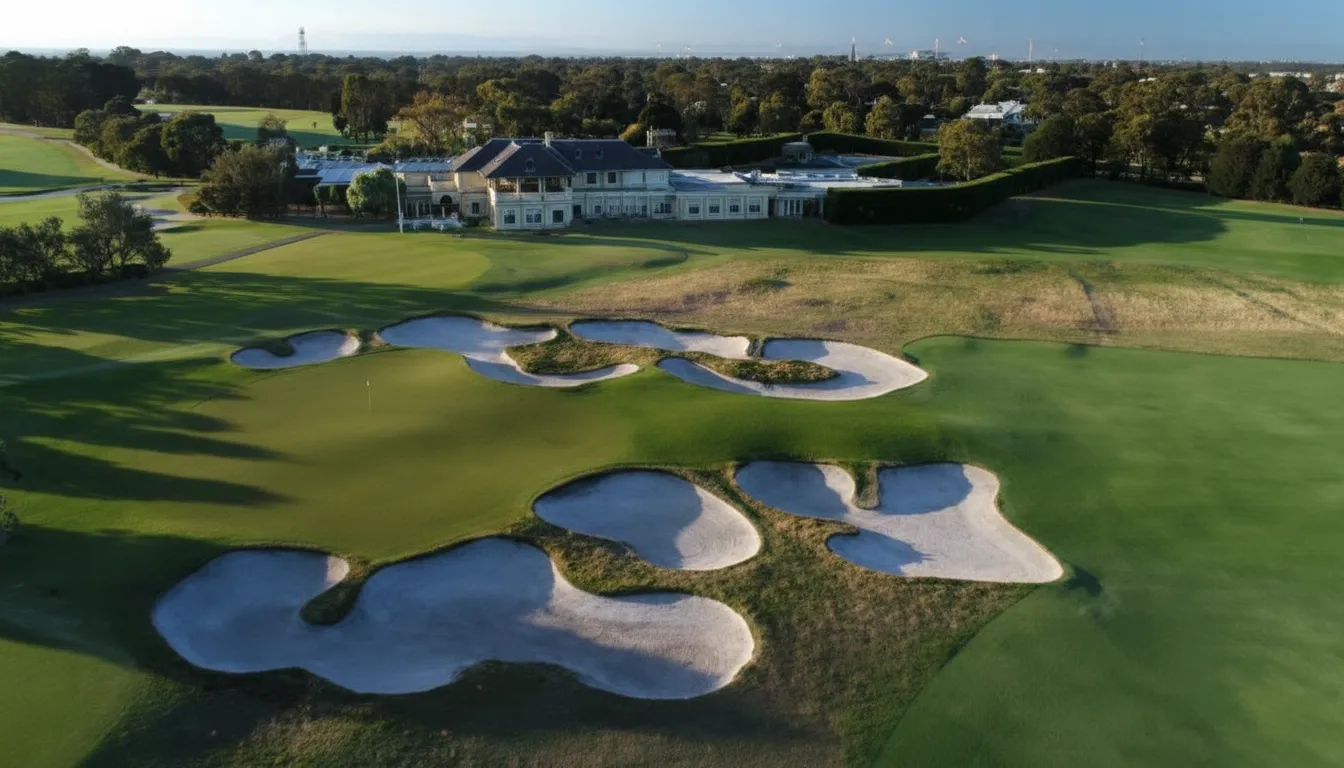
Alister MacKenzie designed Royal Melbourne West between 1926 and 1931. He designed Augusta National between 1931 and 1933. One course hosts the Masters every April, drawing global attention and defining what millions of people think great golf looks like. The other sits in suburban Melbourne, known primarily to serious golfers, architects, and anyone who’s studied where MacKenzie’s best ideas actually came from.
Augusta National gets the glory. Royal Melbourne has the blueprint.
The courses share MacKenzie’s strategic philosophy—wide fairways, options from the tee, greens that reward proper angles of approach, bunkers placed to create decisions rather than simply punish. But Augusta evolved under commercial and television pressures that Royal Melbourne never faced. The Masters demands excitement, accessibility for television coverage, and conditions that produce low scores for Sunday drama. Royal Melbourne demands nothing except that golfers think, adapt, and execute.
The result is a course that architects consistently rank among the world’s top ten and that many—including Tom Doak, Gil Hanse, and other modern masters—consider MacKenzie’s finest work. It’s Augusta National without the azaleas, the corporate infrastructure, or the compromises that hosting a major championship every year requires. It’s MacKenzie’s vision preserved in sandy soil, firm turf, and strategic brilliance that hasn’t needed significant alteration in ninety years.
The Collaboration That Built It
MacKenzie designed Royal Melbourne West in partnership with Alex Russell, a member and accomplished amateur player who understood both the land and the strategic principles MacKenzie championed. This collaboration matters. Russell knew the Sandbelt soil—sandy, well-draining, similar to the heathland courses of England and the Pine Barrens of New Jersey. He understood how the terrain could be shaped to create strategic interest.
MacKenzie brought architectural philosophy forged through decades of work. He believed courses should offer width from the tee, strategic options for every skill level, greens with subtle contours that reward proper approach angles, and bunkers placed to create decisions rather than simply narrow landing areas. He despised penal architecture that punished with forced carries and narrow targets. He championed strategic design that rewarded thinking and penalized poor planning.
Royal Melbourne West represents these principles in their purest form. The course measures just 6,510 yards from the championship tees—short by modern standards. Yet it routinely humbles scratch golfers and tour professionals. The 1998 Presidents Cup was held on the Composite Course (combining West holes with holes from the East Course), and the scoring average for the world’s best players exceeded par. Distance doesn’t create difficulty here. Strategy, firm conditions, and nuanced green complexes do.
The course opened to immediate acclaim. Australian golfers recognized something special. Visiting players—including Bobby Jones, who came in 1930—praised the strategic demands and firm conditions. Architects studied the bunkering, the green contours, the routing that maximized strategic interest from relatively flat terrain. Royal Melbourne West established Australian golf’s identity and proved that great courses could be built far from Scottish linksland.
The Design That Rewards Thinking
The opening hole establishes expectations. At 428 yards, it’s a proper test that requires a good drive and a precise approach to a green that slopes from back to front. The fairway is generous—roughly 40 yards wide in the landing area—but bunkers sit strategically to create decisions. Go left and you have the better angle but must carry bunkers. Go right and you’re safe but facing a more difficult approach. The hole introduces MacKenzie’s essential question: what risk are you willing to accept for better positioning?
The 3rd hole might be the finest short par-4 in golf. It plays just 333 yards, drivable for long hitters but protected by deep bunkers short and around the green. The strategic options are clear: attempt to drive the green and risk disaster, lay back to the ideal wedge distance, or split the difference and accept whatever angle results. Tour players debate this hole constantly. There’s no obviously correct answer—which makes it perfect.
The 5th—a 176-yard par-3—plays to one of MacKenzie’s most brilliant green complexes. The putting surface slopes dramatically from back to front, with bunkers short and long. Choose the wrong club and two-putting becomes difficult. Even from the fairway, getting close requires proper distance control and understanding how the slope affects ball movement. It’s a hole that looks straightforward until you attempt to make par.
The back nine increases intensity. The 12th plays 476 yards with the fairway angled along a ridge. Miss left and you’re in deep bunkers. Miss right and you’re below the fairway with a blind approach. The green sits on a plateau, rejecting anything hit with improper trajectory. It’s MacKenzie creating strategic complexity from subtle terrain.
The 14th might be Royal Melbourne’s signature hole. At 358 yards, it’s another short par-4 offering options. The green sits beyond a deep barranca that cuts across the fairway roughly 50 yards short. Long hitters can carry it and have short irons in. Shorter hitters must lay back, then face an intimidating approach over the hazard. The hole creates different tests for different players—MacKenzie’s strategic ideal.
The 17th plays 439 yards and demands precision from tee to green. The approach must avoid bunkers and land on a green that falls away on multiple sides. Par feels like victory. The 18th—a par-4 of 433 yards—finishes the round with MacKenzie’s philosophy on full display: generous landing area from the tee, but approach angles matter enormously, and the green complex rewards proper strategy while punishing carelessness.
What Makes It MacKenzie’s Best
Augusta National receives endless attention and analysis. Television cameras capture every blade of grass. Millions watch the Masters seeking glimpses of MacKenzie’s design—though decades of alterations mean Augusta barely resembles what MacKenzie and Bobby Jones originally built.
Royal Melbourne West remained largely unchanged. The club didn’t lengthen holes to accommodate modern distance. They didn’t add rough to narrow fairways. They didn’t soften green contours or simplify strategic options. The course MacKenzie and Russell built in 1931 still exists, asking the same questions, rewarding the same strategies, punishing the same mistakes.
This preservation reveals MacKenzie’s brilliance more clearly than Augusta can. The strategic width that Augusta has largely abandoned remains at Royal Melbourne. The firm, fast conditions that Augusta can’t maintain (due to Georgia climate and Masters week demands) are standard at Royal Melbourne. The subtle green contours that create strategic interest without resorting to severity—these remain exactly as MacKenzie intended.
Modern architects study Royal Melbourne obsessively. Tom Doak has written that it’s “the standard by which all other courses should be judged.” Gil Hanse talks about the bunkering as the finest example of strategic hazard placement. Coore and Crenshaw reference the green complexes when explaining how subtlety creates more interesting golf than severity.
The course proves MacKenzie’s central argument: strategic design creates better golf than penal design. Royal Melbourne doesn’t need 7,500 yards, narrow fairways, or excessive rough to challenge the best players. It uses width, firm conditions, strategic bunkering, and brilliant green complexes to create golf that rewards thinking as much as execution.
The Sandbelt Advantage
Royal Melbourne sits in the Sandbelt region southeast of Melbourne—an area blessed with sandy soil that drains quickly and supports firm playing conditions. This soil creates golf similar to the heathland courses of England (Sunningdale, Walton Heath) and the Pine Barrens courses of America (Pine Valley, Friar’s Head).
The Sandbelt includes multiple world-class courses within short driving distance: Kingston Heath, Metropolitan, Victoria, Commonwealth. Together, they form one of golf’s great regional collections—comparable to the Long Island courses near New York or the linksland courses around St Andrews.
This concentration matters. Melbourne golfers grow up playing firm, fast conditions. They learn ground game strategy, trajectory control, and reading how balls react after landing. The Sandbelt created a golf culture that values strategic thinking over raw power—which explains why Royal Melbourne hasn’t felt pressure to add distance or alter MacKenzie’s design philosophy.
The climate helps. Melbourne’s weather allows courses to maintain firm conditions year-round. Fairways stay fast. Greens run at speeds that demand touch and proper approach angles. The courses play as MacKenzie intended—not as occasionally achieved novelty, but as standard operating conditions.
Modern championship golf has largely moved away from firm, fast setups. Irrigation technology allows courses to maintain lush conditions that hold approach shots. Television prefers dramatic Sunday charges enabled by soft greens. The Sandbelt represents golf’s road not taken—proof that firm conditions create more interesting strategy and reward complete games.
Access and Experience
Royal Melbourne operates as private club, but access exists for international visitors and golfers with proper introductions. The club maintains reciprocal agreements with clubs worldwide. Advance planning and appropriate connections can secure tee times.
Unlike Augusta National—which ordinary golfers will never play—Royal Melbourne remains theoretically accessible. Difficult, requiring planning and connections, but possible. This accessibility matters. Architects, serious golfers, and anyone studying strategic design can experience MacKenzie’s vision directly rather than viewing it through television coverage that emphasizes azaleas over architecture.
The experience emphasizes golf over spectacle. The clubhouse is comfortable but not ostentatious. The course lacks corporate infrastructure or manufactured drama. Royal Melbourne doesn’t try to impress visitors with anything except the golf—which is exactly how MacKenzie would have wanted it.
Playing Royal Melbourne West reveals subtleties that rankings and descriptions miss. The way firm fairways create strategic options. How green contours reward proper approach angles while punishing carelessness. The brilliance of bunker placement that creates decisions rather than simply narrowing targets. The accumulation of strategic demands over 18 holes without a single weak moment.
Tour players who’ve competed at Royal Melbourne speak about it with reverence. Tiger Woods called it one of the world’s best. Greg Norman—who grew up playing Melbourne golf—consistently ranks it atop his personal list. Architects including Doak, Hanse, Coore, and Crenshaw cite it as the standard for strategic design. These aren’t marketing endorsements. They’re professionals recognizing excellence.
The Standard MacKenzie Set
Augusta National defines golf for millions of people who watch the Masters every April. Royal Melbourne defines golf for architects, serious players, and anyone seeking to understand what MacKenzie actually believed great golf should be.
The difference matters. Augusta evolved into spectacle—beautiful, dramatic, capable of producing Sunday theater that television demands. Royal Melbourne remained examination—strategic, subtle, rewarding complete games rather than hot putting weeks or perfectly timed runs.
Both courses matter. But only one shows MacKenzie’s vision without commercial compromise, tournament pressures, or need to produce low scores for television drama. Only one maintains the firm conditions, strategic width, and subtle green complexes that MacKenzie championed. Only one proves that strategic design creates golf that remains relevant ninety years later without needing lengthening, narrowing, or fundamental alteration.
Augusta National gets the glory—the tradition, the azaleas, the green jacket ceremony watched by millions. Royal Melbourne has something more valuable: the blueprint MacKenzie drew before anyone asked him to compromise, before television discovered golf, before distance and commercial pressures reshaped championship golf into something MacKenzie might not recognize.
The West Course sits in suburban Melbourne, asking questions MacKenzie posed in 1931 that still don’t have easy answers. It humbles scratch golfers. It fascinates architects. And it stands as proof that strategic design—when executed brilliantly and preserved faithfully—creates golf that doesn’t need updating, lengthening, or modernizing.
MacKenzie built the masterpiece first. Then he went to America and built the course everyone knows. Both accomplishments matter. But only one shows what MacKenzie could do when nobody asked him to make compromises. Royal Melbourne West is that course—the blueprint, the standard, and the proof that strategic design creates golf that endures.