
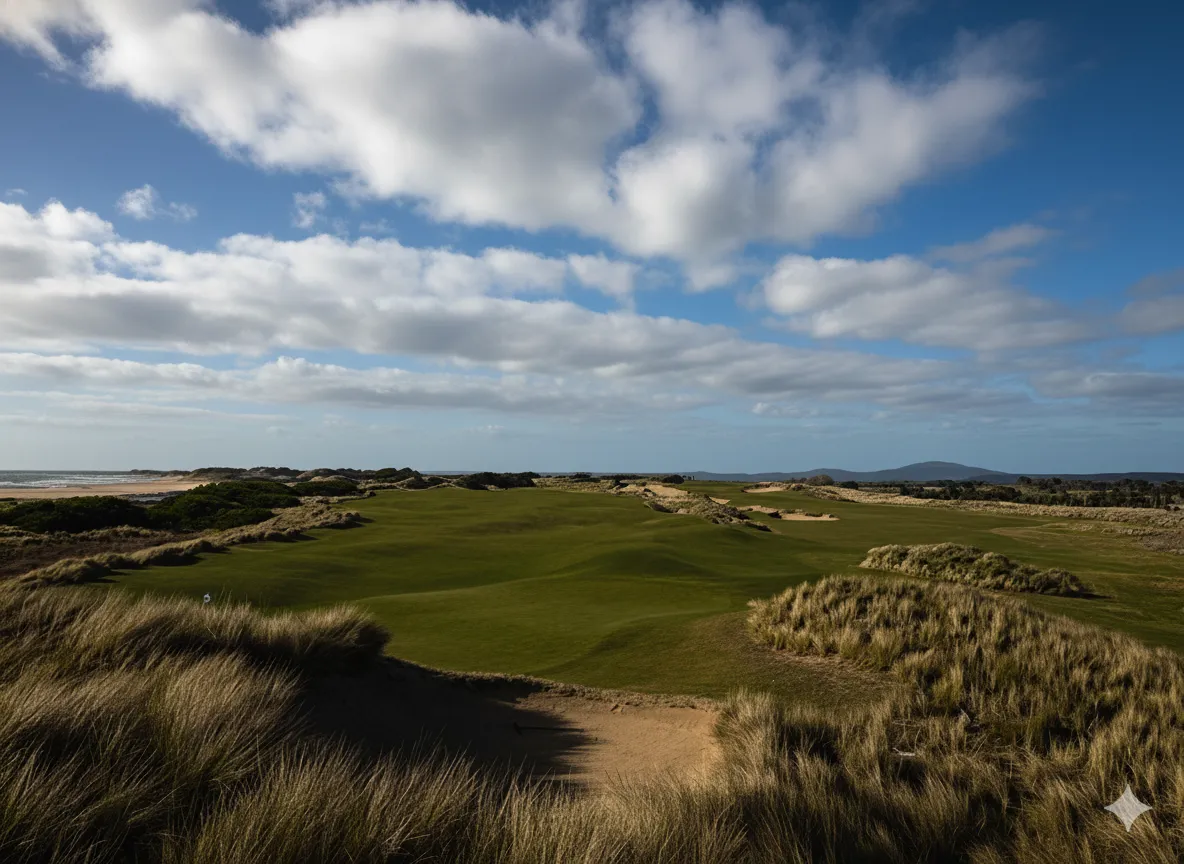
The northeast coast of Tasmania is about as far from anywhere as you can get. Four hours from Melbourne by plane and ferry. Two hours from Hobart through countryside that looks like Scotland had a baby with New Zealand. And at the end of that journey sits a links course that has no business being this good.
Barnbougle Dunes opened in 2004. Within five years, it was ranked among the top 50 courses in the world. Not because of marketing or hype, but because architect Tom Doak found 340 acres of perfect linksland and had the wisdom to let it be.
The Land That Waited
The property at Barnbougle sat unused for decades. Sheep grazed the dunes. Wind shaped the sand. The Bass Strait pounded the shore. And nobody thought to build a golf course there until Greg Ramsay and Richard Sattler looked at the land and saw what it could be.
They hired Doak, who’d built Pacific Dunes at Bandon and understood links golf better than most architects working outside Scotland. He walked the property, studied the natural contours, and realized he didn’t need to build much. The golf course was already there. It just needed to be revealed.
The result is 18 holes that feel like they’ve existed for centuries. No forced carries. No artificial mounding. No manufactured drama. Just pure links golf on land that was meant for it.
The Holes That Define It
The 7th (Tom’s Little Devil)
A 160-yard par-3 that plays over a valley to a green perched on a dune. The hole is named after Tom Doak, who calls it “Little Devil” because it looks innocent and plays like hell.
The green is 40 yards deep but only 15 yards wide. Miss left or right, and you’re facing a recovery shot that requires more creativity than skill. The wind off Bass Strait changes constantly. Club selection is a guess. Execution is everything.
This is the kind of hole that makes you want to play it again immediately, regardless of the result.
The 4th (Purgatory)
A 475-yard par-4 that doglegs left along the dunes. The fairway is generous, but the approach shot is terrifying. The green sits on a plateau, surrounded by falloffs that reject anything short or offline.
The hole earned its name. You can play it ten times and never figure it out. The wind changes the strategy. The pin position changes the approach. The only constant is that you’ll walk off either thrilled or humiliated.
The 15th (Waterloo)
A 545-yard par-5 that plays along Bass Strait. Reachable in two if you’re long and brave. Guaranteed disaster if you’re long and stupid.
The second shot is the decision. Lay up to a comfortable wedge distance, or go for a green protected by dunes, bunkers, and wind that can turn a perfect shot into a scramble. The hole doesn’t judge. It just presents the choice and waits to see what you do.
What Makes It Special
Barnbougle Dunes doesn’t try to be anything other than what it is: a links course on spectacular land. The fairways are firm and fast. The greens are quick but fair. The rough is manageable. The course wants you to play well. It just wants you to think first.
The conditioning is immaculate without being precious. The grass is tight enough to allow bump-and-run shots. The bunkers are deep enough to penalize poor shots without being penal. The greens have movement that rewards precision without demanding perfection.
This is golf the way it was meant to be played. On the ground. With the wind. Using creativity as much as power.
The Walk That Matters
Barnbougle Dunes is walking-only. No carts. No exceptions. This isn’t elitism—it’s philosophy.
The course flows naturally across the property, with green-to-tee walks that showcase the landscape. The 7th green sits 30 yards from the 8th tee, with views of Bass Strait that make you forget you’re between holes. The walk from 15 to 16 takes you through dunes that look like they were sculpted by wind and time, not machines.
Walking Barnbougle isn’t a requirement. It’s part of the experience.
The Sister Course
In 2010, Barnbougle opened Lost Farm, a second 18-hole links course designed by Bill Coore and Ben Crenshaw. It sits on the same property, uses the same land, and is equally spectacular.
Having two world-class links courses on one property, in the middle of Tasmania, is absurd. It’s like finding a Michelin three-star restaurant in a gas station. It shouldn’t exist. But it does, and it’s glorious.
Visitors typically play 36 holes a day—Dunes in the morning, Lost Farm in the afternoon. Or vice versa. The courses are different enough to feel distinct but similar enough to feel like they belong together.
The Lodge That Gets It
The Barnbougle Lodge sits between the two courses. It’s not fancy. The rooms are comfortable but simple. The dining room serves good food without pretension. The bar stocks local whisky and beer.
Everything about the lodge says: you’re here for the golf. We’re here to make that easy.
Guests can walk to both first tees. Tee times are spaced to prevent slow play. The staff understands that people have traveled halfway around the world to play these courses and treats them accordingly.
Why It Works
Barnbougle Dunes succeeds because it doesn’t try to be anything other than great golf on great land. No resort amenities. No spa. No championship pedigree. Just two world-class links courses in a place most people have never heard of.
The courses don’t rely on difficulty to be memorable. They’re not the longest or the hardest. They’re just endlessly interesting. Every hole presents strategic choices. Every shot requires thought. Every round reveals something new.
This is golf as exploration, not examination. The courses want you to try different shots, take different lines, experiment with different strategies. They reward creativity and punish rigidity.
The Pilgrimage
Getting to Barnbougle requires commitment. Fly to Melbourne or Hobart. Rent a car or take the ferry. Drive through countryside that makes you understand why Tasmania is called the “Island of Inspiration.”
The journey is part of the appeal. You’re not just playing golf. You’re making a pilgrimage to one of the great golf destinations in the world—one that exists because two people believed great golf could happen anywhere if the land is right and the design is honest.
The Details
Location: Bridport, Tasmania, Australia
Courses: Barnbougle Dunes (Tom Doak, 2004) and Lost Farm (Coore & Crenshaw, 2010)
Yardage: Dunes: 6,900 yards; Lost Farm: 6,700 yards
Par: Both 72
Green fees: AUD $200-300 per round depending on season
Accommodation: Barnbougle Lodge on property
Best time: October through April (Southern Hemisphere summer)
Getting there: Fly to Launceston (1 hour drive) or Hobart (2.5 hours)
The Verdict
Barnbougle Dunes is proof that great golf doesn’t need history or pedigree. It needs great land, honest design, and the courage to let the course be what it wants to be.
Tom Doak found perfect linksland on the edge of the world and had the wisdom not to overwork it. The result is a course that feels ancient despite being barely 20 years old. A course that rewards creativity over power. A course that makes you want to play it again before you’ve finished the first round.
This is what golf looks like when architects trust the land. When developers prioritize the course over the amenities. When everyone involved understands that great golf is its own reward.
Barnbougle Dunes is remote. It’s inconvenient. It requires planning and commitment. And it’s worth every mile, every dollar, every moment of the journey.
Because this is golf the way it’s supposed to be. On land that was meant for it. Designed by people who understood it. Built for players who love it.
The only question is: when are you going?